Dynamic infrastructure testing
The first trains over new infrastructure, run at night and built up step by step.
Last updated 2026-09-05
What is Dynamic infrastructure testing?
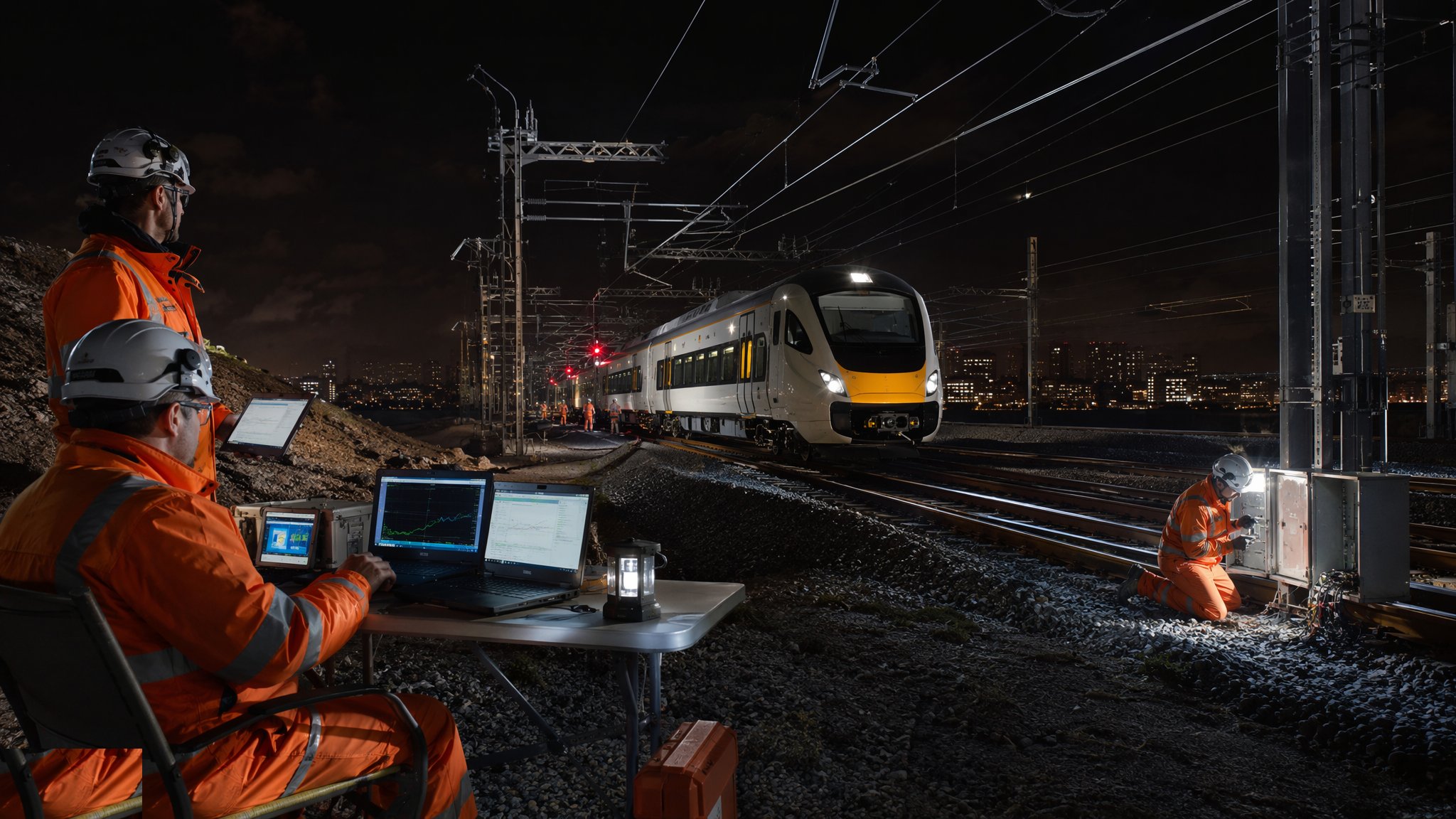
Dynamic testing is the first time a train runs over the new railway. Until this point everything has been proved standing still, and the purpose now is to prove the things that only reveal themselves under a moving load: whether the track geometry rides as designed, whether the train passes the structures and the equipment beside the line without conflict, whether the power system delivers what a moving train draws from it, whether the current collection works along the whole route, and whether the ride quality, noise and vibration match what was predicted. It is also the first time the completed railway is treated as a whole system rather than as a set of assets.
It is built up progressively and deliberately slowly. The first movements are typically at walking pace with observers on the train and along the route, checking clearance to structures, platforms and lineside equipment before anything faster is attempted. Speed is then increased in stages, with the results of each stage reviewed before the next is authorised. The build-up exists because the consequences of finding a conflict at speed are severe, and because each increment tests something the previous one did not - dynamic behaviour of the track, the interaction between the train and the overhead line or conductor rail, and the response of the power system to real load.
Almost all of it happens at night or in blocks of possession, because the infrastructure being tested is either connected to an operational railway or about to be. Test trains have to be pathed, staff have to be rostered for night work over long periods, and the weather and the season affect what can be proved. Fatigue management, communications between the train and the site, and absolute clarity about who controls the movement are fundamental. Every movement takes place under the infrastructure manager's safe system of work, and the authority to move a train and the conditions attached to it come from that regime, never from the project programme.
How does Dynamic infrastructure testing work, step by step?
- 1
Step 1: Confirm the infrastructure is ready to be run over
Dynamic testing begins only when the static evidence pack for the area is complete and accepted. Track is confirmed as installed, stressed where applicable and inspected. Structures, platforms and lineside equipment are surveyed and confirmed clear of the running envelope by the designer. Power systems are energised and proved. Any outstanding item that could affect a moving train is closed. This gate exists because the first train movement is the point at which a documented error becomes a physical event.
- 2
Step 2: Plan the test programme and secure the paths
A dynamic test programme is agreed setting out what will be proved, in what order, with what train, at what speeds and over how many nights. Test train paths are booked with the infrastructure manager alongside the possessions or blocks required, and the test train itself - whether a purpose-built measurement vehicle or service stock - is arranged well in advance because such vehicles are scarce. The programme is deliberately sequenced so that each night builds on the last rather than repeating it.
- 3
Step 3: Establish control of the movement and the site
Before any movement, the arrangements for controlling it are set out and briefed: who authorises the movement, who is in charge on the train, who is in charge on the ground, how they communicate, what the stop arrangements are and what happens if communication is lost. Everyone on the route is accounted for and protected. These arrangements come from the infrastructure manager's safe system of work, and no test movement takes place outside them under any circumstances.
- 4
Step 4: Run the first movements at the lowest speed
The first passes are made at walking pace with observers on board and along the route, specifically to check that the train passes everything beside and above the line without conflict - platforms, structures, signals, equipment cabinets, walkways and temporary works. Anything found is corrected before the next stage. This slow first pass is also the first opportunity to observe the track under load and the behaviour of points, crossings and transitions with a real vehicle rather than a calculation.
- 5
Step 5: Prove the power system under real load
A moving train is a moving electrical load, and the power system has to be proved against it. Current collection along the whole route is observed, the interaction between the pantograph or shoegear and the overhead line or conductor rail is monitored, voltage behaviour under load and under regeneration is measured, and protection behaviour is confirmed. Faults here tend to be localised to particular sections or particular pieces of equipment, which is exactly why the run is made over the whole route rather than a representative sample.
- 6
Step 6: Increase speed in authorised stages
Speed is raised in steps, with each step authorised only after the results of the previous one have been reviewed and accepted. Track geometry under load, ride quality, dynamic behaviour at transitions and through switches and crossings, noise and vibration at the lineside, and the performance of the power system are all measured at each stage. The steps, the criteria and the authorisation to move to the next one belong to the infrastructure manager and the designer. Where a measurement falls outside expectation the cause is found and corrected before the speed is increased further.
- 7
Step 7: Measure, review and correct between shifts
Recorded data is analysed between test runs, and the corrective work identified is done in the same possession pattern - track adjustment, overhead line adjustment, equipment repositioning, or design review where the issue is not simply an installation matter. This cycle of run, measure, correct, re-run is the substance of dynamic testing, and the number of cycles required is the hardest thing to predict on the programme. Every correction is recorded against the asset so that the as-built record stays true.
- 8
Step 8: Close out and release for integration testing
Dynamic infrastructure testing finishes with a documented demonstration that the infrastructure carries a train as intended across the whole route and the whole speed range required. Measurement records, corrective actions and any remaining restrictions are collated and accepted. That evidence releases the railway for the signalling and train-control integration testing that follows, where the control system, the trains and the infrastructure are proved together.
What are the benefits of Dynamic infrastructure testing?
- Proves the infrastructure under a real moving load, which no static test can replicate
- Finds clearance and physical conflicts at walking pace rather than in service
- Demonstrates power system behaviour against actual traction load and regeneration
- Provides measured baseline data on track geometry and ride quality for future maintenance
- Progressive speed build-up limits the consequences of anything found
- Gives the maintenance organisation its first practical familiarity with the completed asset
- Generates objective evidence for the assurance case rather than opinion
What are the limitations of Dynamic infrastructure testing?
- Requires the infrastructure to be essentially complete, so it sits late on the programme
- Almost entirely night work, with the fatigue, productivity and staffing costs that brings
- Test trains and measurement vehicles are scarce and have to be booked long in advance
- Possessions and paths are shared with other users and can be lost to higher priorities
- The number of run-measure-correct cycles needed is very hard to predict
- Weather and season constrain what can be run and what can be measured meaningfully
- Any correction may invalidate earlier results and force a repeat of completed stages
What is Dynamic infrastructure testing best suited for?
What plant does Dynamic infrastructure testing need?
- Test or measurement train, or service stock instrumented for the purpose
- Track geometry, ride quality and acceleration measurement equipment
- Overhead line or conductor rail interaction monitoring equipment
- Power system measurement and recording equipment at substations and along the route
- Clearance survey and gauging equipment for the low-speed passes
- Noise and vibration monitoring equipment at lineside receptors
- Road-rail plant and maintenance equipment for corrective work between runs
- Site communications equipment for control of the movement and lineside observers
How is Dynamic infrastructure testing quality-checked?
- Static evidence pack complete and accepted before the first movement is authorised
- Clearance to structures and lineside equipment confirmed by the designer before any run
- Control of movement arrangements briefed and confirmed for every shift under the infrastructure manager's regime
- Measured results reviewed and accepted before each authorised increase in speed
- Corrective actions recorded against the asset and reflected in the as-built record
- Instrumentation calibration verified and recorded before measurement runs
- Competence and fitness for duty of test staff confirmed for night working
- Final measurement records and any residual restrictions collated and accepted before the next stage