Static testing and system commissioning
Every system proved on its own, in writing, before anything is allowed to move.
Last updated 2026-09-05
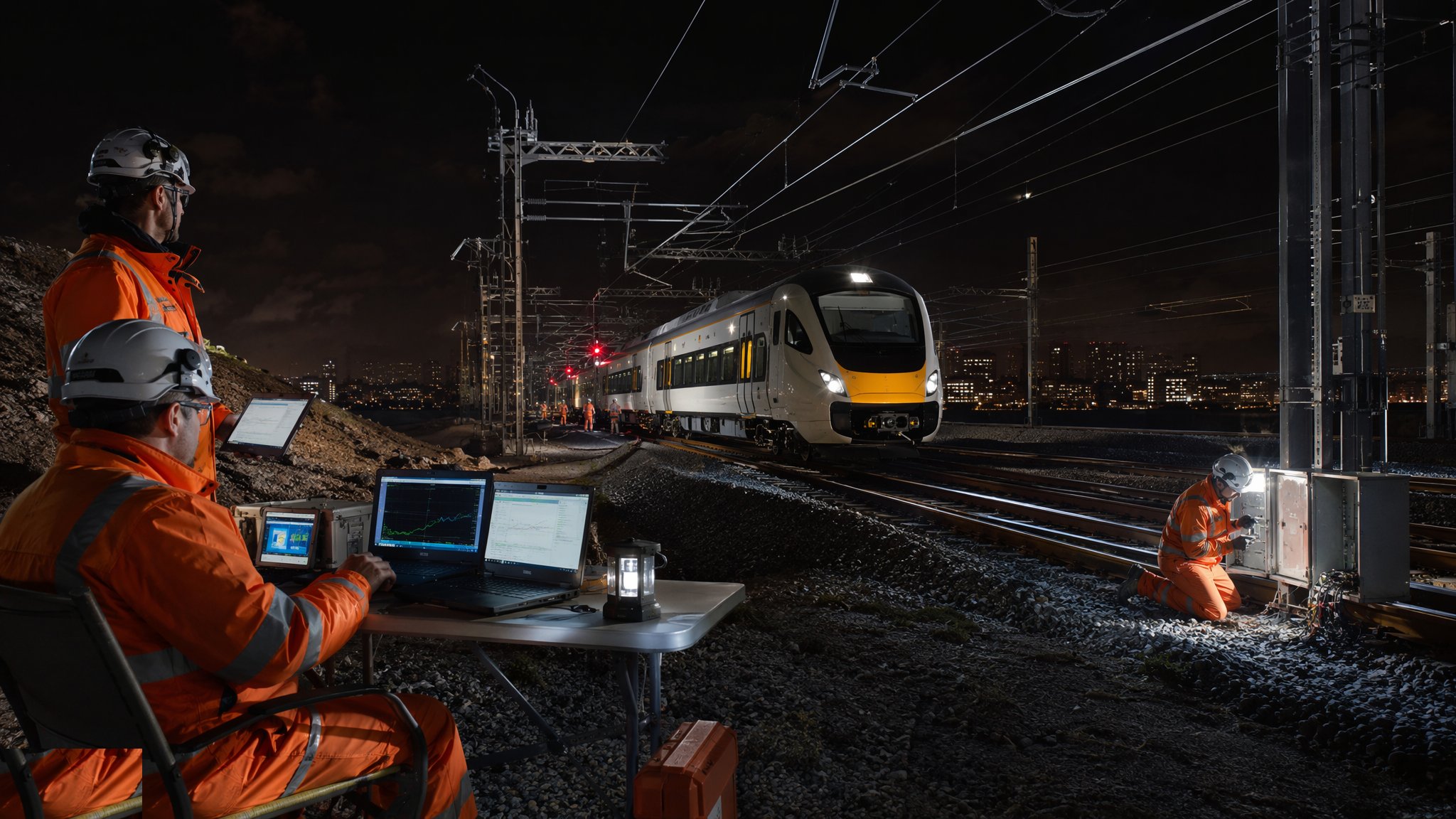
What is Static testing and system commissioning?
Static testing is where a railway stops being a construction project and starts becoming an operating system. Nothing moves. Each installed system is energised and proved in isolation - power, signalling equipment, communications, track circuits and detection, points machines, tunnel ventilation, fire systems, station systems, control room equipment - and each one is demonstrated to do what the specification said it would do before it is allowed to interact with anything else. The logic is simple and it is not negotiable: a fault found in an isolated system is a fault with one possible cause, while the same fault found during dynamic testing has dozens.
The scale of it is what surprises people. A modern railway is not one system but many hundreds of interconnected ones, and every one of them has a test schedule, a set of results, a witness and a signature. A single station may have dozens of subsystems in its own right before the railway systems outside it are counted. The documentation is not administrative overhead - it is the evidence base on which the entry into service decision will eventually be made, and a system with an incomplete test record is a system that cannot be accepted regardless of whether it works. Test records, as-built information, configuration data, software versions and every outstanding item are tracked as a single register from the first test onwards.
The activity is sequential in a way that construction is not. Power has to be proved before the systems that depend on it. Communications have to work before the systems that report through them. Signalling equipment has to be proved at the equipment level before any attempt is made to prove the control logic. This dependency chain is why static testing so often becomes the critical path: it cannot start until installation is complete in the area concerned, it cannot be compressed by adding people, and any late change to installed equipment invalidates tests that have already been done. On most projects the realistic protection against this is to start testing area by area as installation completes rather than waiting for the whole railway to be finished.
How does Static testing and system commissioning work, step by step?
- 1
Step 1: Plan the testing before the installation finishes
A testing and commissioning strategy is produced early, setting out which systems are tested, in what order, against what evidence, and who witnesses and accepts each stage. It defines the areas the railway will be divided into, the dependency between systems, and the hold points where nothing proceeds without a signature. Test procedures are written and approved in advance, not drafted while the test is being attempted. The strategy is agreed with the operator, the infrastructure manager and the independent assurance parties before testing starts.
- 2
Step 2: Accept the installation before energising anything
Each system is inspected against the design and the as-built record before it is powered. Cable routes, terminations, labelling, earthing and bonding, physical protection and equipment settings are checked, and the installation is formally accepted as complete for the area concerned. This is the last opportunity to correct installation errors cheaply. From the moment the system is energised, changing it means retesting it, and the cost of a change rises steeply from that point onwards.
- 3
Step 3: Energise progressively and prove the power systems
Power is the first dependency and is proved in a controlled sequence: supply arrangements, switchgear, protection settings, earthing, distribution, standby and uninterruptible supplies, and the traction power system where it applies. Isolation and permit arrangements are in place throughout, and access to energised equipment is controlled by a documented regime. Everything downstream depends on this being right, so protection settings and discrimination in particular are proved rather than assumed.
- 4
Step 4: Prove each system in isolation against its specification
With power available, each system is tested on its own. Signalling equipment is proved at the equipment level - detection, points operation, indication - without yet proving the control logic. Communications, public address, customer information, CCTV, radio coverage, fire detection and alarm, ventilation, drainage pumping, lifts and escalators are each demonstrated against their own specification. Results are recorded as they are obtained, and a failed test is recorded as a failed test and closed out formally rather than repeated quietly until it passes.
- 5
Step 5: Prove the interfaces between systems
Once systems work individually, the connections between them are proved: alarms reaching the control room, the fire system triggering the ventilation response, the power system reporting its status, the communications network carrying what the other systems send. Interfaces are where the majority of commissioning problems live, because each side was designed and often supplied by a different party. Interface testing is planned as its own activity with both parties present, rather than assumed to fall out of the individual system tests.
- 6
Step 6: Prove the control room as a working environment
The control room is where the railway is actually operated, so it is commissioned as a system in its own right. Displays, controls, alarms, communications, recording, and the workstations themselves are proved, and the operators who will use them are involved in the proving. Alarm handling in particular is tested for what happens in a busy period rather than one alarm at a time, because a control room that floods with alarms during an incident is a hazard rather than a tool.
- 7
Step 7: Manage the defect and change register with discipline
Every observation, defect and outstanding item is logged in a single register with an owner, a category and a required closure point. Items are classified by whether they must be closed before dynamic testing, before trial running, before entry into service, or can be carried into operation with a mitigation agreed by the operator. Any change made to a tested system triggers an assessment of what has to be retested. The register is reviewed regularly with the operator and the assurance parties, because it is the honest picture of how close the railway actually is.
- 8
Step 8: Assemble the evidence for the next stage
Static testing ends with a documented, witnessed evidence pack for each area: completed test records, as-built information, configuration and software versions, competence records for the people who carried out the tests, and the status of every open item. That pack is what permits dynamic testing to begin. No railway moves a train over new infrastructure on the basis that the systems appeared to work - it moves on the basis that they were proved and the proof exists.
What are the benefits of Static testing and system commissioning?
- Isolates faults where they have one possible cause, which is far cheaper than diagnosing them later
- Can proceed area by area as installation completes, without needing the whole railway finished
- Requires no train paths, no possessions of the whole system and no operational resources
- Builds the documented evidence base that the entry into service decision will depend on
- Exposes interface problems between suppliers while there is still time to resolve them commercially
- Involves the operator early, so the people who will run the railway shape the acceptance
- Largely daytime work, unlike almost everything that follows it
What are the limitations of Static testing and system commissioning?
- Cannot start in an area until installation there is genuinely complete, and partial completion causes abortive testing
- Sequential dependency between systems means it cannot be compressed by adding resources
- The volume of documentation is very large and is a programme risk in its own right
- Late design or equipment changes invalidate completed tests and force retesting
- Proves systems in isolation only - a system can pass every static test and still fail in combination
- Depends on specialist test personnel and equipment that are often shared across projects
- Frequently becomes the critical path precisely because it sits between construction and everything else
What is Static testing and system commissioning best suited for?
What plant does Static testing and system commissioning need?
- Test and measurement equipment for power, earthing, insulation and protection systems
- Signalling test equipment and simulators for equipment-level proving
- Communications and radio coverage survey equipment
- Temporary power, lighting and access arrangements for testing before permanent systems are complete
- Control room workstations and simulation tools for operator-facing testing
- Configuration management and document control systems for test records and evidence packs
- Isolation, locking and permit equipment for controlled access to energised systems
How is Static testing and system commissioning quality-checked?
- Test procedures written, reviewed and approved before any test is carried out
- Installation formally inspected and accepted against the as-built record before energisation
- Every test witnessed by the parties named in the strategy, with results signed at the time
- Failed tests recorded, investigated and closed out formally rather than simply repeated
- Configuration and software versions recorded for every system, and controlled from that point
- Competence of test personnel verified and recorded against the tests they carry out
- Single defect and change register maintained, categorised by required closure point and reviewed regularly
- Evidence pack assembled and accepted before dynamic testing is authorised to begin
More systems integration, testing & trial running methods
Next method
Dynamic infrastructure testing