Trial running and timetable proving
The full service run without passengers, until the railway proves it can do it every day.
Last updated 2026-09-05
What is Trial running and timetable proving?
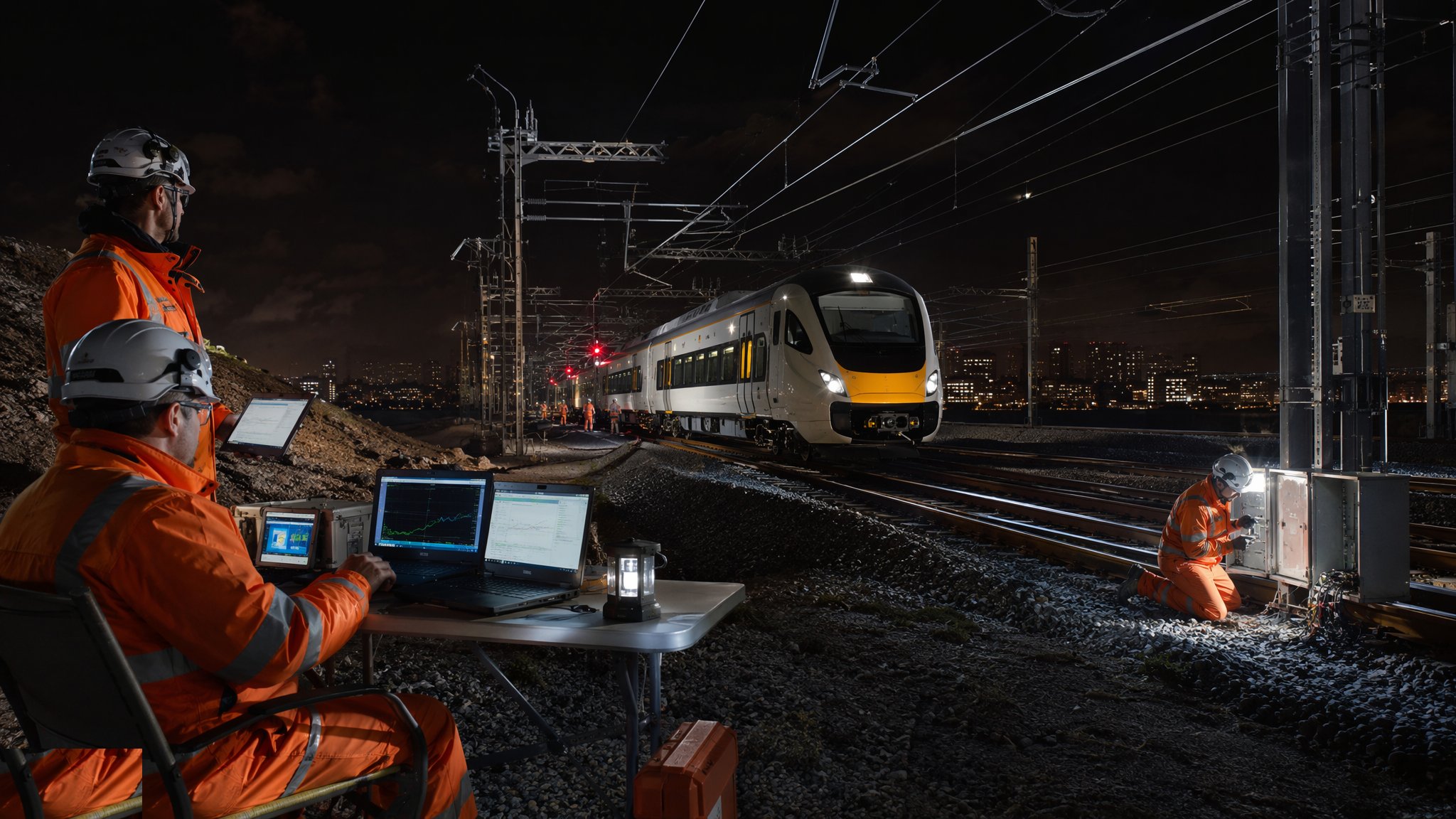
Trial running is the last stage before a railway opens. The complete service is operated to the intended timetable, with the real trains, the real staff, the real depots and the real control centre, but without passengers. The purpose is not to test equipment - that has already been done - but to test the railway as an operating business. Can the timetable actually be delivered? Do the trains turn round in the time allowed? Can the depot present the right number of units in the right condition every morning? Do the staff know what to do? What happens when something goes wrong at the worst moment?
It runs for a sustained period, typically weeks rather than days, because the point is repeatability. A railway that delivers the timetable once has proved nothing. The performance is measured day after day against defined criteria, and the trend matters as much as the numbers - a service that improves through the period is a railway learning, while one that does not is a railway with a structural problem. Reliability of the trains, of the infrastructure and of the systems is measured together, because in service the passenger experiences only the combination.
Degraded operation is where most of the value is. Faults are introduced deliberately and incidents are simulated so that the operator has to use the procedures written for them: a failed train in a tunnel, a points failure at a critical junction, loss of a control system, an evacuation, a fire alarm, a station closure. The emergency services usually take part in the larger exercises. What is being proved is that the plans work when they are executed by real people under time pressure, and that the railway can recover to the timetable afterwards. Entry into service is granted on the strength of all of this as a formal authorisation - it is not a handover, and it is the reason the last phase of a railway project is so often the one that determines the opening date.
How does Trial running and timetable proving work, step by step?
- 1
Step 1: Define what trial running has to prove
Entry criteria and exit criteria are agreed before trial running starts. The entry criteria confirm what must be complete - testing closed out, staff trained and competent, depots operational, procedures issued, outstanding items dispositioned. The exit criteria define what the railway must demonstrate: sustained delivery of the timetable, reliability at the level agreed, successful execution of the degraded-mode scenarios, and the closure of anything the period itself throws up. Both sets are agreed with the operator, the infrastructure manager and the assurance parties.
- 2
Step 2: Get the people ready before the trains run
Drivers, signallers, controllers, station staff, maintenance staff and depot staff are trained and formally assessed as competent, and drivers gain route knowledge over the new infrastructure. Rosters are built for the full service, which is often the first test of whether enough people have been recruited and trained. Trial running is where an under-resourced or under-trained operation becomes visible, and there is no way to conceal it - the timetable simply does not get delivered.
- 3
Step 3: Prove the depot and the fleet
The depot is exercised as the service demands: stabling, cleaning, fuelling or charging, maintenance examinations, fault rectification and the daily presentation of units to the timetable. Fleet availability and reliability are measured. Depots are frequently the last part of a project completed and the least tested, and a depot that cannot turn out the required number of units in the morning stops the railway just as effectively as a signalling fault.
- 4
Step 4: Run the timetable and measure it
The full service is run to the intended timetable, day after day, without passengers. Punctuality, cancellations, turnaround times, dwell allowances, headways and the recovery of the service after a delay are measured against the criteria. Where the timetable proves undeliverable, the cause is identified - it may be the infrastructure, the fleet, the operating plan or the timetable itself - and the timetable is adjusted before opening rather than after. Better to change it now than to publish something the railway cannot achieve.
- 5
Step 5: Exercise degraded operation deliberately
Faults are introduced and incidents simulated so that the degraded-mode procedures are actually used: equipment failures, a train stopped between stations, control system loss, station or platform closure, and the reversion arrangements that go with each. The measure is not only whether the immediate response is safe but whether the railway recovers to the timetable afterwards. Findings feed straight back into the procedures, and significant ones are re-exercised rather than simply written up.
- 6
Step 6: Run the major emergency exercises
Full-scale exercises are run for the scenarios that matter most - evacuation, fire, a serious incident requiring the emergency services - usually with the emergency services taking part and often with volunteers standing in for passengers. These exercises test communication between organisations, command arrangements, access for responders and the practical usability of the evacuation routes. They are debriefed formally and the actions are tracked to closure like any other finding.
- 7
Step 7: Close out the findings and confirm the criteria are met
Everything observed during trial running is logged, categorised and dispositioned: closed before opening, mitigated with an agreed operational restriction, or accepted into service with a plan. Performance against the exit criteria is assessed over the whole period rather than on the best week. The operator, the infrastructure manager and the assurance parties review the outcome together, and where the criteria are not met the period is extended - which is uncomfortable, and is the correct decision.
- 8
Step 8: Obtain entry into service authorisation
Opening is a formal authorisation granted on the strength of the complete evidence base - design, construction, static testing, dynamic testing, integration testing, trial running, competence, procedures and the disposition of every outstanding item. It is a decision made by defined parties against defined criteria, not a certificate issued at the end of a construction contract. Because it sits at the end of a long dependency chain and cannot be brought forward by working harder, entry into service is the critical path on almost every railway project.
What are the benefits of Trial running and timetable proving?
- Proves the railway as an operating business, which no equipment test can do
- Exposes timetable and turnaround problems while the timetable can still be changed
- Gives staff extended practice on the real system before passengers depend on them
- Tests the depot and the fleet under the demands of the actual service
- Exercises degraded and emergency procedures under realistic conditions with the emergency services
- Sustained running finds the intermittent faults that short tests never reproduce
- Builds public and stakeholder confidence with visible evidence that the railway works
What are the limitations of Trial running and timetable proving?
- Consumes weeks of programme at the very end, when pressure to open is highest
- Requires the entire operation - trains, staff, depots, control centre - to be complete and resourced
- Expensive to run a full service that earns no revenue
- Cannot start until testing is closed out, so it inherits every upstream delay
- A significant finding late in the period can push the opening date with no room to recover
- Simulated incidents can never fully reproduce the behaviour of real passengers in crowds
- Extending the period is often the right answer and is always the hardest one to take
What is Trial running and timetable proving best suited for?
What plant does Trial running and timetable proving need?
- The complete operational fleet, presented daily from the depot
- Depot maintenance, cleaning and servicing facilities in operational use
- Control centre and communications systems operating as they will in service
- Performance monitoring and train describer data recording for measurement against the timetable
- Simulation and fault-injection arrangements for degraded-mode exercises
- Evacuation and emergency exercise equipment, with volunteer participants where used
- Maintenance and response arrangements ready to react as they would in service
How is Trial running and timetable proving quality-checked?
- Entry and exit criteria agreed and documented before trial running begins
- Competence and route knowledge records complete for every operational role
- Timetable performance measured daily against defined criteria and trended across the whole period
- Fleet and depot availability recorded and reconciled with the service requirement
- Every degraded-mode and emergency scenario exercised, debriefed formally and its actions tracked to closure
- All findings logged, categorised and dispositioned with an owner and a required closure point
- Outcome reviewed jointly by the operator, the infrastructure manager and the assurance parties
- Entry into service authorisation granted formally against the complete evidence base before any passenger travels