Wide-strip and stepped foundations
Strips that climb hills and stretch across marginal ground - detailing as engineering.
Last updated 2026-08-22
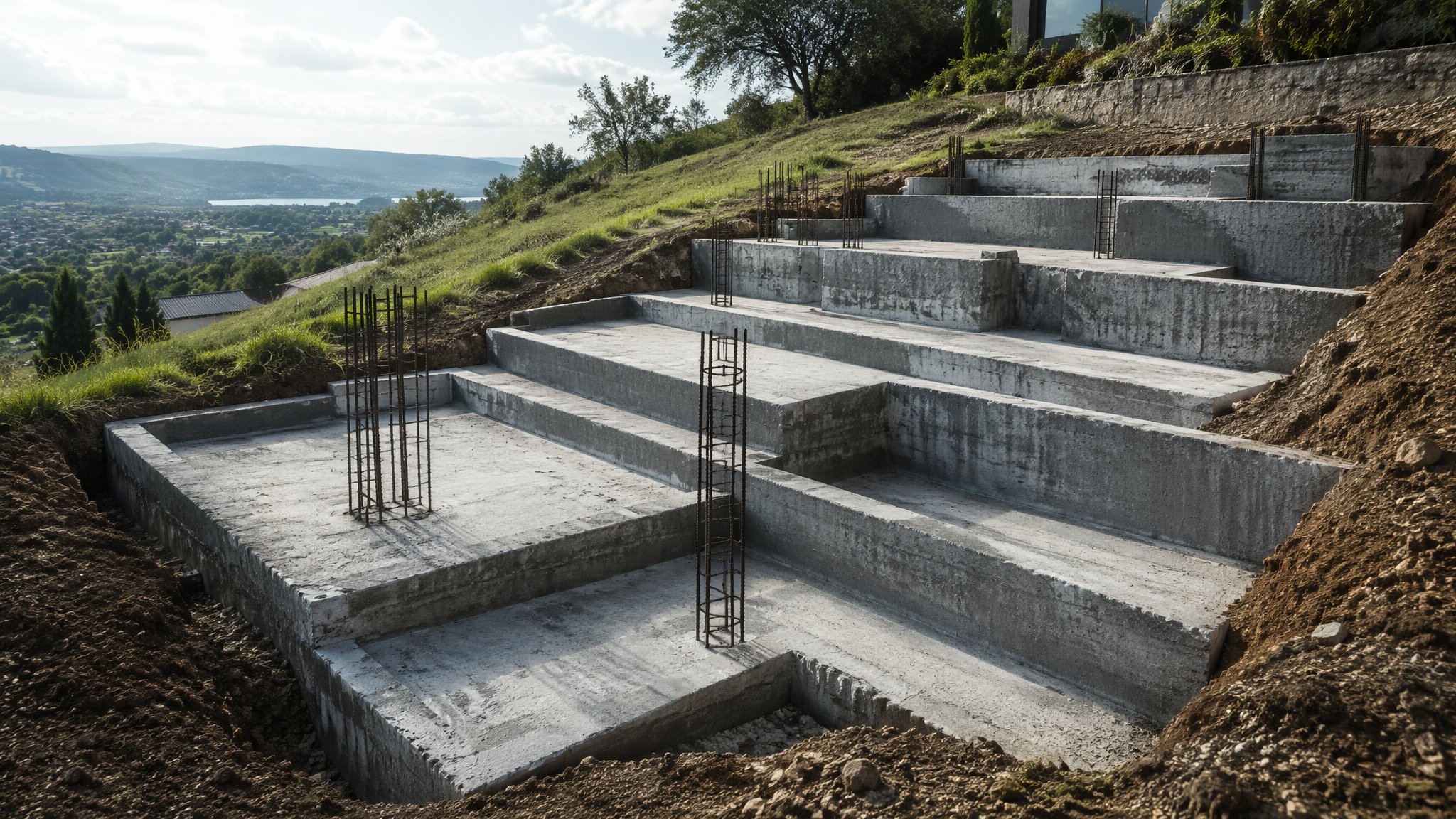
What is Wide-strip and stepped foundations?
Wide-strip foundations are the pragmatic answer to marginal bearing: where the ground can almost carry a standard strip, widening the concrete - sometimes to a metre or more - drops the bearing pressure to what the formation can take, with reinforcement added where the width makes the strip work in bending rather than simple load spread. It is a calculation with a shovel: cheaper than a raft on ground that is merely mediocre, and far cheaper than piling on ground that is nearly good enough.
Stepped foundations solve the slope problem. On a sloping site, a strip kept level must step down the hill; the steps are detailed at masonry course increments so the blockwork above builds cleanly, with each step overlapping the one below by at least the foundation depth or 300 mm, whichever is greater. The drawings must show every step and change of level explicitly - a "step as required" note is a cold joint and a dispute in waiting.
Both variants punish casual execution more than their simple appearance suggests. Wide strips need the reinforcement they were designed with - poured as plain concrete to save a mesh order, they crack across the width exactly as the calculation predicted. Stepped strips need their benching poured in one continuous operation where possible, with construction joints kept vertical and at designed positions; and the formation at each step must be inspected in its own right, because a soft pocket at a step concentrates the differential movement at exactly the wrong place.
Process storyboard
Step 1 of 5 - slide through the snapshots.
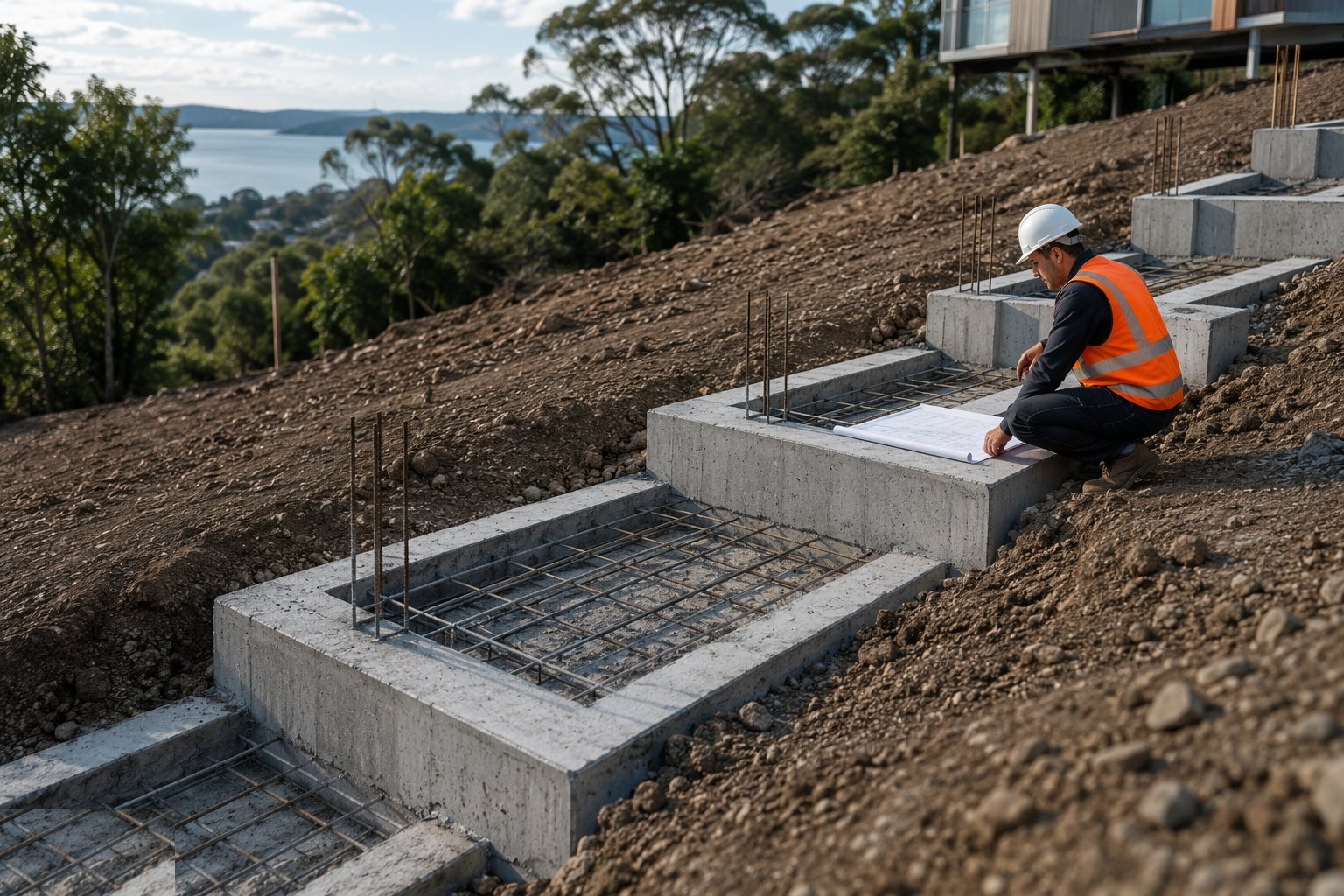
STEP 1
Confirm the widths, steps and reinforcement from the drawing
Every step position, level, overlap and width is taken from the engineer's drawing - not improvised on the digger.
How does Wide-strip and stepped foundations work, step by step?
- 1
Step 1: Confirm the widths, steps and reinforcement from the drawing
Every step position, level, overlap and width is taken from the engineer's drawing - not improvised on the digger. Where the actual ground disagrees with the assumed bearing, the width is re-run through the calculation before the trench is widened, not after the concrete is in.
- 2
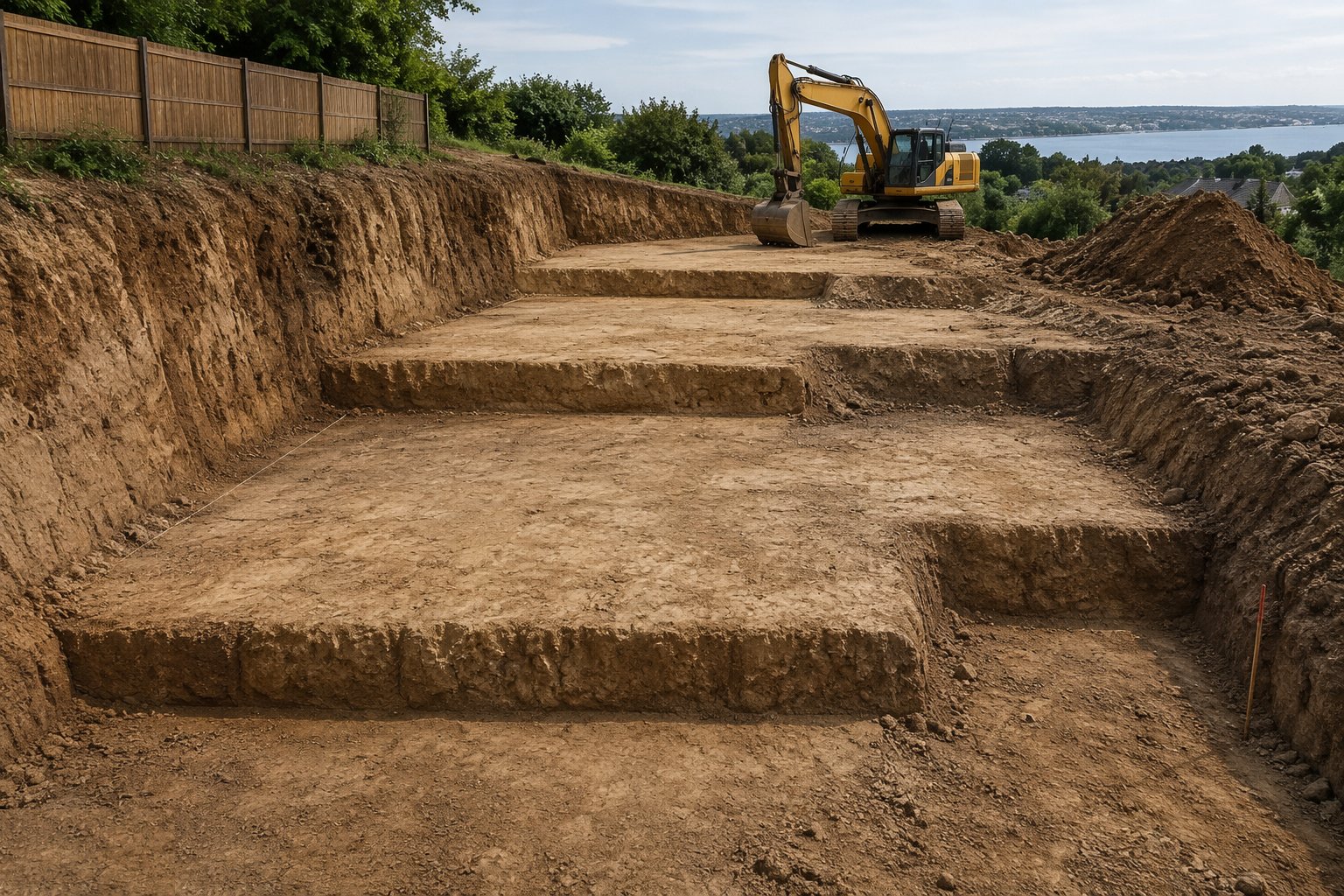
Step 2: Excavate to the stepped profile
The trench is dug as a staircase of level benches, each bench trimmed clean and checked from the datum. Step faces are kept vertical and square. As with any clay dig, the programme keeps open-trench time short; a stepped trench collects water at every bench and each one softens independently.
- 3
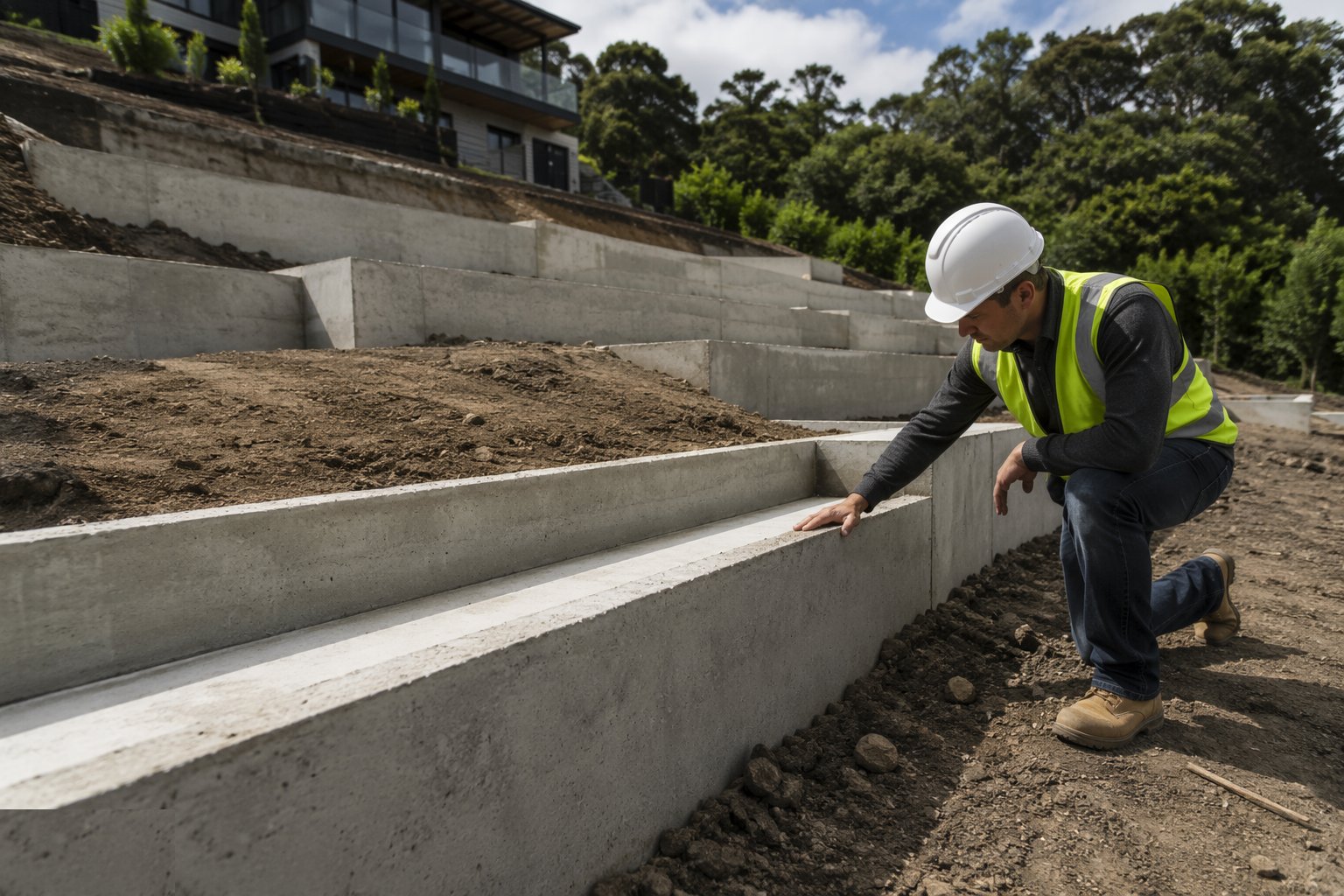
Step 3: Inspect every bench
Formation inspection covers each step individually: stratum, level, soft spots. On marginal ground this is where wide strips are won - the widened section must bear on the verified material for its full width, and any suspect pocket is taken out and made good in mass concrete with the step detail adjusted on record.
- 4
Step 4: Fix reinforcement and pour in sequence
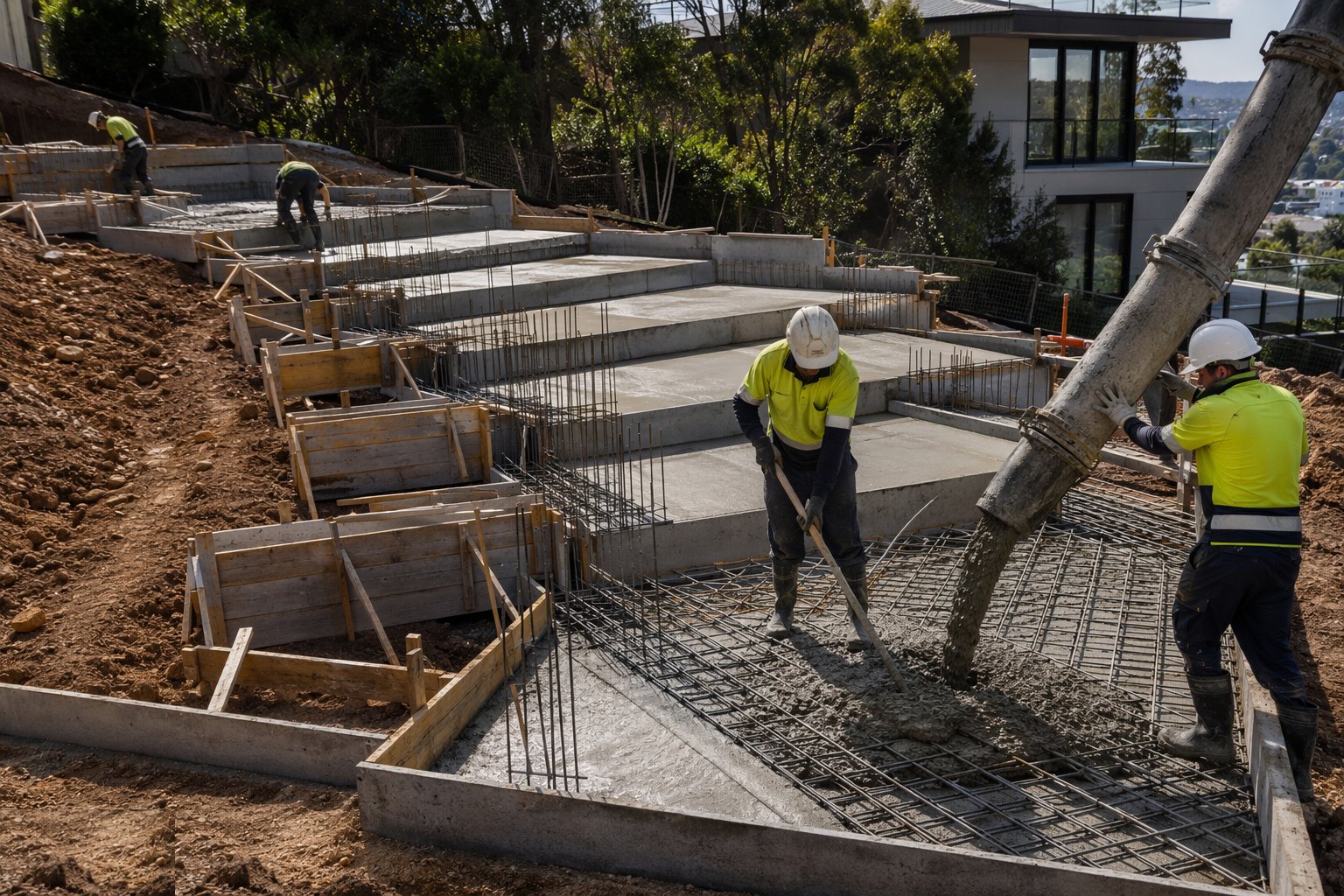
Mesh and bars are fixed to the bending schedule with cover maintained on the slopes between benches - cover spacers on a sloping face are a detail, not an afterthought. The pour runs continuously uphill where possible so each bench's concrete knits with the next; joints, where unavoidable, are vertical, at designed positions, and prepared to the specification.
- 5
Step 5: Cure, record levels and brief the bricklayers
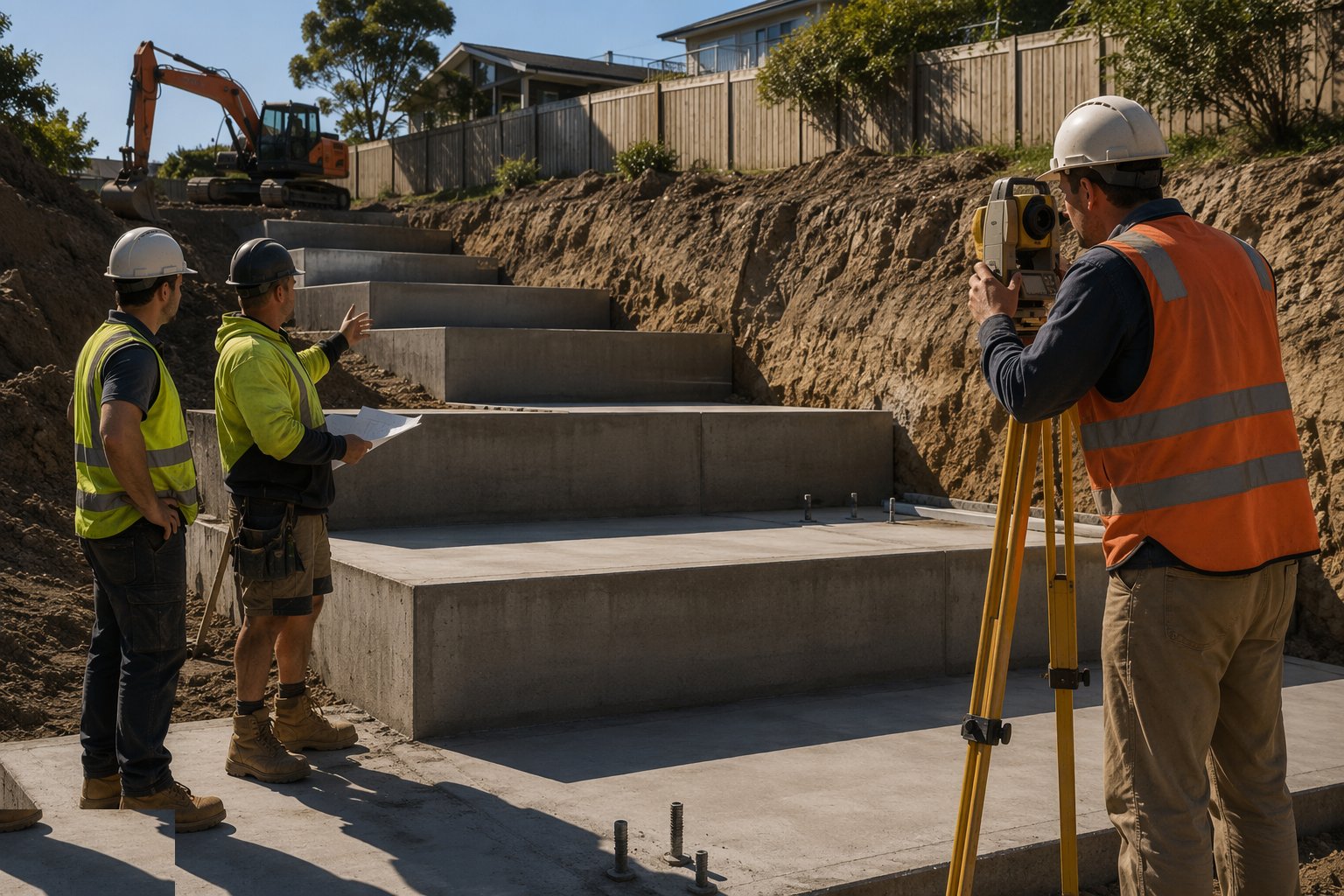
Steps are cured and protected; the as-built levels of every bench are recorded and issued to the masonry gang, whose coursing was designed around them. Cube results and inspection records file as normal. A stepped foundation that matches its drawing disappears under the building; one that does not reappears in every course above it.
What are the benefits of Wide-strip and stepped foundations?
- Unlocks marginal ground without rafts or piles - the cheapest upgrade from a standard strip
- Steps make sloping sites buildable with ordinary masonry skills
- Continuous with standard strip detailing elsewhere on the plot
- No specialist plant or labour - any groundwork gang with the drawing can build it
What are the limitations of Wide-strip and stepped foundations?
- Extra excavation, concrete and reinforcement erode the saving fast as widths grow
- Stepped digs on clay are weather-sensitive at every bench
- Detail-dependent - wrong overlaps and misplaced joints are structural defects, not snags
- Still a shallow foundation - genuinely weak or variable ground needs a raft or piles
What is Wide-strip and stepped foundations best suited for?
What plant does Wide-strip and stepped foundations need?
- Excavator with trenching and grading buckets
- Readymix supply with pump for long or deep runs
- Poker vibrator, screeds and levels
- Rebar cutting and fixing tools
- Profiles, traveller and laser level for the stepped benches
How is Wide-strip and stepped foundations quality-checked?
- Formation inspection recorded for every bench and widened section
- Step levels, overlaps and widths checked against the drawing before pouring
- Reinforcement and cover verified against the bending schedule - including on sloping faces
- Slump per load; cubes at 7 and 28 days; as-built levels issued to the masonry trade