Ground-bearing rafts and pads
Simple spread foundations for the lighter balance-of-plant items, used wherever the ground is good enough to take them.
Last updated 2026-09-07
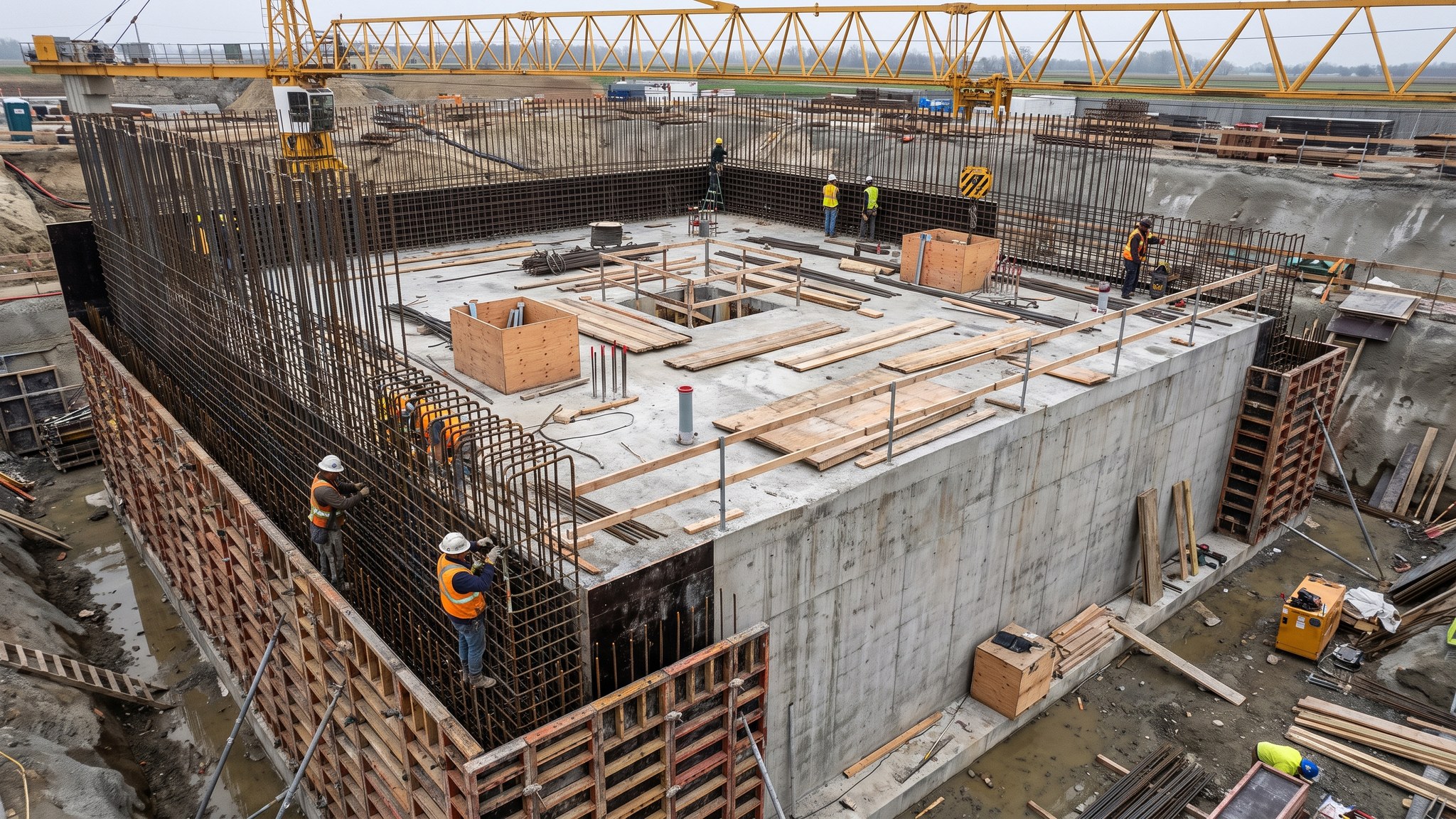
What is Ground-bearing rafts and pads?
Not everything on a thermal power project needs piles. A large part of the balance of plant - pump houses, water treatment equipment, tanks, small buildings, compressor skids, packaged units, cable and pipe supports, hardstandings and laydown areas - is comparatively light and comparatively tolerant of small movements. Where the ground has the strength and stiffness to carry those loads, ground-bearing rafts and pads are the obvious answer: excavate, prepare the formation, cast the foundation, and move on. They are quick, cheap and familiar, and they free the piling rig for the structures that genuinely need it.
The judgement is about ground rather than about the structure. The designer looks at bearing capacity, at settlement under the load and, importantly, at differential settlement between adjacent items that are connected by pipework or cable. Two pads that each settle a little are fine. Two pads that settle by different amounts and are joined by a rigid pipe are a problem in service. Groundwater, made ground, buried obstructions from previous use, frost susceptibility and the risk of the formation being softened by weather or by site traffic all feed the same decision. On many power sites the answer is mixed: rafts and pads in the areas where the ground is competent, piles where it is not, and the boundary between them drawn deliberately.
The work itself is ordinary construction done to a power station standard of record keeping. Formations are inspected and signed off, blinding goes down promptly, reinforcement and holding-down assemblies are set accurately, and levels are checked. What catches teams out is not the technique but the coordination: pads on a power site are riddled with penetrations, ducts, earthing tapes, drainage and buried services, and they are usually set out relative to skids and packaged units that arrive with their own bolt patterns. Getting the sequence right - services first, then the foundation - saves a great deal of breaking out later.
How does Ground-bearing rafts and pads work, step by step?
- 1
Step 1: Establish where ground bearing is viable
The ground investigation is read across the whole site, not just under the main structures, because the balance of plant is spread widely and the ground can change over short distances. The designer identifies the areas where strength, stiffness and water conditions allow spread foundations, and the areas where they do not. Made ground from previous use, soft alluvial pockets, old foundations and buried structures usually decide the boundary. On many projects a small amount of additional investigation in the balance-of-plant areas pays for itself immediately.
- 2
Step 2: Design for settlement as well as bearing
Bearing capacity is rarely the difficulty for light plant - settlement usually governs, and differential settlement between connected items governs more often still. The designer sizes the rafts and pads to keep movement within what the connected equipment and pipework can accept, and where two items must not move relative to each other they are commonly carried on a single raft rather than on separate pads. Where a light item sits next to a heavy piled structure, the designer decides how the joint between them is handled rather than leaving it to the site.
- 3
Step 3: Coordinate the buried services before excavating
Power sites carry a dense network of drainage, ducts, cable routes, earthing and firefighting mains, much of it below or through the foundations. The buried services layout is agreed and set out before the foundations are dug, so that penetrations, sleeves and ducts are cast in rather than cut in. Existing services are located and proved, and permits are in place. The order of works - services, then foundations, then surfacing - is planned across the whole area rather than pad by pad.
- 4
Step 4: Excavate to formation and protect it
Excavation is taken to the designed formation level, with the sides supported or battered as required and with water controlled. Formation is the thing that matters: it is inspected against the design assumption, it is signed off, and it is blinded quickly, because a formation left open to rain or tracked over by plant is a formation that has lost the properties it was accepted for. Where the formation is unsuitable, it is dug out and replaced with engineered fill to the designer's requirement rather than being made to do.
- 5
Step 5: Place reinforcement and cast in the embedded items
Reinforcement is fixed to the drawing with cover maintained on all faces, and holding-down bolt assemblies, sleeves, pockets, earthing connections and drainage penetrations are set on rigid supports. Even on light foundations these items follow an equipment supplier's bolt pattern, so they are surveyed rather than tape-measured. Where a packaged unit or skid is coming, its template is used wherever the supplier provides one.
- 6
Step 6: Pour, finish and cure
Concrete is placed and compacted, and the top surface is finished to the tolerance the equipment needs - which for a plinth carrying a skid is usually tighter than for a hardstanding. Curing is protected, and levels are checked once the concrete has gained strength. Where grout beds will be used under baseplates, the surface is prepared for them at this stage rather than being hacked back later.
- 7
Step 7: Backfill and reinstate in controlled layers
Backfill around rafts and pads is placed in layers and compacted to the specification, because settling backfill around a foundation is one of the most common defects on a power site and shows up as slumped surfacing, dragged-down services and standing water. Compaction records are kept. Surfacing, kerbs, drainage falls and access are then completed so that the area is usable rather than left as a patchwork of finished foundations in soft ground.
- 8
Step 8: Survey, record and hand over to the mechanical trades
Final levels and the position of every holding-down assembly are surveyed and issued as an as-built record. Any deviation is agreed with the equipment supplier before it is packed or corrected. The foundations are then protected and handed over clean, with bolt threads covered and pockets kept free of debris, so that the mechanical and electrical teams can set their plant without remedial work.
What are the benefits of Ground-bearing rafts and pads?
- Much cheaper and faster than piling where the ground allows
- Frees the piling rig and its programme for the structures that genuinely need it
- Familiar construction that a general civils team can resource without specialist plant
- Easy to adapt as balance-of-plant layouts develop through the design
- Straightforward to inspect, with the formation visible before it is covered
- Lower embodied carbon than a piled solution for the same light loads
What are the limitations of Ground-bearing rafts and pads?
- Depends entirely on competent ground, which many power sites do not have everywhere
- Differential settlement between connected items can cause problems in service even when each pad is acceptable
- Formations are vulnerable to weather, water and site traffic between excavation and blinding
- Made ground, buried obstructions and old foundations from previous use frequently disrupt the work
- Extensive excavation across the site conflicts with buried services and needs careful sequencing
- Poorly compacted backfill around the foundations causes long-term defects that are expensive to put right
What is Ground-bearing rafts and pads best suited for?
What plant does Ground-bearing rafts and pads need?
- Tracked excavators with trimming buckets, plus dumpers for muck away
- Trench support equipment and pumps for water control at formation
- Compaction plant sized for the backfill layers, from rollers to trench compactors
- Concrete supply by truck mixer with pump or skip placement, plus vibrating pokers
- Levelling and finishing equipment appropriate to the required surface tolerance
- Survey instruments and supplier templates for holding-down assemblies
How is Ground-bearing rafts and pads quality-checked?
- Formation inspected and signed off against the design assumption before blinding
- Unsuitable material dug out and replaced with engineered fill to the designer's requirement, with records
- Reinforcement, cover and embedded items checked and surveyed before every pour
- Concrete records kept for each pour, with surface tolerance verified where equipment demands it
- Backfill placed in specified layers with compaction testing records retained
- As-built survey of levels and holding-down assemblies issued and agreed with the equipment supplier