Modular or distributed conversion
Conversion spread across many smaller units so that a single fault takes out a small part of the site rather than a large one.
Last updated 2026-09-06
What is Modular or distributed conversion?
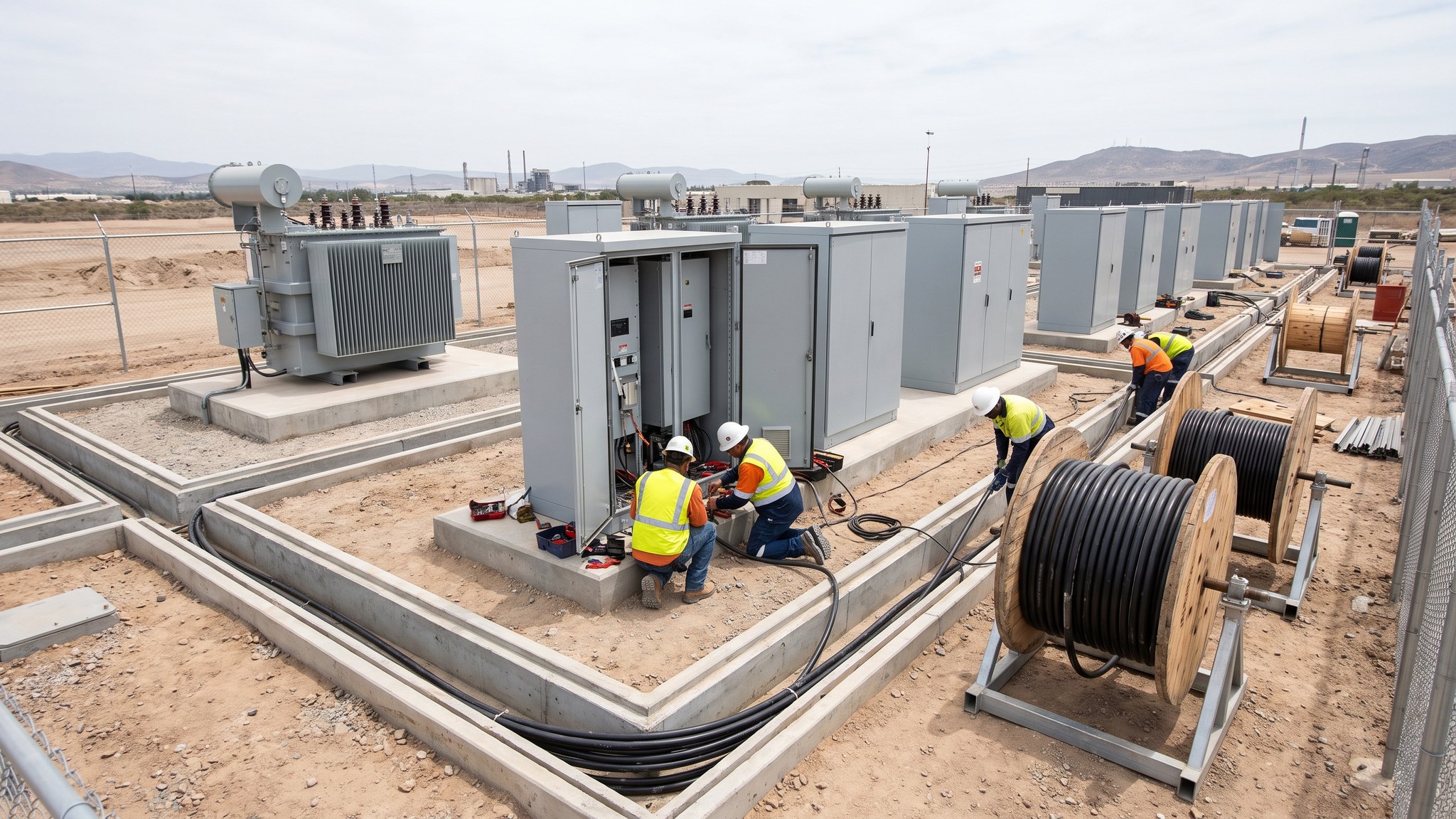
Modular conversion breaks the conversion duty into many small units rather than a few large ones. Instead of one large item of plant serving a whole row of batteries, a number of smaller units share the work, often mounted close to the battery positions they serve. The design intent is granularity. When one unit fails, the site loses the share of its output that the unit was carrying and continues to trade with the rest. On a large project that difference is measured directly in revenue, because a battery that cannot respond when it is called on earns nothing and may attract a penalty.
The approach suits assets whose value depends on availability. Storage projects generally earn by being ready to respond, and an outage that takes a large block of the site out of service is far more damaging than one that shaves a small slice off it. Distributing the conversion also makes replacement easier and cheaper: units are small enough to be handled without heavy craneage, held as spares economically, and swapped by the operator's own team rather than by a specialist mobilised from a distance. Over a long operating life the ability to swap a small unit quickly is often worth more than the efficiency of a larger one.
The trade is complexity. More units means more of everything - more connections, more control points, more items in the asset register, more firmware to keep aligned, more equipment to inspect. The control system has to coordinate a larger population and present it sensibly to an operator, and it has to handle the case where units are in different states. Commissioning takes longer simply because there are more items to prove. Capital cost per unit of capacity is often higher than for large plant. On most projects the choice comes down to whether the owner is buying the cheapest way to build a site or the most available way to run one, and that is a commercial decision taken with the operator rather than a purely technical one.
How does Modular or distributed conversion work, step by step?
- 1
Step 1: Decide what granularity is worth
The starting question is how much of the site the project is willing to lose to a single failure. That is answered commercially, by looking at how the asset expects to earn and what an outage of a given size actually costs, and then technically, by the electrical designer setting out what arrangements deliver it. The answer determines how many conversion units there are and how the batteries are grouped behind them. Choosing granularity by instinct rather than by that comparison is how projects end up with complexity they never needed.
- 2
Step 2: Arrange the units across the site
Distributed units are commonly placed near the battery positions they serve, which shortens cabling but spreads equipment across the site. The layout has to give every unit access for inspection and replacement, keep the fire engineer's requirements satisfied for equipment sited near battery enclosures, and keep the routes clear for a vehicle to reach any unit. Equipment that can only be reached by moving something else will eventually not be reached at all.
- 3
Step 3: Design the control system for the population
A distributed scheme lives or dies on its control system. The site controller has to see every unit, dispatch every unit, aggregate their behaviour into a single site response, and cope with units being out of service without disrupting the rest. The control designer works to what the network operator requires of the site as a whole, then works backwards to what each unit must do. This is the item that most often drives the commissioning programme on a modular scheme.
- 4
Step 4: Build the foundations, mountings and routes
Small units still need proper mountings, proper earthing and proper cable routes, and there are many of them. The civils package is more repetitive and less heavy than for large plant, which suits standardisation: one detail, repeated accurately, checked by sample. Where units are mounted on or beside battery enclosures the arrangement follows the fire engineer's assessment rather than convenience.
- 5
Step 5: Install in repeating sets
Installation is organised as a repeated set of identical operations rather than a series of one-offs. That allows a first set to be installed, inspected, corrected and then used as the benchmark for the rest, which is by far the most reliable way to control quality across a large population. Labelling conventions are fixed at the first set and never deviated from, because on a distributed site the labelling is how anyone ever finds anything again.
- 6
Step 6: Align firmware and configuration across the fleet
A large population of identical units only behaves identically if it is configured identically. Firmware versions, settings and configuration files are recorded per unit and brought into a known, matching state before commissioning, and the process for changing them later is agreed with the operator. Mixed versions across a site produce behaviour that is extremely difficult to diagnose and is a recurring cause of delay.
- 7
Step 7: Prove the units, then prove the aggregate
Commissioning a distributed scheme happens at two levels. Each unit is proved individually in the correct sequence, and then the site is proved as one aggregated resource responding as a single plant. Both are required and neither substitutes for the other. The site-level behaviour is what the network operator is interested in, and it is only credible once the individual units beneath it are known to be right.
- 8
Step 8: Set up the operator to swap units
The benefit of the arrangement is only realised if failed units are replaced quickly, so the project hands over the means to do it: a spares holding agreed with the operator, a documented swap procedure to be carried out by competent people, access maintained to every position, and an asset register that identifies each unit unambiguously. A modular site that cannot be swapped quickly has the complexity without the availability.
What are the benefits of Modular or distributed conversion?
- A single failure removes only a small share of the site's capability
- Higher availability, which is what a storage asset is generally paid for
- Small units can be handled, stocked and replaced without heavy craneage
- Replacement can often be carried out by the operator's own competent team
- Capacity can be built out or augmented in smaller increments
- Failures are easier to localise because the population is finely divided
What are the limitations of Modular or distributed conversion?
- More units means more connections, more control points and more to inspect
- Higher capital cost per unit of capacity than large conversion plant
- Control system complexity is significantly greater
- Longer commissioning programme because there are more items to prove
- Firmware and configuration must be kept aligned across a large population
- A larger asset register and a heavier maintenance administration burden
What is Modular or distributed conversion best suited for?
What plant does Modular or distributed conversion need?
- Light lifting equipment and telehandlers rather than heavy mobile cranes
- Excavators and rollers for repeated foundations, mountings and access routes
- Cable installation gear suited to many short runs rather than few long ones
- Termination equipment operated by the competent parties named for that work
- Control system test and configuration equipment
- Secure storage for the spares holding agreed with the operator
How is Modular or distributed conversion quality-checked?
- A first installed set inspected and corrected, then used as the benchmark for the rest
- A fixed labelling convention applied without deviation across the whole population
- Firmware and configuration recorded per unit and confirmed aligned before commissioning
- Sample inspection regime agreed for repeated details, with the sample rate set in the specification
- Individual unit proving completed before any aggregated site behaviour is assessed
- Asset register reconciled against the units physically installed before handover