Site substation and connection compound
The point where the project meets the network - built to the network operator's requirements, on the network operator's programme, and very often the thing that fixes the project date.
Last updated 2026-09-06
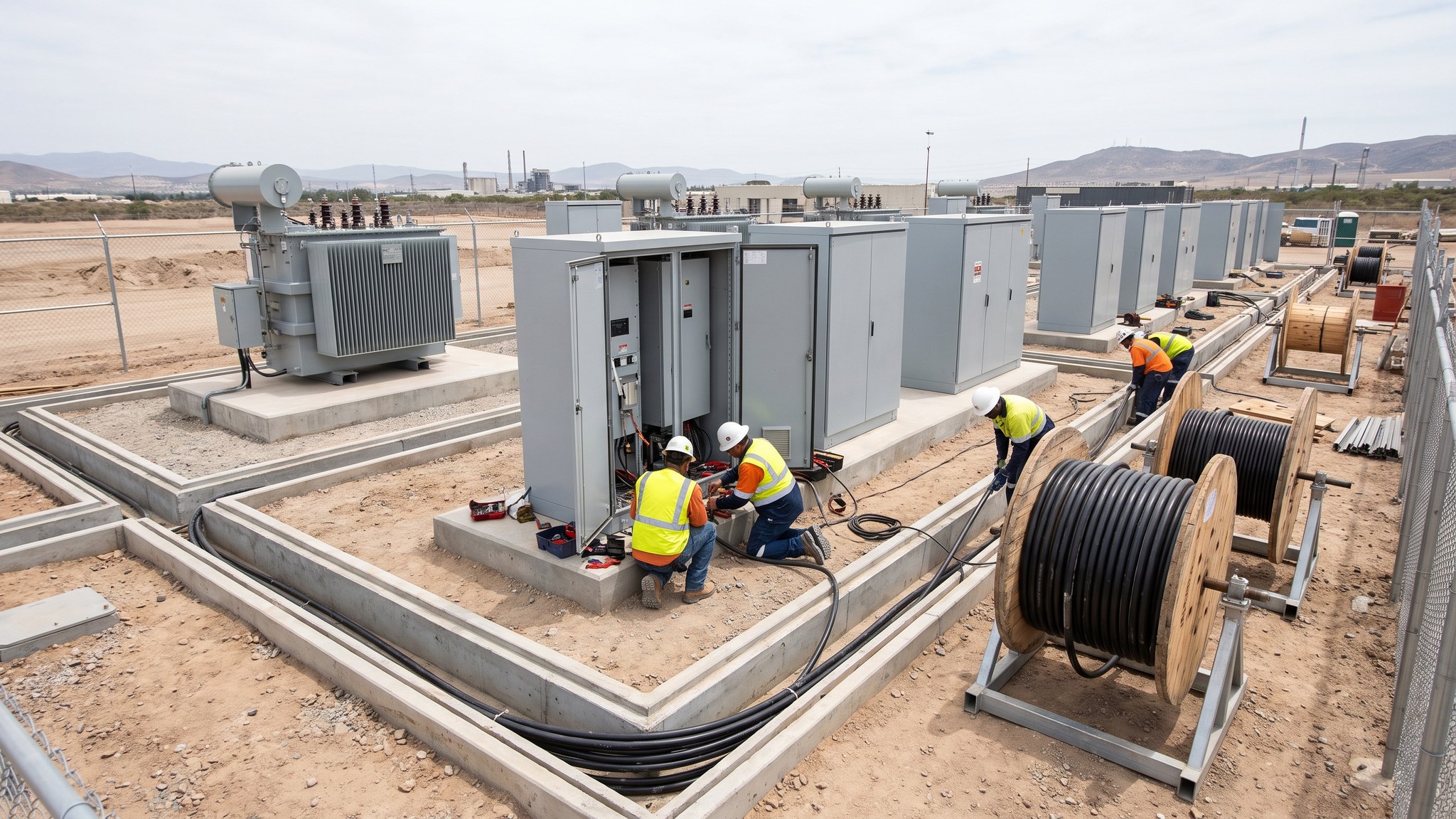
What is Site substation and connection compound?
The connection compound is where the project stops being a private site and becomes part of the public network. It contains the switchgear, protection, metering and control equipment through which the site exports and imports, and it is the physical and contractual boundary between the developer's asset and the network operator's system. Everything else on the project exists to deliver power to this point. Nothing the project builds earns anything until this point is live.
What makes the compound different from every other part of the project is that the developer does not control it. Its arrangement, its equipment, its protection philosophy, its metering, its security and access provisions and often its construction are all set by the network operator to their requirements, and the works are carried out or witnessed on their programme by their people. That programme is set by an organisation running many connections at once. It is not adjusted because a battery project is ready early, and outages on the wider network are planned far ahead and are difficult to move. Projects that treat the connection as a package to be procured like any other are the projects that finish and then wait.
In practice the connection date drives the whole project. The realistic approach is to establish the network operator's programme first and build the construction programme backwards from it, engaging early, tracking the operator's milestones as project milestones, and accepting that some dates simply cannot be pulled forward. The compound is also usually the item with the longest lead equipment and the most third-party dependencies, including land, access rights and consents that may sit outside the main site. On most projects the compound is started early, watched closely and reported on separately, because it is the single item most likely to determine when the asset starts earning.
How does Site substation and connection compound work, step by step?
- 1
Step 1: Establish the connection terms and the operator's programme
The connection agreement sets what the site may do, where it connects and when. The network operator's programme sets when their works and their witnessing will happen. Both are established before the construction programme is fixed, because the construction programme is built backwards from them. Early and continuous engagement with the operator is the single most valuable thing a project team does on this item.
- 2
Step 2: Design the compound to the operator's requirements
The compound is designed to the network operator's standards rather than the developer's preferences. Arrangement, equipment selection, protection philosophy, metering, earthing, security, access and even fencing and signage generally follow their requirements. The design is submitted for their acceptance, and the acceptance process takes time that is allowed for in the programme rather than discovered in it.
- 3
Step 3: Secure land, access and consents for the connection
The compound and the cable route to it frequently sit partly outside the main site, which brings land acquisition, wayleaves, easements, highway consents and third-party landowners into the critical path. These are legal and commercial processes with their own durations and their own failure modes. They are started at the earliest possible point, because no amount of construction effort recovers a wayleave that has not been granted.
- 4
Step 4: Order the long-lead equipment early
Connection equipment typically carries the longest lead times on the project, and manufacturing slots are booked well in advance. Orders are placed as soon as the design is settled enough to allow it, and the delivery dates are tracked as project milestones rather than as supplier matters. A slipped equipment delivery on this item usually slips the project end date directly.
- 5
Step 5: Build the compound civils and structures
Foundations, plinths, containment, earthing, buildings, hardstandings, fencing and access are constructed to the accepted design. Earthing in particular is installed and recorded carefully, because it is buried, it is fundamental, and it is inspected against records rather than by excavation. The compound is built to a finished standard rather than a construction standard, because the network operator will take it as they find it.
- 6
Step 6: Install the equipment and complete the interface works
Switchgear, protection, metering and control equipment are installed by the parties named for that work, with the interface to the network operator's equipment completed to their requirements. Documentation is assembled as the work proceeds. The operator's inspections and witnessing are scheduled into the programme as fixed points, and the site is made ready in advance of them rather than on the day.
- 7
Step 7: Complete the operator's acceptance process
Before anything is energised the network operator has to be satisfied that the compound has been built and installed as accepted. That is a formal process with documents, inspections and authorisations, carried out on their terms and their timescale. The project's role is to have everything ready, complete and evidenced, so that the process runs once rather than repeatedly.
- 8
Step 8: Hold the compound as the master milestone
Throughout the project the compound is reported separately and treated as the master milestone that other work is arranged around. Battery deliveries, conversion plant installation and site commissioning are all sequenced to arrive ready for it. A project that is ready before the network is waiting; a project that is late for the network may wait considerably longer than it was late.
What are the benefits of Site substation and connection compound?
- Provides the single defined boundary between the project and the network
- Built to the network operator's standards, which are consistent and well established
- Once accepted, it gives the asset a clear and durable basis for operating
- Concentrates the third-party dependencies into one identifiable package
- Makes the project's true critical path visible from the earliest stage
- Provides the metering and control that the commercial arrangements depend on
What are the limitations of Site substation and connection compound?
- The programme belongs to the network operator, not to the project
- Longest lead equipment and the least flexibility to recover time
- Frequently involves land, wayleaves and consents outside the main site
- Design freedom is minimal, because the operator's requirements govern
- Network outages needed for the works are planned far ahead and are hard to move
- A delay here delays revenue directly, whatever else has been achieved on site
What is Site substation and connection compound best suited for?
What plant does Site substation and connection compound need?
- Excavators, rollers and concrete plant for foundations, plinths and hardstandings
- Mobile cranes for switchgear and transformer placement
- Earthing installation equipment, with records taken before backfill
- Cable installation and termination equipment operated by the parties named for that work
- Fencing, security and access installation equipment to the operator's requirements
- Survey equipment for setting out to the accepted design
How is Site substation and connection compound quality-checked?
- Design submitted to and accepted by the network operator before construction
- Land, wayleave and consent status tracked as programme items with named owners
- Long-lead equipment delivery dates tracked as project milestones
- Earthing installation photographed and recorded before it is covered
- Documentation assembled progressively so the operator's acceptance runs once
- Compound status reported separately as the project's master milestone