Engineered granular platform
A compacted stone platform and nothing else - the cheapest option, and the easiest to take away.
Last updated 2026-09-06
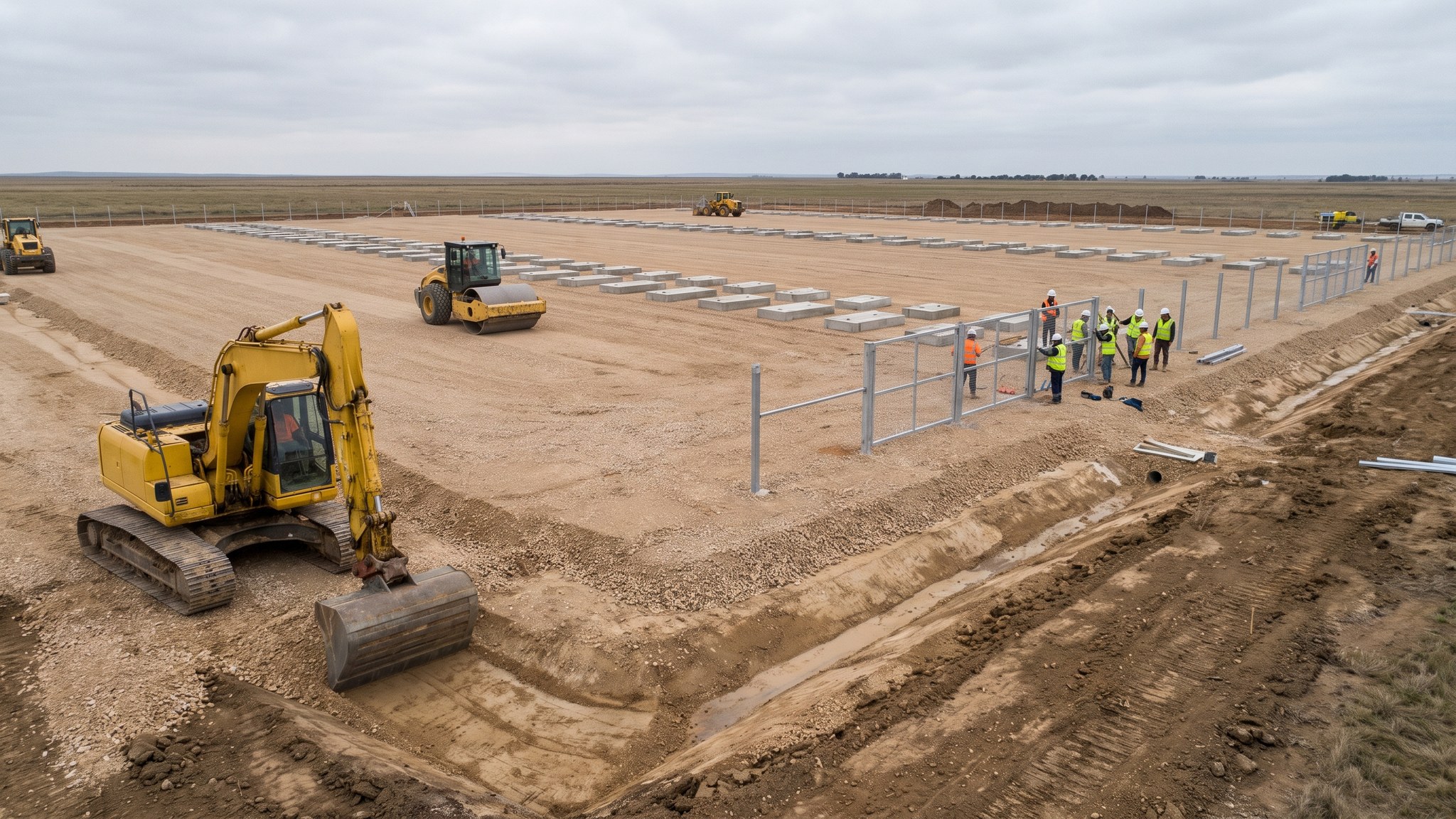
What is Engineered granular platform?
An engineered granular platform supports the units on compacted stone rather than on concrete. It is exactly what it sounds like: the ground is stripped and trimmed to a designed formation, granular material is placed and compacted in layers, and the units are set down on the finished surface, sometimes directly and sometimes through spreader elements or a light bearing arrangement. There is no concrete, no reinforcement, no formwork and no curing. On the right site it is the cheapest platform option by a clear margin and the fastest to build, and it is the option a designer will look at first where the units are light enough and the ground is good enough to support them.
Those two conditions do the deciding. The units have to impose loads the platform can spread into ground that will accept them without unacceptable settlement, and the ground below has to be competent enough that a granular layer is genuinely improving a decent situation rather than papering over a poor one. Where either condition fails, the option fails with it - a granular platform on soft or variable ground will settle unevenly, and uneven settlement under a battery unit is a problem for the unit, for its connections and for the equipment inside it. The geotechnical designer decides whether the option is viable, and sets the formation, the material and the layer thicknesses from the ground investigation and the loads the battery supplier has given.
The great advantage beyond cost is reversibility. A granular platform can be lifted, the material recovered or reused, and the land returned close to its original condition with far less work than breaking out concrete. On a project with a time-limited consent - which describes a large share of battery storage schemes - that is a direct and quantifiable saving at the end of the term, and it is often the argument that wins the option its place. Against that, the platform is a maintained asset rather than a finished one. It has to be kept level, kept drained and kept free of vegetation and rutting for the life of the site, and it is more sensitive to weather and to site traffic than concrete. Craneage and delivery access still govern the layout, and the platform has to be built to carry the crane as well as the units, which on light units is frequently the load case that sizes it.
How does Engineered granular platform work, step by step?
- 1
Step 1: Confirm the option is viable at all
The geotechnical designer assesses the ground investigation against the loads from the battery supplier and decides whether a granular platform can carry the units within the settlement the equipment tolerates. This is a genuine go or no-go step. Where the ground is soft, variable or made, or where the units are heavy, the answer is a concrete or piled solution and the platform option is dropped early rather than value-engineered in later.
- 2
Step 2: Design the platform and the formation
The designer sets the formation level, any material to be removed, the granular material to be used, the layer thicknesses, the compaction requirement and any geosynthetic layers. The design covers the crane and delivery loads as well as the operational loads, and on light units the crane is often the governing case. The specification, not the site, decides the material.
- 3
Step 3: Strip and prepare the formation
Topsoil and unsuitable material are removed, the formation is trimmed to level, inspected and proof-rolled, and any soft spots are dug out and replaced. Because the platform relies entirely on the ground beneath it, formation acceptance is the most important inspection in the whole operation and it is recorded position by position.
- 4
Step 4: Place and compact in layers
Granular material is placed and compacted in layers to the designed thickness, with compaction testing at the frequency the specification sets. Layer discipline is what makes the platform work - material tipped deep and rolled once looks the same on the surface and behaves nothing like a properly compacted platform under a crane.
- 5
Step 5: Install services and containment as the platform is built
Cable ducts, earthing and drainage that pass through or under the platform are installed as the layers go up rather than dug back into a finished surface. Positions are surveyed and recorded, because a duct cut into a compacted platform later is a weak point that has to be reinstated properly.
- 6
Step 6: Trim, level and survey the finished surface
The top surface is trimmed and regulated to the finished level and surveyed against the tolerance the battery supplier requires. Surface regularity matters because the units are levelled off this surface, and correcting a low area under a unit after delivery is far harder than getting the level right beforehand.
- 7
Step 7: Complete drainage, edges and access routes
Surface water drainage, platform edge details and the access and crane routes are completed. Edges are the weak point of any granular platform - they ravel under traffic and erode under water - so the edge detail and the drainage arrangement are designed rather than left to the site.
- 8
Step 8: Maintain the platform through installation and operation
The platform is inspected and maintained through the installation phase and thereafter: rutting made good, levels checked, drainage kept clear and vegetation controlled. Unlike concrete, a granular platform degrades if it is left alone, and the maintenance regime is agreed as part of the design rather than discovered later.
What are the benefits of Engineered granular platform?
- Cheapest of the platform options by a clear margin where the ground and the loads allow it
- Fastest to build, with no formwork, no reinforcement and no curing period
- No concrete, so the lowest embodied carbon of the four options
- Most reversible - material can be lifted and the land returned close to its original state
- Well suited to time-limited consents where decommissioning cost is part of the appraisal
- Easy to extend, adjust or repair without breaking anything out
What are the limitations of Engineered granular platform?
- Only viable where the units are light enough and the ground good enough - the designer decides
- Vulnerable to differential settlement, which battery units and their connections tolerate poorly
- A maintained asset rather than a finished one, needing levels, drainage and vegetation managed for life
- Sensitive to weather and to site traffic, and edges ravel under repeated use
- Surface tolerance is harder to achieve and hold than on a concrete slab
- Crane and delivery loads frequently govern the design even where the units are light
What is Engineered granular platform best suited for?
What plant does Engineered granular platform need?
- Excavators and dozers for strip, formation trimming and soft spot removal
- Dumpers or tippers for granular material delivery and placement
- Rollers and compaction plant sized to the layer thicknesses specified
- Grader or laser-guided plant for trimming the finished surface to tolerance
- Compaction testing equipment at the frequency the specification requires
- Survey equipment for formation, layers and finished level
How is Engineered granular platform quality-checked?
- Designer confirmation that a granular platform suits the loads and the ground before the option is adopted
- Formation inspected, proof-rolled and accepted position by position, with soft spots recorded and replaced
- Granular material checked on delivery against the specified grading and cleanliness
- Compaction testing at the specified frequency for every layer, with results accepted before the next layer
- Finished surface surveyed against the battery supplier tolerance before any delivery
- Maintenance regime agreed and running from completion, covering levels, rutting, drainage and vegetation