Piled or screw-pile foundations
Where the ground is weak or settlement matters - and where screw piles come back out again at the end.
Last updated 2026-09-06
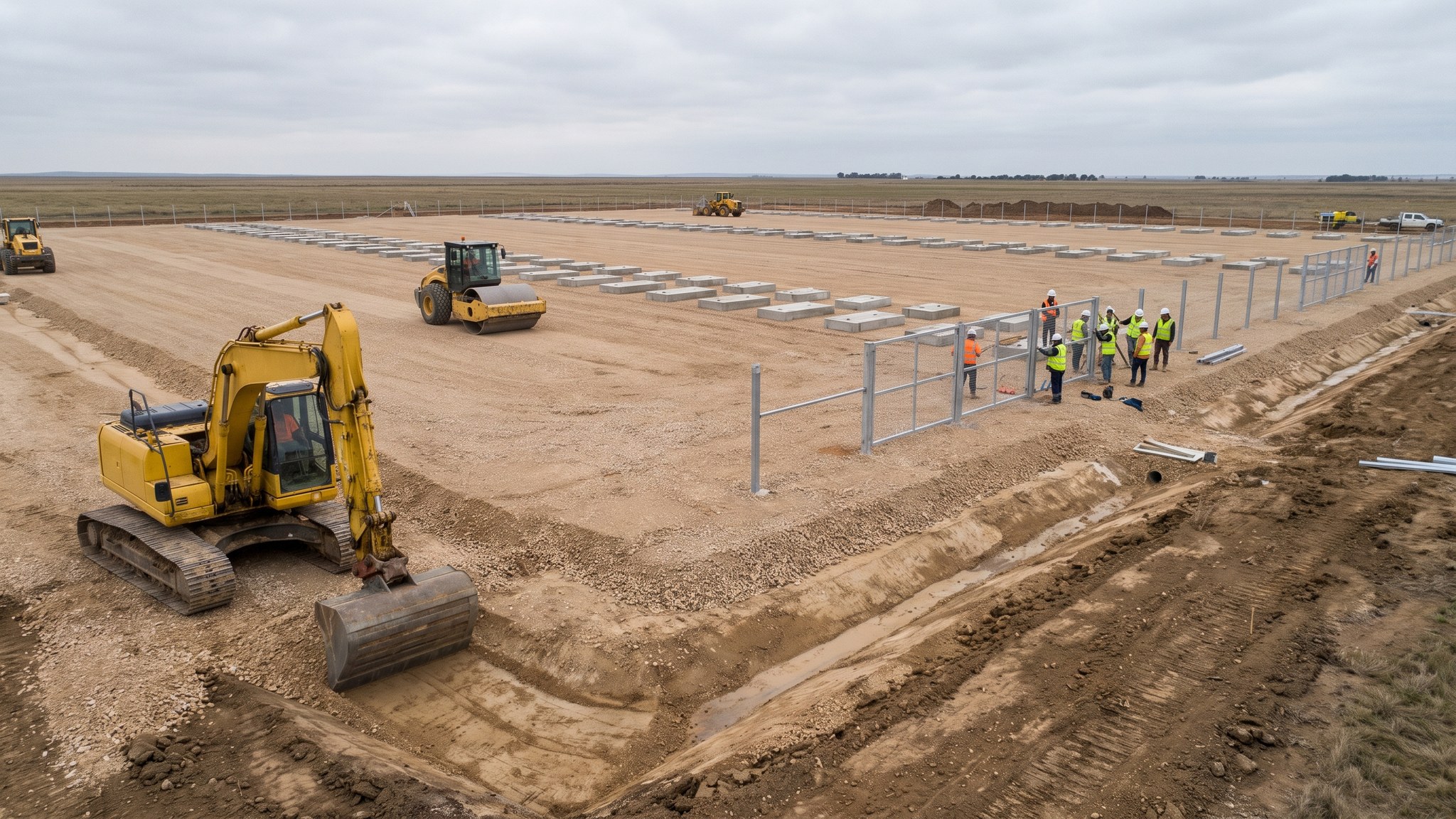
What is Piled or screw-pile foundations?
Piled and screw-pile foundations carry the units down to ground that can take them. On a battery storage project the trigger is usually one of two things: the near-surface ground is too weak or too variable to support a shallow base, or the settlement a shallow base would allow is more than the equipment and its connections can tolerate. Battery sites often occupy brownfield land, filled land or ground next to an existing substation because that is where the connection is, and none of those is reliably good ground. Piling removes the argument by bypassing the problem layer altogether.
Screw piles are particularly attractive on this type of project, and the reasons are worth setting out. They are quick, so a large array of foundations can be installed in a short and predictable period, which matters when the units arrive to a fixed date. They are installed by torque rather than by impact, so they are low-vibration and low-noise, which helps on sites next to occupied buildings or sensitive equipment. They generate almost no spoil, which on contaminated brownfield land is a direct cost saving. And they can be unwound and taken out at the end of the project, leaving the ground substantially as it was found. Where the planning consent is time-limited and the site has to be returned, that reversibility is not a nicety - it is often the reason the option is chosen.
Driven and bored piles remain the answer where the loads, the ground or the depth put screw piles out of range, and they bring the usual consequences: more plant, more noise or vibration, spoil to handle and a permanent element left in the ground. Whichever type is used, the pile arrangement is designed by the geotechnical designer from the ground investigation and the loads the battery supplier gives, and it is verified by testing agreed before installation starts. The pile heads then have to be brought together into something the units can sit on - caps, a capping beam or a supported frame - and that connection is where the tolerance problem lives, because piles install to a construction tolerance and equipment demands an installation tolerance. On top of all this, the same two project-wide facts apply: the layout has to let a delivery vehicle and a crane reach every position, and the civils sit on the critical path because the units are coming whether the foundations are finished or not.
How does Piled or screw-pile foundations work, step by step?
- 1
Step 1: Establish the ground model and the loads
The ground investigation defines the strata, the water conditions and the depth to competent ground, and the battery supplier defines the loads and the settlement the equipment will tolerate. The geotechnical designer works from both. On brownfield sites the investigation also has to find obstructions, old foundations and contamination, all of which affect which pile type is viable.
- 2
Step 2: Select the pile type against ground, noise and end of life
The choice between screw piles, driven piles and bored piles is made on capacity, depth, ground conditions, vibration and noise constraints, spoil arising and whether the foundations have to be removable. On a time-limited consent the removability of screw piles frequently decides it. The designer makes this call, and it is made before the layout is fixed because different pile types suit different arrangements.
- 3
Step 3: Design and prove the pile arrangement
The number, depth and arrangement of piles under each unit are designed by the geotechnical designer and confirmed by a preliminary test where the specification calls for one. Testing establishes that the assumed capacity is real in the ground actually present, and it is far cheaper to find a shortfall in a test pile than under a loaded unit.
- 4
Step 4: Prepare a working platform and set out
Piling plant is heavy and works on the weakest ground on the site, so a designed and certified working platform is prepared before any rig tracks on. It is inspected through the works and re-certified when rig traffic damages it. Setting out is taken from a single control network across the compound, as it is for any discrete-base option.
- 5
Step 5: Install the piles and record every one
Screw piles are wound in by a torque head on an excavator, with installation torque recorded against depth for each pile - the torque record is the primary evidence that the pile found the ground the design assumed. Driven and bored piles are recorded to their own criteria. Any pile that refuses short or runs deep is reported to the designer rather than accepted on site.
- 6
Step 6: Test to the agreed regime
Working pile tests are carried out at the rate the specification sets, on piles selected with the designer rather than chosen for convenience. Results are assessed against the acceptance criteria and shortfalls are made good by additional or replacement piles before anything is built on them.
- 7
Step 7: Trim the heads and build the connecting structure
Pile heads are trimmed or set to level and connected by caps, a capping beam or a steel support frame that carries the unit. This is where construction tolerance meets equipment tolerance, and the connecting structure normally provides the adjustment. The finished bearing surfaces are surveyed against the battery supplier tolerances before delivery.
- 8
Step 8: Complete surfacing, access and drainage
The ground between and around the foundations is surfaced and drained, and the access and crane routes are completed to carry the delivery vehicles and the crane to every position. As with plinths, this is a separate work item and it belongs in the cost plan from the start.
What are the benefits of Piled or screw-pile foundations?
- Carries load past weak, variable or filled near-surface ground rather than trying to improve it
- Controls settlement where the equipment and its connections will not tolerate movement
- Screw piles install quickly, which suits a project with a fixed equipment delivery date
- Screw piles are low-vibration and low-noise, helping on constrained or neighbouring-sensitive sites
- Screw piles generate little or no spoil, a real saving on contaminated brownfield land
- Screw piles can be unwound and removed at end of life, which suits a time-limited consent
What are the limitations of Piled or screw-pile foundations?
- More expensive per unit than a shallow base where the ground would have carried one
- Needs a designed, certified and maintained working platform before any rig tracks on
- Obstructions in made ground cause refusals and redesign, which brownfield battery sites are prone to
- Construction tolerance on pile positions has to be absorbed by the connecting structure
- Driven and bored options bring vibration, noise, spoil and a permanent element left in the ground
- Depends on a testing regime that has to be agreed, programmed and paid for up front
What is Piled or screw-pile foundations best suited for?
What plant does Piled or screw-pile foundations need?
- Excavator-mounted torque head with screw pile shafts and helices for screw pile installation
- Piling rig appropriate to the type selected where driven or bored piles are used
- Dozers, rollers and dumpers for the working platform and its maintenance
- Pile testing equipment and reaction arrangements to suit the specified regime
- Steel fixing, formwork or fabricated frames for the pile caps and connecting structure
- Survey equipment and a protected control network across the compound
How is Piled or screw-pile foundations quality-checked?
- Ground investigation and battery supplier loads both in hand before the pile design is issued
- Working platform designed, certified in writing and re-inspected through the works
- Preliminary test pile carried out where specified, with results accepted before production
- Installation record for every pile - torque against depth for screw piles - reviewed daily, with refusals reported to the designer
- Working pile tests at the specified rate on piles selected with the designer
- As-built survey of pile positions and finished bearing levels issued and checked against the supplier tolerance