UAE villa garden with irrigation
Heat, evaporation and salt decide what lives - and the irrigation system is part of the build, not an accessory bolted on at the end.
Last updated 2026-09-05
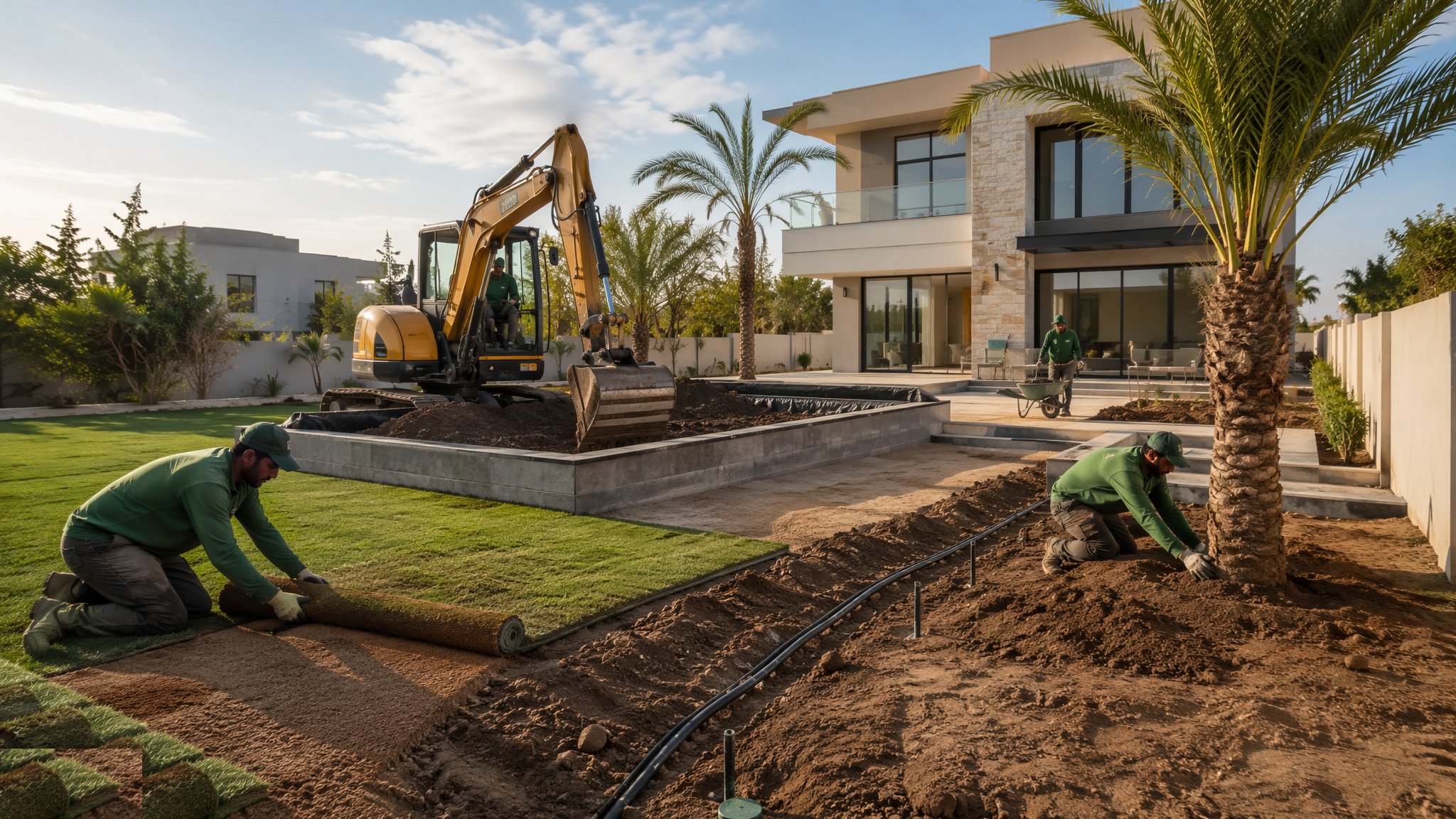
What is UAE villa garden with irrigation?
A villa garden in the Gulf is designed around water and heat rather than around soil and season. Summer air temperatures run well above anything a UK garden ever sees, the ground surface gets hotter still, humidity swings from coastal to desert within a short drive, and evaporation removes water from soil and foliage faster than most plants can replace it. Rainfall is negligible and cannot be counted on for anything. The consequence is simple and absolute: without a working, commissioned irrigation system, everything planted dies in its first summer. Irrigation is therefore not a finishing trade in this market - it is an integral part of the garden build, designed alongside the levels and installed before the soil and the planting.
Salinity is the second governing constraint and the one that catches people out. Native ground is frequently sandy, sometimes gypsum-rich or crusted, low in organic matter and often saline, and the groundwater in coastal plots can be brackish and close to the surface. Irrigation water itself carries salt, and every irrigation cycle that evaporates leaves that salt behind in the root zone. The result is a slow accumulation that shows up as scorched leaf margins and stunted growth months after handover. Designers deal with it through the soil build-up - imported sweet soil and organic improvement in the beds, sometimes over a drainage layer - through species selection, and through an irrigation regime that includes a leaching allowance so that salts are periodically flushed below the roots rather than concentrated in them. The water source matters as much as the system: the design distinguishes between the potable supply, treated recycled water where it is available, and any well or tanker source, and each has a different quality, a different cost and different rules attached to its use.
Everything else follows from those two constraints. Shade is a functional element of the garden rather than a decorative one, provided by structures, pergolas and screens and by the canopy of the trees themselves, and it changes what will grow beneath it. Species selection leans on palms, salt- and drought-tolerant shrubs, ground cover and native or regionally adapted material, with high-water lawn kept to the area the client will actually use rather than spread over the whole plot. Planting is done in the cooler months because summer establishment is a losing battle. And the garden shares the plot with boundary walls, paving, a pool and its plant room, and external services, so the interfaces between the soft landscaping and the hard landscaping dominate the detailing far more than they do on a temperate project.
How does UAE villa garden with irrigation work, step by step?
- 1
Step 1: Establish the water source, its quality and what it costs
The first question on a Gulf villa garden is where the water comes from and what is in it. The supply available to the plot, its pressure and flow, its salinity and its cost per unit all feed straight into the design: they determine the size of the system, whether a storage tank and booster set are needed, how the zones are arranged, and which plants are viable. Water is tested rather than assumed, because a source with a high salt content changes both the species list and the leaching regime. Where treated recycled water is available it is usually cheaper and is often required for landscape use, but it comes with its own handling requirements and its own separate pipework identification. The authority having jurisdiction sets the connection requirements and the approvals, and the design follows them.
- 2
Step 2: Assess the ground and design the soil build-up
Existing ground on a villa plot is normally sand or imported fill, compacted hard by construction traffic and low in anything a plant wants. It is tested for salinity, alkalinity, gypsum content and drainage before the soil design is fixed. On most projects the answer is a build-up rather than a treatment: the compacted layer is broken up, beds and tree pits are excavated and backfilled with imported sweet soil blended with organic matter, and drainage is provided at the base of deeper planters and beds so that irrigation and leaching water has somewhere to go. Depth follows the planting - lawns take a shallower profile than shrub beds, and trees need a genuine pit rather than a hole. The designer decides the mix and the depths for the plot; what is common to all of them is that soil is imported and engineered rather than found.
- 3
Step 3: Design and first fix the irrigation
The irrigation design is produced with the planting plan, not after it, because the hydrozones follow the planting. Lawn, shrub bed, tree and planter each have different water demands and are separated onto different zones so they can be run at different rates and durations. Mains, sub-mains and valve boxes are set out and installed at first fix, while the ground is open and before the soil and the paving go down. Sleeves are laid under every path, driveway and paved area so that laterals can cross later without breaking anything up. Valve boxes are placed where they can actually be reached for service. This is the stage that decides whether the system can be maintained for the next twenty years or whether every repair means lifting paving.
- 4
Step 4: Install drip, sub-surface and spray zones to suit the planting
Delivery method follows what is being watered. Drip line and individual emitters put water directly at the root of shrubs, hedges and trees with very little exposed to evaporation, and are the default for beds. Sub-surface drip beneath lawn areas buries the line below the surface, which cuts evaporation further and keeps the emitters out of the way of mowers, at the cost of being harder to inspect. Pop-up spray or rotor heads are still used on lawn where the shape or the maintenance regime suits them, accepting the evaporation loss. Bubblers serve tree pits and large planters. Filtration and pressure regulation are part of the system rather than optional extras, because emitter blockage from fine particles and from mineral deposition is the normal failure mode in this climate.
- 5
Step 5: Set up the controller and the zone programme
The controller is the part of the garden that keeps it alive, and it is treated as a piece of building services: housed where it is protected from heat and weather, powered from a supply that is recorded, and wired back to each zone valve on cables that are ducted and labelled. Programmes are set to water in the cooler hours around dawn rather than in the heat of the day, at frequencies and durations that suit each hydrozone, and they are changed with the season rather than left on the setting they were commissioned with. Rain and moisture sensing, flow monitoring and a master valve are common additions, and on larger plots the controller may be remotely monitored. The programme itself is set by the irrigation designer and adjusted by whoever maintains the garden.
- 6
Step 6: Build shade and the hard-landscape interfaces
Shade structures, pergolas, screens, boundary walls, paving and the pool surround are built before the planting goes in, and they define the microclimates the planting has to suit. A bed on the south or west side of a wall with paving in front of it is a fundamentally harsher place than a bed under a canopy, and the planting plan responds to that. Interfaces are detailed carefully: mowing edges between lawn and paving, root barriers where a tree sits near a wall or a service run, drainage from the paving that does not discharge into a bed, and clean separation between the pool backwash and the irrigation. These joints are where villa gardens most often look unfinished, and they are all decided before a plant arrives.
- 7
Step 7: Select and plant in the cool season
The species list is drawn from material that tolerates heat, drought, salt and, on coastal plots, wind-borne salt spray - palms, regionally adapted and native shrubs, tough ground covers, and lawn grasses selected for warm-season performance. High-water and high-maintenance plants are used deliberately and sparingly, in the sheltered, irrigated, frequently used parts of the garden. Planting is carried out in the cooler months, which in practice is broadly the autumn-to-early-spring window, so that roots establish before the first summer. Stock is checked on delivery for root condition and for pests, pits are dug generously and backfilled with the improved soil, palms and large trees are supported until they are anchored, and everything is watered in immediately - not at the end of the day.
- 8
Step 8: Commission, then hand over a regime rather than a garden
Commissioning covers the whole system: every zone run and observed, coverage checked, emitters and heads checked for blockage and for alignment, pressures verified, the controller programme demonstrated, and the as-built layout of mains, valves and sleeves recorded. The establishment period that follows is watered more heavily and more frequently than the eventual regime, and it is tapered rather than switched off. Handover includes the zone plan, the controller settings, the seasonal adjustments, the filter cleaning interval and the leaching regime. A villa garden handed over without that information reverts to a set of dead beds within a year, whatever it looked like on the day.
What are the benefits of UAE villa garden with irrigation?
- A designed irrigation system makes a garden viable in a climate where nothing planted would otherwise survive
- Drip and sub-surface delivery put water where the roots are and lose far less of it to evaporation than spray
- Zoning by planting type lets lawn, shrubs and trees be watered at rates that suit each rather than at one compromise setting
- Imported and improved soil gives full control over the growing medium rather than working with poor native ground
- A controller with sensing and monitoring cuts water use and flags failures before the planting shows the damage
- Regionally adapted species and generous shade reduce the long-term water demand of the whole garden
What are the limitations of UAE villa garden with irrigation?
- Total dependence on the system - a failed valve, a blocked filter or a tripped controller in summer can kill planting within days
- Salinity accumulates in the root zone with every irrigation cycle and has to be actively managed rather than ignored
- Water cost and, on some plots, water availability constrain the design directly
- Filtration, emitter cleaning and seasonal reprogramming are ongoing obligations, not one-off tasks
- The planting window is narrow, so a summer handover means either holding the planting or accepting heavy losses
- Sub-surface systems are hard to inspect, so faults can run for a long time before anyone notices
What is UAE villa garden with irrigation best suited for?
What plant does UAE villa garden with irrigation need?
- Excavator and tracked dumper for bulk soil import, bed excavation and tree pits
- Trencher or mini excavator for irrigation mains, sub-mains and cable ducts
- Pipe fusion and threading equipment for the irrigation mains, with pressure testing gear
- Storage tank, booster pump set, filtration and pressure regulation where the supply requires it
- Irrigation controller, zone solenoid valves, valve boxes and the associated wiring and ducting
- Telehandler or crane for palms and semi-mature stock, with water bowser for planting and establishment
How is UAE villa garden with irrigation quality-checked?
- Irrigation water tested for salinity and quality, and the source confirmed and approved before the system is sized
- Imported soil tested for salinity, alkalinity, organic content and drainage before it is placed
- Irrigation mains pressure tested and the as-built layout of mains, sleeves and valve boxes recorded before backfill
- Every zone run at commissioning with coverage, pressure and emitter performance checked and recorded
- Controller programme, seasonal adjustments and the leaching regime documented and demonstrated at handover
- Plant stock inspected on delivery for root condition, pests and disease, and rejected material sent back rather than planted