Blockwork or liner pools
A reinforced blockwork or panel box with the waterproofing done by a liner - the lower-cost route, and a faster one.
Last updated 2026-09-05
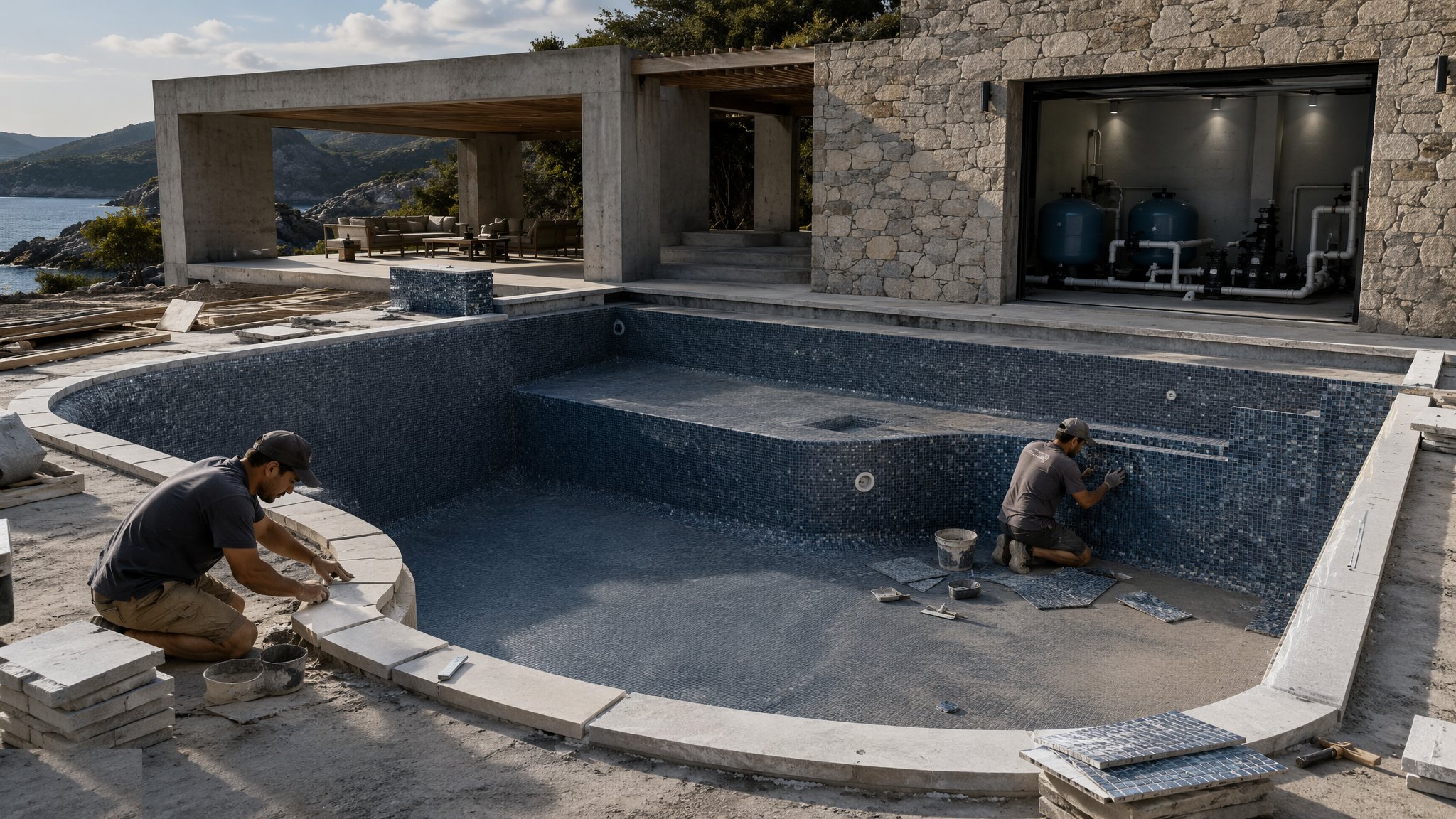
What is Blockwork or liner pools?
A blockwork or liner pool separates the two jobs a pool shell has to do. The structure is built as a reinforced blockwork box, or from proprietary steel, polymer or composite wall panels bolted together on a concrete base, and it holds the ground back and takes the load. The waterproofing is then done by a liner - a welded or prefabricated sheet, commonly a reinforced membrane, hung from a track at the top of the wall and dressed down over the walls and floor. The structure does not have to be watertight in its own right, which is the whole economy of the method: the blockwork is built to the designer's specification for a reinforced retaining structure, filled and reinforced as they require, but it is not being asked to be a water-retaining concrete shell.
The programme is the other attraction. A panel system can be erected in days rather than the weeks a sprayed and cured shell takes, and blockwork is a common trade available anywhere. There is no long cure before the next operation, no specialist spray crew to book, and the finish goes on quickly once the substrate is right. Preparation is what governs the result. The liner takes up the shape of whatever is under it, so the walls have to be flat and the floor has to be laid to a smooth screed or a sand and cement base with no ridges, sharp arrises or protruding fixings. Anything left proud shows through the liner and, eventually, wears through it.
Where the method differs most is over the long run. A liner is a wearing item with a service life measured in years rather than decades, and replacing it is a planned event: the pool is drained, the old liner comes out, the substrate is checked and made good, and a new one goes in. That is a straightforward and comparatively cheap operation compared with re-tiling a shell, and small damage can often be patched underwater. Against that, a liner is more vulnerable in service - sharp objects, poorly controlled water chemistry and ultraviolet at the water line all shorten its life - and it looks and feels different from tile. It is a sound, honest answer for a private pool where budget and speed matter, provided everyone understands that the liner is a component that will be replaced rather than a permanent finish.
How does Blockwork or liner pools work, step by step?
- 1
Step 1: Excavate and lay the base
The dig is squarer and simpler than a sprayed shell needs, because the structure is a box. The formation is trimmed and proved and the base slab or floor build-up is laid to the designer's detail, with the falls run to the outlet positions. Groundwater is assessed here as it is on any pool: an empty box in wet ground is buoyant, and the designer sets whatever drainage, hold-down or ballast measures are required. Where the water table is high, land drainage around the structure is often part of the answer.
- 2
Step 2: Build the walls
Blockwork walls are built to the designer's specification, reinforced and filled as detailed and tied into the base, or panel walls are erected, bolted and braced to the manufacturer's arrangement and set out to line and level. Either way the walls are a retaining structure and are designed as one, allowing for the earth pressure on an empty pool. Bracing and backfill sequence matter - backfilling one side of an unrestrained wall is how panel pools get pushed out of line.
- 3
Step 3: Build in the wet-side items and run the pipework
Skimmer bodies, returns, floor outlets, lights and any vacuum points are built into the walls in their designed positions, set out from the fixed water line. Pipework is run from these back to the plant room, supported and protected, and then pressure tested and held before backfill goes over it. As on any pool, buried untested pipework under a finished deck is the defect that costs the most to reach later.
- 4
Step 4: Backfill and consolidate around the structure
The structure is backfilled in layers to the designer's requirement, evenly around the perimeter and with the walls braced or the pool part-filled as the sequence demands, so the walls are never loaded from one side alone. Compaction is controlled, because settlement of poorly placed backfill shows up later as a sunken deck and a coping that has dropped away from the liner track. Land drainage and any groundwater measures are completed as part of this stage.
- 5
Step 5: Prepare the substrate the liner will sit on
This is the stage that decides how the pool looks and how long the liner lasts. Walls are made good and flat, floors are screeded or laid to a smooth base, and every arris, ridge, fixing head and pipe collar is dressed so that nothing is proud. A protective underlay or fleece is laid where the specification calls for it. The liner will telegraph everything underneath it, so the substrate is inspected and accepted before the liner comes near the site.
- 6
Step 6: Install the liner
A prefabricated liner is unfolded and hung from the track at the top of the wall and pulled into the corners; a welded membrane is laid, cut and hot-air welded on site by the specialist. Either way it is worked into the profile without stretching or trapping air, faceplates and flanges are bolted through with their gaskets at the skimmers, returns, outlets and lights, and the openings are cut only after the liner is in position. Welded seams are tested by the installer. This is specialist work and the warranty depends on it being done by the people who supplied the liner.
- 7
Step 7: Fill, and finish the deck and coping
The pool is filled in a controlled way, often while the liner is still being worked in so the water pulls it home into the corners and floor. Levels and the liner are watched as the water rises. Coping and deck are then completed to the falls, running surface water away from the pool. The filled pool is monitored for level in the same way any pool is, to confirm the structure, the fittings and the liner are all holding.
- 8
Step 8: Fit out the plant room, commission and hand over
The plant room takes the pump, filter, valves, panel, any heating and the dosing and monitoring equipment, with working space, ventilation, drainage, power and access for future replacement. The pool specialist designs, installs and commissions the treatment plant and sets up the monitoring. Commissioning balances the flow across skimmers and returns and proves the filter and backwash. Handover covers the operating and maintenance information, the as-built pipework layout, the liner warranty and its care requirements, and a walk round the plant room.
What are the benefits of Blockwork or liner pools?
- Lower capital cost than a sprayed shell with a tiled finish, often substantially so
- Faster to build, with panel systems erected in days and no long concrete cure in the sequence
- Uses common trades and plant, so it does not depend on booking a specialist spray crew
- The structure does not have to be watertight in itself, which removes a whole category of shell defects
- Liner replacement is a planned, comparatively cheap operation compared with re-tiling
- Small damage can often be patched, sometimes without draining the pool
What are the limitations of Blockwork or liner pools?
- The liner is a wearing item with a service life in years, so replacement is a certainty rather than a risk
- Vulnerable to sharp objects, to poorly controlled water and to ultraviolet at the water line
- The liner telegraphs every ridge and fixing under it, so poor substrate preparation is permanently visible
- Shapes are more constrained than a sprayed shell allows, particularly with panel systems
- Does not read as a tiled pool, which rules it out where the finish is the point
- Panel and blockwork walls are vulnerable during backfill if the sequence or bracing is wrong
What is Blockwork or liner pools best suited for?
What plant does Blockwork or liner pools need?
- Excavator and dumper, with temporary works support and dewatering as required
- Concreting and blockwork gear, or the manufacturer's panel erection and bracing kit
- Compaction plant sized for backfilling in layers against the walls
- Screeding tools and materials for the floor base and wall make-good
- Liner installation equipment - hot-air welding gear for welded membranes, and handling gear for prefabricated liners
- Pipework and pressure testing equipment with gauges
- Plant room equipment - pump, filter, valves, panel, heating and the dosing and monitoring package
How is Blockwork or liner pools quality-checked?
- Formation proved and groundwater and buoyancy measures agreed with the designer before construction
- Blockwork reinforcement and filling, or panel erection and bracing, inspected against the design
- Wet-side item positions surveyed against the fixed water line before backfill
- Buried pipework pressure tested and held, with the result recorded before backfill
- Backfill placed in layers evenly around the structure, with wall line and level checked as it proceeds
- Substrate flatness and freedom from ridges, arrises and proud fixings inspected and accepted before the liner arrives
- Liner installed by the supplier's specialist, with welded seams tested and the warranty documentation issued
- Flanged connections at skimmers, returns, outlets and lights checked for gasket seating and tightness
- Filled pool monitored for level, and deck falls confirmed to run away from the pool
- Plant commissioned by the specialist, with liner care requirements explained at the plant room handover