Dehydration and impurity removal package
Taking the water and the contaminants out - the single most important conditioning requirement, because wet carbon dioxide attacks ordinary pipeline steel.
Last updated 2026-09-06
What is Dehydration and impurity removal package?
Of everything that happens between a capture plant and a pipeline, this is the step that the whole transport system depends on. Carbon dioxide with water in it is corrosive to ordinary carbon steel. Dry, it is not, and an ordinary steel pipeline will carry it for decades. Wet, it attacks the line from the inside, and the consequences are not a maintenance nuisance but a threat to the integrity of a long asset that is difficult and expensive to inspect and repair - and in the offshore case, almost impossible to replace. The dehydration package is the barrier between those two futures. On most projects it is the specification item that the pipeline designer is least willing to negotiate.
Water is not the only thing that has to go. A capture plant hands over a stream that can carry traces of the capture solvent, oxygen, other acid gases, particulates and non-condensable components, and each of those has a reason to be limited. Some accelerate corrosion, some affect how the fluid behaves in the line, some matter to the storage operator because of what they do in the reservoir, and some simply take up capacity in a system that has been paid for by the tonne. The specification the stream must meet is written by the pipeline designer and the storage operator together, and the conditioning package is designed to hit it with margin rather than to hit it exactly. Margin matters because the package has to keep hitting it during upsets on the capture plant upstream.
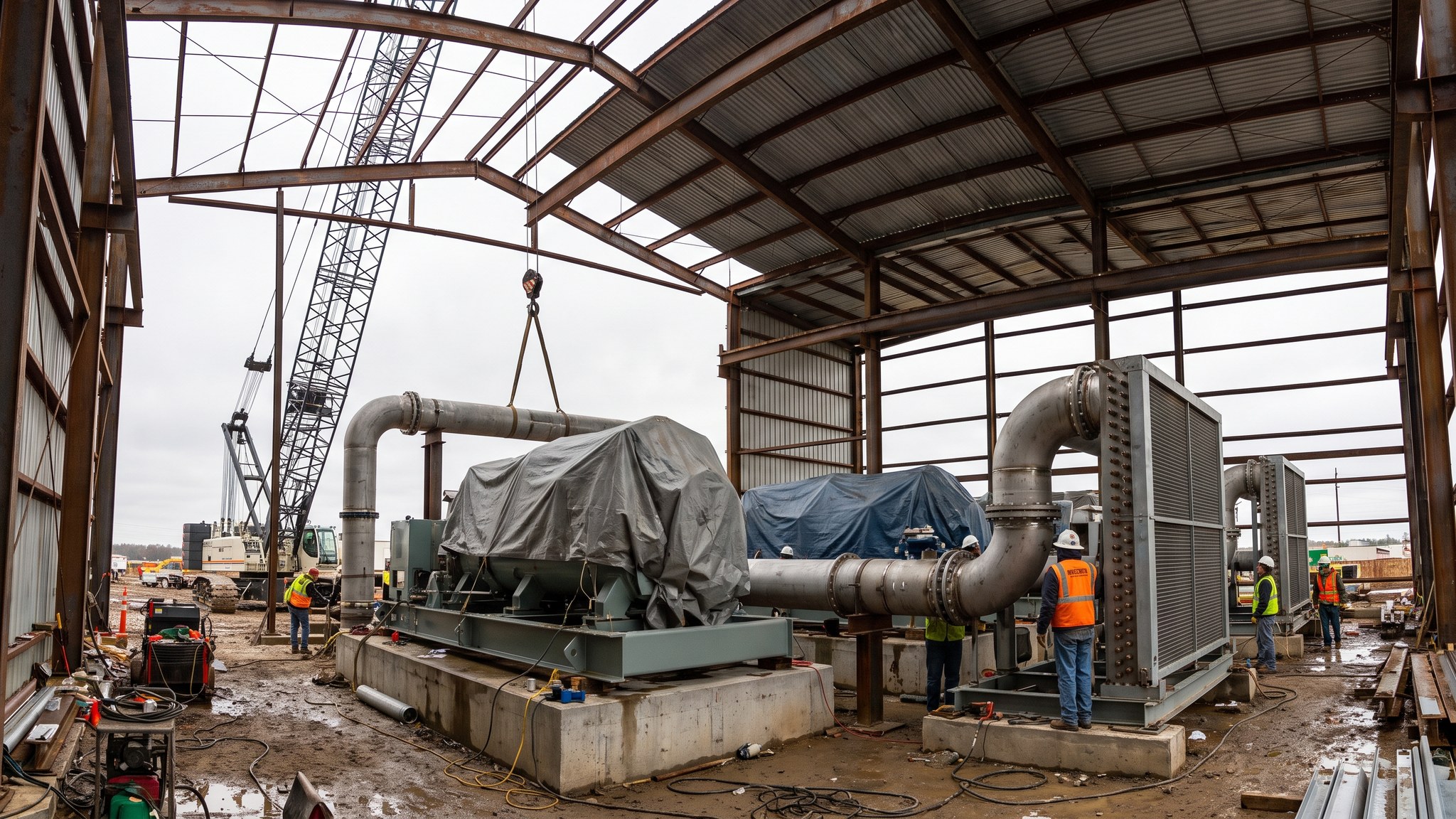
Physically the package sits within the compression train rather than beside it, because drying is done most effectively at a point in the compression sequence that the designer selects. It is typically a set of vessels containing a drying medium, arranged so that one is in service while another is being regenerated, with the regeneration circuit - heating, cooling and separation - alongside. Other removal steps, where they are needed, are arranged around it. For the construction team it is a package of vessels, exchangers, valves and instrumentation with a high valve count and a control system that runs an automatic cycle, and its commissioning is proved by measurement rather than by inspection. The instrument that measures the moisture content is the most important instrument on the plant, and the arrangements for calibrating it, checking it and acting on it are part of the design rather than an operational afterthought.
How does Dehydration and impurity removal package work, step by step?
- 1
Step 1: Agree the export specification with the pipeline designer and the storage operator
Everything starts with a written specification for what the transport system will accept. It lists the components that are limited and it is agreed between the capture project, the pipeline designer, the storage operator and, where a shared network is involved, everyone else who will inject into it. On a cluster project this is a commercial document as much as a technical one, because it defines what each emitter must deliver at the boundary. Once agreed it is treated as fixed, and the conditioning package is designed to it with margin.
- 2
Step 2: Characterise what the capture plant will actually deliver
The design case is not the average case. The designer establishes what the stream will contain at normal operation, at turndown, at start-up, and during the upsets the capture plant can credibly have - solvent carryover being the classic example. The package is sized for the demanding cases, because a conditioning system that meets specification only when everything upstream is behaving is not a barrier at all. Where the host process is variable, that variability is quantified rather than assumed away.
- 3
Step 3: Select the drying technology and the arrangement
The designer selects the drying method and where in the compression sequence it sits. On most projects the arrangement uses beds of a solid drying medium in vessels, cycled so that one bed dries the stream while another is regenerated and returned to standby. The number of vessels, the cycle arrangement and the regeneration method follow from the duty and from how much margin the operator wants. The selection is made with the compression designer, because the position in the train and the drying performance are linked.
- 4
Step 4: Design the removal steps for the other contaminants
Where the specification limits components other than water, additional steps are provided - filtration and coalescing for particulates and liquid carryover, and further treatment where oxygen, other acid gases or non-condensables have to be reduced. What is needed depends entirely on the capture technology and the host process, so this part of the package varies far more between projects than the drying does. The designer confirms each step against the specification rather than including it by habit.
- 5
Step 5: Build and install the package
The package normally arrives as skids or modules with the vessels, exchangers, valve manifolds and instrumentation already assembled, and it is set on foundations sized for the vessels full. Cleanliness during installation matters more here than almost anywhere on the plant, because debris left in the system ends up in the beds or in the filters. Pipework is cleaned and inspected before the medium is loaded, and the beds are loaded to the supplier's procedure by people who have done it before.
- 6
Step 6: Instrument the outlet and make the measurement trustworthy
The moisture measurement at the package outlet is the instrument the whole transport system leans on. It is specified with the sampling arrangement designed around it, installed where it sees a representative stream, and provided with the means to calibrate and check it in service. The design also decides what happens automatically when it reads out of specification - which route the stream takes and what shuts down. Those actions are engineered as interlocks rather than left as operator instructions.
- 7
Step 7: Commission by measurement through a full cycle
Commissioning proves the package by running it through complete cycles, including regeneration and switchover, and measuring the outlet across the range. The switchover is watched closely because that is the moment a badly configured system lets a slug of off-specification stream through. Off-specification routing and shutdown interlocks are tested deliberately. Only when the package holds specification through a full cycle at load is the pipeline accepted onto the stream.
- 8
Step 8: Hand over with the monitoring and medium replacement regime defined
The operator inherits a package with a defined medium life, a regeneration cycle, a filter change schedule and a monitoring regime that includes calibration of the outlet instrumentation. The reporting obligation to the pipeline and storage operators is defined at the same time, because on a shared network the emitter is contractually accountable for what it puts in. Access for changing the medium and the filters is confirmed as built.
What are the benefits of Dehydration and impurity removal package?
- Protects the entire downstream transport system, which is the most expensive and least replaceable part of the chain
- Allows ordinary carbon steel to be used for the pipeline, avoiding a very large cost in exotic materials
- Removes contaminants that would otherwise affect flow behaviour, capacity and the storage reservoir
- Skid or module delivery keeps site work and site risk relatively low
- Cyclic bed arrangement lets one vessel regenerate while another stays in service, so operation is continuous
- Provides the measured, auditable evidence that the emitter is meeting the network specification
What are the limitations of Dehydration and impurity removal package?
- Adds vessels, a regeneration circuit, a high valve count and a control cycle to the plant
- Regeneration consumes energy and utilities, adding to the parasitic load of the capture scheme
- The drying medium and the filters are consumables with a replacement cost and a shutdown implication
- Performance depends on the outlet measurement being trustworthy, so calibration discipline is essential
- Upsets on the capture plant, particularly solvent carryover, can challenge the package
- Contaminant removal beyond drying is project-specific, so there is little standard design to borrow
What is Dehydration and impurity removal package best suited for?
What plant does Dehydration and impurity removal package need?
- Drying vessels containing the selected medium, arranged for cyclic operation
- Regeneration circuit with heating, cooling, separation and its own control
- Automated valve manifolds and the control system that runs the cycle
- Filtration and coalescing equipment upstream and downstream as specified
- Additional contaminant removal equipment where the specification requires it
- Outlet moisture and composition analysers with their sampling systems and calibration provision
- Crane or lifting provision and access for loading and changing the drying medium
How is Dehydration and impurity removal package quality-checked?
- Written export specification agreed and issued before the package is designed
- Design cases documented for normal operation, turndown, start-up and credible upsets
- Pipework and vessels cleaned and inspected before the drying medium is loaded
- Medium loading carried out and recorded to the supplier's procedure
- Valve sequencing and cycle control functionally tested before operation on process
- Outlet analysers installed with representative sampling, calibrated and their calibration procedure issued
- Off-specification routing and shutdown interlocks tested and witnessed
- Full cycle including regeneration and switchover demonstrated at load with the outlet within specification throughout