Monitoring and observation wells
Wells that inject nothing - they prove where the plume goes and that it stays where it should, for decades after the contractor has left.
Last updated 2026-09-06
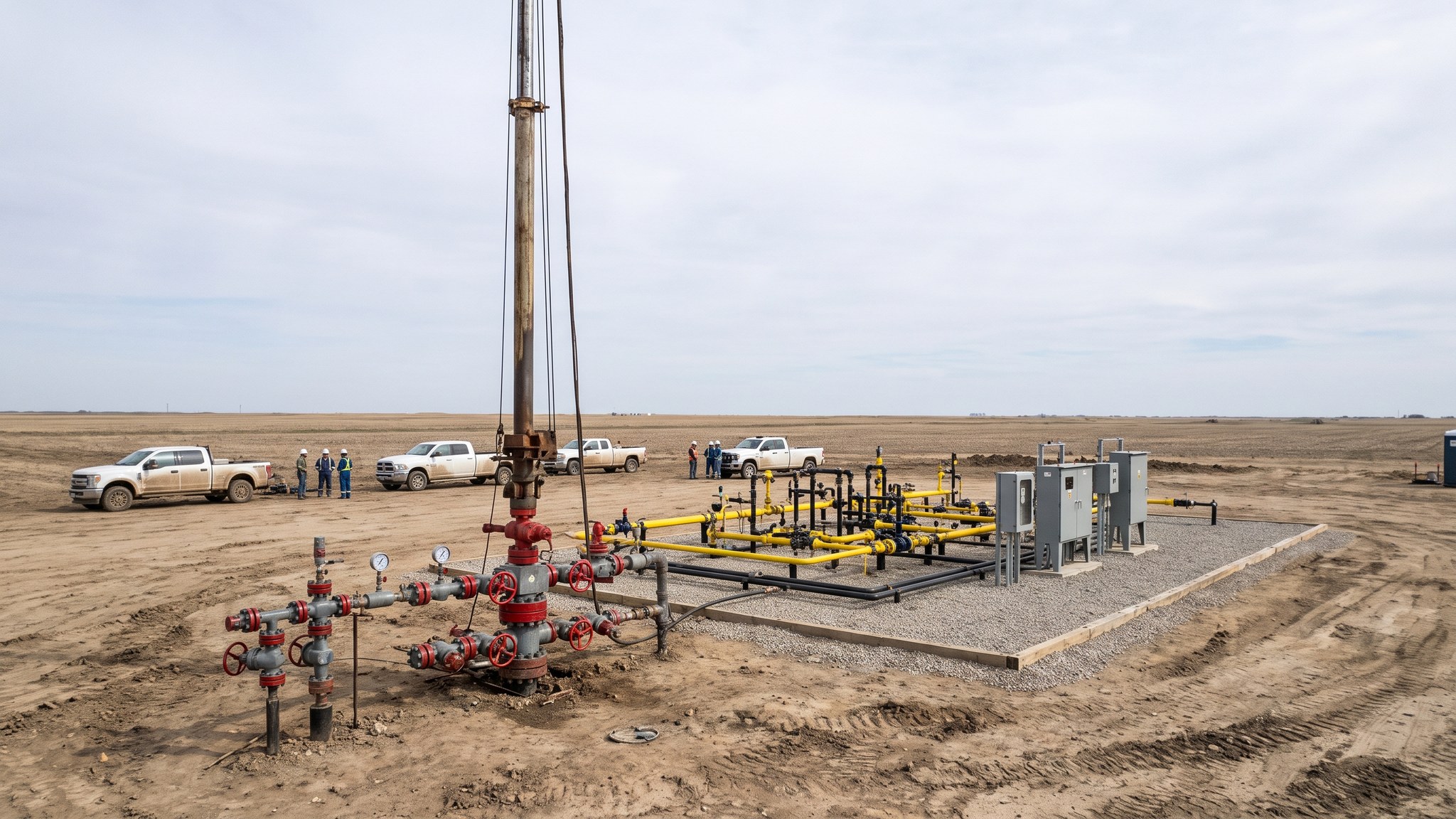
What is Monitoring and observation wells?
A storage project is not permitted simply to inject and hope. The licence to store carries an obligation to know where the injected volume is going and to demonstrate that it is staying contained, and that obligation is discharged in large part through monitoring wells. These are wells that never take a drop of the stream. They exist to observe - to sample, to measure and to provide the direct subsurface evidence that complements the surveys carried out from the surface or from vessels.
What they monitor falls into two broad purposes. Some wells watch the storage formation itself, tracking how the injected volume spreads and whether it is behaving as the storage model predicted. Others watch above it, in the layers between the storage formation and the surface, providing early evidence if anything is moving where it should not. Both purposes matter to the regulator, and the mix, number and position of wells is set out in a monitoring plan that forms part of the storage permit. That plan is not fixed forever - it is reviewed and updated as the actual behaviour of the site is observed against the model, and monitoring wells are what generate the observations that drive those updates.
For a construction team the important characteristic of monitoring wells is that they are permanent obligations rather than temporary works. They are drilled or re-completed as part of the project, instrumented, connected to a data system, and then handed to an operator who must keep them working, keep reading them and keep reporting for the operational life of the site and for a long period after injection stops. Storage sites are handed back only when containment has been demonstrated over an extended period, and monitoring wells are the instruments of that demonstration. The construction contract lasts a few years; the monitoring obligation outlives it by decades, and the well has to be built and documented with that in mind.
How does Monitoring and observation wells work, step by step?
- 1
Step 1: Set the monitoring objectives from the storage plan
The monitoring plan starts from the storage model - where the injected volume is predicted to go, what the containment relies on, and what would constitute evidence that the prediction is wrong. From those questions come the monitoring objectives, and from the objectives come the wells. Monitoring is designed to test the model, not simply to gather data, and the regulator assesses it on that basis.
- 2
Step 2: Decide the mix of well-based and surface monitoring
Wells are one technique among several. Surface and marine surveys, repeated seismic imaging and other measurements all contribute, and each has different coverage, resolution and cost. The operator and the subsurface team decide what proportion of the evidence should come from wells, which are precise but only sample a point, and what should come from wide-area techniques, which cover ground but resolve less. That balance is the central design decision of a monitoring programme.
- 3
Step 3: Locate the wells against the predicted behaviour
Positions are chosen so that the wells will actually see what they are meant to see - within the predicted extent of the injected volume for some, above the storage formation for others, and often at locations chosen because they would give early warning if the model is wrong. Because the model is uncertain, the plan usually keeps the option of adding wells later as the site behaves. A monitoring well in the wrong place is an expensive source of no information.
- 4
Step 4: Drill or re-complete the wells
Monitoring wells may be drilled new or, quite often, provided by re-completing suitable legacy wells, since the demands on a monitoring well are lower than on an injection well. Where they are drilled new they are normally included in the same rig campaign as the injection wells so that the mobilisation is shared. The well engineer designs them for their monitoring duty and for the decades they will spend in service.
- 5
Step 5: Instrument the wells and build the data system
The wells are fitted with the permanent instrumentation and sampling arrangements the monitoring plan requires, and connected to a data acquisition and transmission system that gets the readings to the operator reliably. On offshore sites that link is a significant piece of engineering in itself. Power, communications, calibration provision and redundancy are all designed for a system that has to work for a very long time with limited attention.
- 6
Step 6: Establish the baseline before injection starts
Baseline readings are taken across the whole monitoring system before any injection, because every later result is interpreted as a change from the baseline. If the baseline is thin or poorly documented, decades of subsequent monitoring are weakened by it. Baseline acquisition is therefore treated as a deliverable in its own right, with its own quality requirements, and it is completed before the chain is commissioned.
- 7
Step 7: Operate, interpret and update the plan
In service the wells are read on the schedule the permit sets, the results are interpreted against the storage model, and the model is updated as real behaviour is observed. Where observation and prediction diverge, the operator investigates and reports, and the monitoring plan itself may be changed - more frequent readings, additional techniques, or additional wells. The regulator reviews the results and the plan periodically. This is an active obligation, not a filing exercise.
- 8
Step 8: Carry the obligation through to site handback
Monitoring continues throughout injection and then for an extended period after injection stops, until containment has been demonstrated well enough for the site to be handed back. Only then are the monitoring wells themselves permanently abandoned. Everyone involved in constructing them should understand that they are building instruments for a programme that will still be running long after the project team has dispersed, which is why the construction and instrumentation records are treated as long-life documents.
What are the benefits of Monitoring and observation wells?
- Provides direct subsurface evidence that surface and marine surveys cannot give
- Detects change early, allowing the operator to respond before a problem develops
- Generates the observations that let the storage model be tested and improved
- Underpins the regulatory case for continued injection and eventually for site handback
- Can often be provided by re-completing suitable legacy wells rather than drilling new
- Instrumented wells give continuous data rather than periodic snapshots
What are the limitations of Monitoring and observation wells?
- Each well samples one location, so coverage across a large site is inherently limited
- Wells cost money to drill, instrument and maintain and produce no revenue
- Positions have to be chosen from an uncertain model, so some may see little of interest
- Instrumentation must survive decades in a hostile environment with limited access
- Offshore data transmission and power are significant engineering problems in their own right
- The obligation continues long after injection stops, so the liability outlives the project
What is Monitoring and observation wells best suited for?
What plant does Monitoring and observation wells need?
- Drilling rig or intervention unit, normally shared with the injection well campaign
- Completion and instrumentation equipment specified for long-term monitoring duty
- Permanent downhole sensors and sampling arrangements
- Data acquisition, power supply and transmission equipment, including subsea links offshore
- Surface or marine survey equipment where the plan uses wide-area techniques alongside wells
- Calibration and maintenance access provision for the life of the programme
How is Monitoring and observation wells quality-checked?
- Monitoring plan derived from the storage model, submitted with the permit and approved
- Well locations justified against the predicted behaviour and recorded
- Well construction and instrumentation records compiled as long-life documents
- Data acquisition, power and transmission systems proven end to end before injection
- Baseline readings acquired, quality checked and archived before any injection
- Reading schedule, interpretation method and reporting route defined and agreed with the regulator
- Procedure in place for investigating and reporting divergence between observation and model
- Long-term stewardship obligations, including post-injection monitoring and eventual abandonment, documented at handover