Re-used or re-completed legacy well
Re-entering a well drilled decades ago for something else - cheaper than drilling, but only if its integrity can be demonstrated.
Last updated 2026-09-06
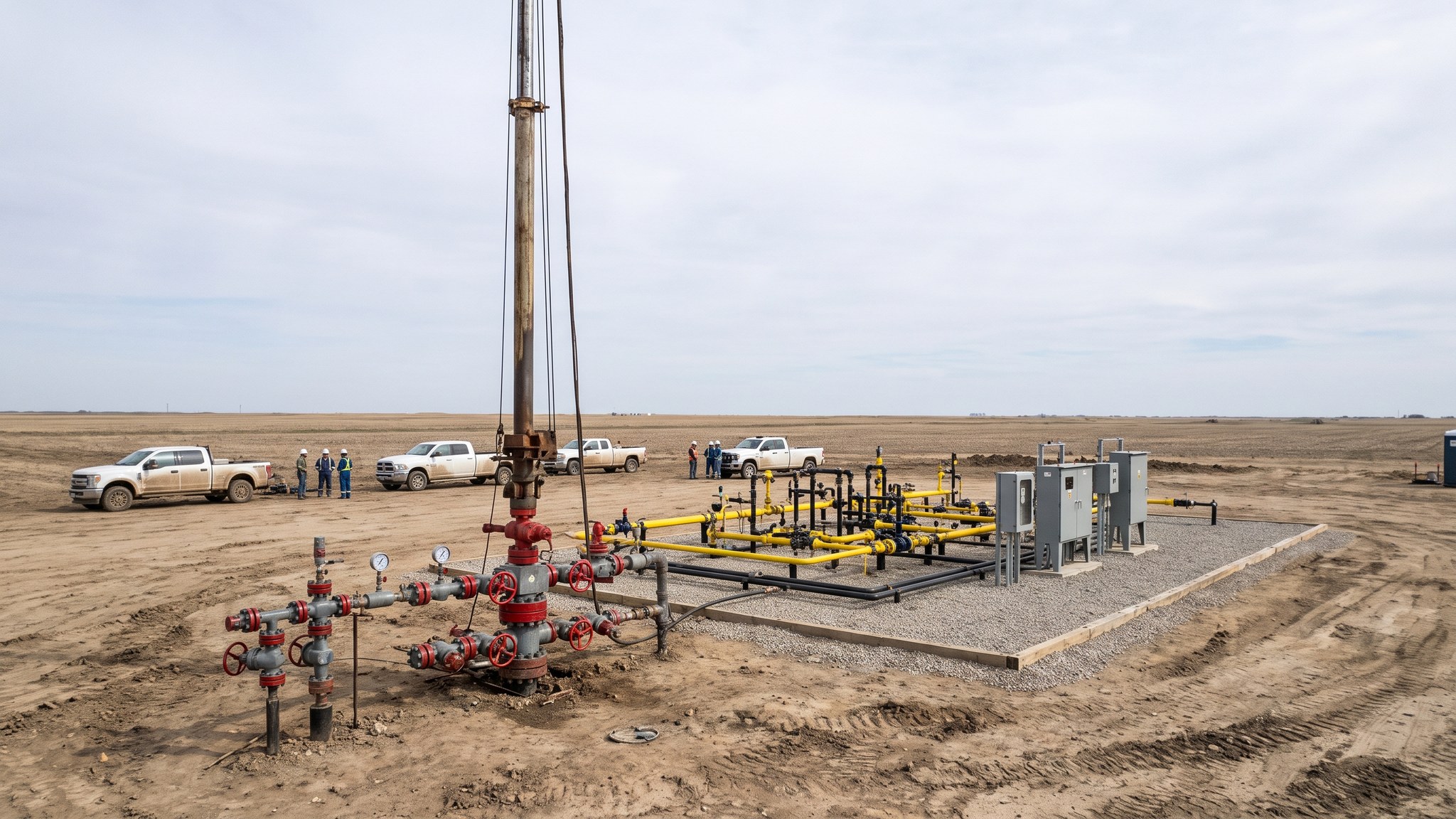
What is Re-used or re-completed legacy well?
Depleted fields have wells in them. Where a storage site is a former hydrocarbon field, there may already be wells penetrating exactly the formation the project wants to inject into, and re-using one avoids the largest single cost in the whole storage scope. Re-entering a legacy well means bringing a rig or an intervention unit back to a well that has been shut in or suspended, opening it up, establishing its condition, and re-completing it for a service it was never designed for. Where it works, the saving against drilling a new well is very large.
The difficulty is that the well is old and it was built for a different purpose. It was constructed to the standards and practices of its time, with the materials available then, for a service that involved taking fluid out rather than putting a different fluid in. It has then spent years or decades in the ground, sometimes shut in with little attention. Its records may be thin. What matters is not what it was but what condition it is in now and whether it can be made fit for a long injection life - and that has to be demonstrated to the regulator with evidence, not argued from the fact that it was a good well once.
There is a further point that makes legacy wells a subject in their own right, independent of whether any are re-used. Every well that penetrates a storage formation is a potential pathway, whether the project uses it or not. So the operator has to know where all of them are, what condition they are in, and whether any of them compromise containment. Assessing legacy wells is therefore part of characterising the site, and re-use is a decision taken within that assessment rather than a separate commercial idea. Sometimes the assessment concludes that a well should be properly abandoned rather than re-used, and that work then becomes part of the project scope with no operational benefit at all - a cost the storage business case has to carry.
How does Re-used or re-completed legacy well work, step by step?
- 1
Step 1: Find every well that penetrates the storage formation
The operator identifies all existing wells within and around the storage site from the available records, including old wells whose documentation may be sparse. Each one is a potential pathway regardless of whether the project intends to use it. Building this register, and being confident that it is complete, is a foundational part of characterising the site and it is scrutinised closely by the regulator.
- 2
Step 2: Assess each well on the record
For each well the operator gathers what is known - when and how it was drilled, what it was built from, what it produced, what interventions it has had, how it was suspended or abandoned and to what standard. The assessment sorts the wells into those that may be usable, those that need remedial work whether or not they are used, and those that are acceptable as they are. The quality of the record is itself a factor, because a well with no reliable history cannot be assumed to be sound.
- 3
Step 3: Select candidates for re-use and plan the intervention
Candidates are chosen on where they are relative to the storage plan and on what the record suggests about their condition. The well engineer plans the re-entry: what will be done, what will be measured, and what the decision points are if the well turns out to be in worse condition than the record suggested. That contingency planning matters, because a re-entry that finds an unexpected problem has to have a defined route to either repair, abandon or walk away.
- 4
Step 4: Re-enter the well and establish its real condition
A rig or intervention unit is mobilised, the well is opened up, and its condition is established by measurement along its length. This is the moment the project finds out whether the assessment was right. The results are compared against the assumptions in the plan and the decision to proceed, to remediate or to abandon is taken on the evidence. Contractually and commercially this is the point of greatest uncertainty in the whole storage scope.
- 5
Step 5: Remediate what the assessment requires
Where the well can be brought up to standard the remedial work is carried out to the well engineer's programme. The extent varies enormously between wells and it is not fully known until the well is open, which is why re-use budgets carry a wider range than new drilling budgets. Where remediation is not viable the well is properly abandoned so that it does not remain a pathway, and the project takes that cost without gaining a well.
- 6
Step 6: Re-complete the well for injection
A well accepted for re-use is re-completed for the injection duty, with the equipment that will remain in the well installed and the wellhead renewed and connected to the surface facilities. The materials and equipment chosen reflect the new service rather than the old one. What the completion consists of is the well engineer's decision within the consented design.
- 7
Step 7: Demonstrate integrity to the regulator
A re-used well has to be shown to be fit for a long injection life, and the evidence is the assessment, the measurements taken at re-entry, the remedial work carried out and the verification testing afterwards. The regulator assesses that package before injection is permitted. The bar is the same as for a new well; only the route to demonstrating it is different, and it is a good deal harder.
- 8
Step 8: Hand over with a monitoring regime that reflects the well's history
The operator takes on the well with a monitoring and inspection regime that is normally more demanding than a new well would carry, and with the whole legacy well register as a continuing obligation - including the wells that were never used. Those obligations run for decades and they are handed over with the evidence base intact, because the operator will need to keep proving the case rather than just having proved it once.
What are the benefits of Re-used or re-completed legacy well?
- Avoids the largest single cost in the storage scope, which is drilling a new well
- Shorter lead time than a new well where a suitable candidate exists in the right place
- Uses infrastructure that already penetrates the target formation
- Intervention units are cheaper and quicker to mobilise than a full drilling rig
- The assessment work has to be done for containment reasons in any case, so re-use builds on it
- Lower material use and disturbance than constructing a new well
What are the limitations of Re-used or re-completed legacy well?
- Real condition is not known until the well is opened, so cost and programme carry wide uncertainty
- Original records are often thin, and a well with no reliable history cannot be assumed sound
- Built for a different service, in a different era, with the materials of the time
- May need extensive remediation, or may prove unusable after the money has been spent finding out
- Wells that cannot be re-used still have to be properly abandoned, at cost and with no operational benefit
- Ongoing monitoring obligations are typically more demanding than for a new well
What is Re-used or re-completed legacy well best suited for?
What plant does Re-used or re-completed legacy well need?
- Drilling rig or well intervention unit sized to the planned scope
- Measurement and inspection equipment for establishing well condition along its length
- Remedial equipment and materials as the well engineer's programme requires
- Completion equipment and a new wellhead with control and safety equipment
- Abandonment equipment for wells that are assessed as unusable
- Marine or onshore logistics support appropriate to the location
How is Re-used or re-completed legacy well quality-checked?
- Complete register of wells penetrating the storage formation compiled and assessed
- Record review documented for each well, with the confidence in each record stated
- Re-entry plan with defined decision points for repair, abandon or walk away agreed before mobilisation
- Condition measurements taken at re-entry, recorded and compared against the assessment assumptions
- Remedial work carried out and recorded to the well engineer's approved programme
- Verification testing completed and assessed against the consented case before injection
- Integrity evidence package submitted to and accepted by the regulator
- Enhanced monitoring regime and the continuing legacy well obligations issued at handover