New purpose-drilled injection well
Drilled for the job by a rig campaign - the most controllable option, and the most expensive.
Last updated 2026-09-06
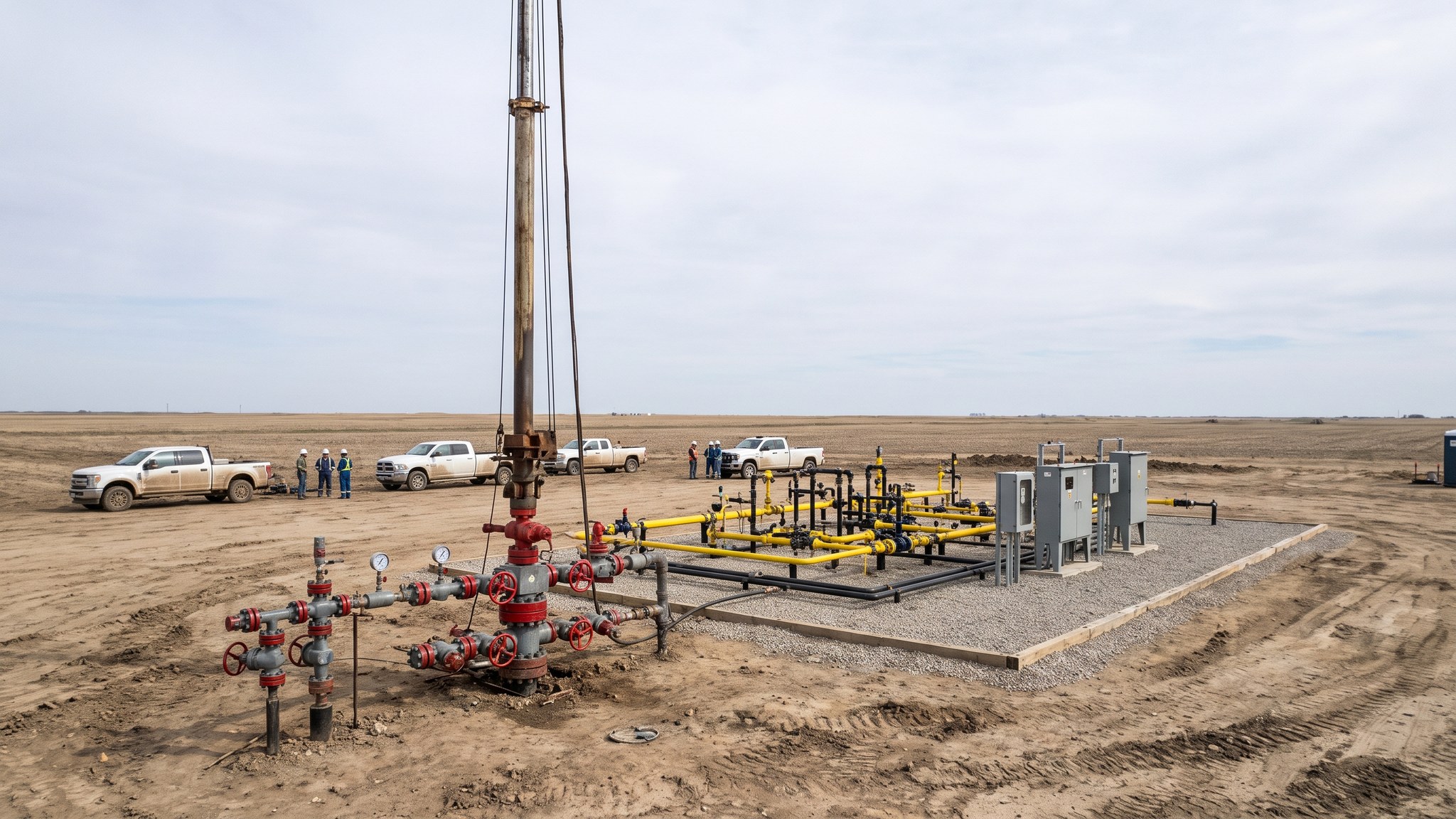
What is New purpose-drilled injection well?
The last link in the chain is the well. A new injection well is drilled specifically for the purpose, which means the well engineer chooses where it goes, how it is oriented, how it is constructed and what is installed in it, all with the injection duty in mind from the first day. Nothing about it is inherited. That is why, where the budget allows, a purpose-drilled well is the option chosen: it gives the operator the greatest confidence that the well will do what the storage plan requires for as long as the plan requires it.
Drilling is a campaign, not a construction activity in the ordinary sense. A rig is contracted, mobilised, and worked continuously - offshore around the clock from a mobile unit or a platform, onshore from a pad built for the purpose. The rig is the most expensive item on the project by the day, so the whole campaign is planned to keep it working and released as soon as it is finished. Where several wells are needed they are normally drilled in one campaign for that reason. The well engineer plans the well from the subsurface data, the drilling contractor executes it, and the regulator has consented the programme beforehand. Construction detail - how the well is built, what goes in it and how it is sealed - is entirely the well engineer's domain and is set out in a consented well design.
For the project team the well campaign is significant because it is where several long threads come together. The subsurface work that identified and characterised the storage site, the consenting and licensing that permits injection, the surface facilities that will deliver the stream, and the monitoring obligations that will run for decades all meet at the wellhead. The campaign also has to be sequenced against the rest of the chain: a completed well with nothing to inject is dead capital, and a completed pipeline with no well to inject into is worse. Getting the well ready at the same time as the capture plant, the conditioning package and the transport route is one of the hardest scheduling problems on a carbon capture project, and it is the reason these projects are managed as programmes rather than as separate contracts.
How does New purpose-drilled injection well work, step by step?
- 1
Step 1: Characterise the storage site and locate the well
The subsurface team characterises the storage formation and the rock above it using seismic data, existing well data and modelling, and predicts how the injected volume will move and where it will stay. The well location and orientation come out of that work. This is a long, iterative, data-heavy exercise, and it is also the evidence base that the storage licence rests on. Everything the well engineer does afterwards is conditioned by it.
- 2
Step 2: Obtain the licence and consent for the well and the storage
Injection is a licensed activity and the well is consented individually. The operator submits the well design and programme, the storage plan, the monitoring plan and the arrangements for the long term, and the regulator assesses them. Consent is not a formality and the conditions attached to it shape the well, the monitoring and the operating regime. On most projects the licensing timetable, not the drilling timetable, decides when the campaign can start.
- 3
Step 3: Design the well for the injection duty
The well engineer designs the well specifically for this service, and every element of that design - the way the well is constructed, the materials used, how it is sealed and what is installed inside it - is selected because of what it will be asked to do for decades. Material selection gets particular attention on this duty. The design is documented, reviewed and consented before the rig is contracted, and it is not adjusted on the rig floor.
- 4
Step 4: Prepare the site or the platform for the rig
Onshore, a pad is constructed with the bearing capacity, drainage, containment, access and services a rig needs, along with the storage and handling areas the campaign requires. Offshore, the arrangement depends on whether a mobile unit or a fixed platform is used, and the marine and logistics support is established. This preparation is ordinary civil and marine construction, and it has to be complete and proven before the rig arrives because rig standby is the most expensive form of delay on the project.
- 5
Step 5: Mobilise and drill the campaign
The rig is mobilised and the well is drilled to the consented programme, working continuously. Progress is monitored against the programme in real time and the data gathered while drilling feeds back into the subsurface model. Where more than one well is required they are drilled in the same campaign to avoid a second mobilisation. The rig is released as soon as its scope is complete, because the day rate does not pause.
- 6
Step 6: Complete the well and install the wellhead
Once drilled the well is completed - the equipment that will be permanently in the well is installed and the well is made ready to accept injection. The wellhead and its control and safety equipment are installed and connected to the surface facilities. What goes into a completion, and why, is the well engineer's decision and part of the consented design. The interfaces to the surface facilities are agreed long before this point so that the connection is a planned operation rather than an improvisation.
- 7
Step 7: Verify the well and establish the baseline
Before injection the well and the storage formation are tested to confirm they behave as the design and the storage plan assumed, and the results are assessed against the consented case. At the same time the baseline monitoring is established - the measurements against which every later monitoring result will be compared. Getting the baseline right matters enormously, because a monitoring obligation lasting decades is only meaningful if there is a proper reference to measure change from.
- 8
Step 8: Commission with the rest of the chain and hand over to operations
The well is brought into service as part of the whole chain rather than on its own - capture, conditioning, transport and injection commissioned together, with the well accepting the stream only when everything upstream can deliver it to specification. Handover transfers a well with a consented operating envelope, a monitoring programme, a reporting obligation and a long-term stewardship plan that outlives the construction contract by decades.
What are the benefits of New purpose-drilled injection well?
- Designed from the outset for the injection duty, with no inherited compromises
- Location and orientation chosen to suit the storage plan rather than to suit an existing well
- Materials and equipment selected specifically for this service
- Complete, modern construction records from day one, which supports the long-term integrity case
- Most controllable option, and the easiest to make a confident regulatory case for
- Several wells can be drilled in one campaign, spreading the mobilisation cost
What are the limitations of New purpose-drilled injection well?
- The most expensive option, dominated by rig day rate and mobilisation
- Long lead time on licensing, consent, rig availability and long-lead equipment
- Offshore campaigns are weather-exposed and rig standby is very costly
- Requires substantial site or platform preparation before the rig can arrive
- Has to be scheduled against the capture plant and the transport route, which are on their own critical paths
- Carries monitoring and stewardship obligations that continue for decades after handover
What is New purpose-drilled injection well best suited for?
What plant does New purpose-drilled injection well need?
- Drilling rig - a mobile offshore unit, a platform rig, or an onshore rig with its camp and support
- Well construction and completion equipment as set out in the consented well design
- Wellhead, control and safety equipment with its connections to the surface facilities
- Onshore pad civils - bearing layer, drainage, containment, access roads and services
- Marine and logistics support, supply vessels and helicopter support for offshore campaigns
- Measurement and testing equipment for well verification and baseline monitoring
How is New purpose-drilled injection well quality-checked?
- Subsurface characterisation and storage plan documented and accepted as the basis for the well location
- Storage licence and well consent obtained, with all attached conditions recorded and carried into the design
- Well design reviewed, approved and consented before the rig is contracted
- Site or platform preparation complete and certified before rig mobilisation
- Drilling executed to the consented programme, with deviations formally assessed and approved
- Well verification testing completed and assessed against the consented case
- Baseline monitoring established and recorded before injection begins
- Operating envelope, monitoring programme, reporting obligations and stewardship plan issued at handover
More injection wells & commissioning methods
Next method
Re-used or re-completed legacy well