Subsea versus platform or onshore wellhead
Where the wellhead sits changes the whole construction, access and intervention picture - it is the decision everything else at the storage end follows from.
Last updated 2026-09-06
What is Subsea versus platform or onshore wellhead?
A well needs a wellhead, and the wellhead has to be somewhere. That single choice - on the seabed, on a platform, or on land - reshapes almost everything about how the storage end of the project is built and operated. It determines the marine or civil scope, the type of contractor, the plant, the programme, the manning, the cost of getting to the well when something needs attention, and how the injection facilities are controlled. It is settled early, and once settled it is very expensive to revisit.
The subsea option puts the wellhead and its control equipment on the seabed, connected back to a host facility or to shore by a pipeline and an umbilical carrying power, control and chemicals. Nothing is manned and nothing is visible. It avoids the enormous cost of a fixed offshore structure and it suits wells that are spread out or far from any host. The trade is access: every intervention needs a vessel and remotely operated equipment, so anything routine has to be designed out and anything unplanned is slow and expensive. Subsea equipment is therefore specified for reliability above almost everything else, and the umbilical - a long, expensive, hard-to-repair item - becomes a critical asset in its own right.
A platform wellhead puts the wells on a fixed structure with the injection facilities on it or beside it. It costs a great deal to build and install, but it gives direct access to the wells, allows intervention with equipment on the structure rather than from a vessel, and lets the facilities be maintained conventionally. It only makes sense where several wells can share it or where an existing structure can be reused. An onshore wellhead is different again: the wellhead sits in a fenced compound on land, and everything about it is cheap and easy by comparison - road access, ordinary plant, ordinary maintenance crews, intervention arranged in days rather than campaigns. Where the storage formation can be reached from land, that is decisive. What replaces the marine difficulty is a land one: planning, neighbours, and a compound that has to be secure, discreet and acceptable in its setting for the several decades it will be there.
How does Subsea versus platform or onshore wellhead work, step by step?
- 1
Step 1: Establish where the storage formation can be reached from
The subsurface work determines where the wells must penetrate the formation, and the well engineer establishes what surface locations can reach those points. Sometimes a formation under the sea can be reached from land or from an existing structure; sometimes it cannot. This is the first filter and it often narrows the choice to one option before any commercial comparison is made.
- 2
Step 2: Compare the options on whole-life cost, not capital cost
The comparison weighs capital cost against the cost of access over decades. A platform is expensive to build but cheap to work on. A subsea arrangement is cheaper to install but every intervention is a campaign. An onshore compound is cheapest on both counts where it is available at all. The operator, the well engineer and the facilities designer evaluate the options together against the expected number of wells, the expected intervention frequency and the monitoring obligations that will run long after injection stops.
- 3
Step 3: Fix the control and umbilical philosophy
How the wells will be controlled follows from where they are. Subsea wells need an umbilical carrying power, control and chemical supply from the host or from shore, and that umbilical is a long-lead, high-value, difficult-to-repair item that has to be routed, protected and installed with the same care as the pipeline. Platform and onshore wellheads are controlled locally with conventional systems. This decision shapes the electrical, control and safety design for the whole storage end.
- 4
Step 4: Design the wellhead arrangement and its protection
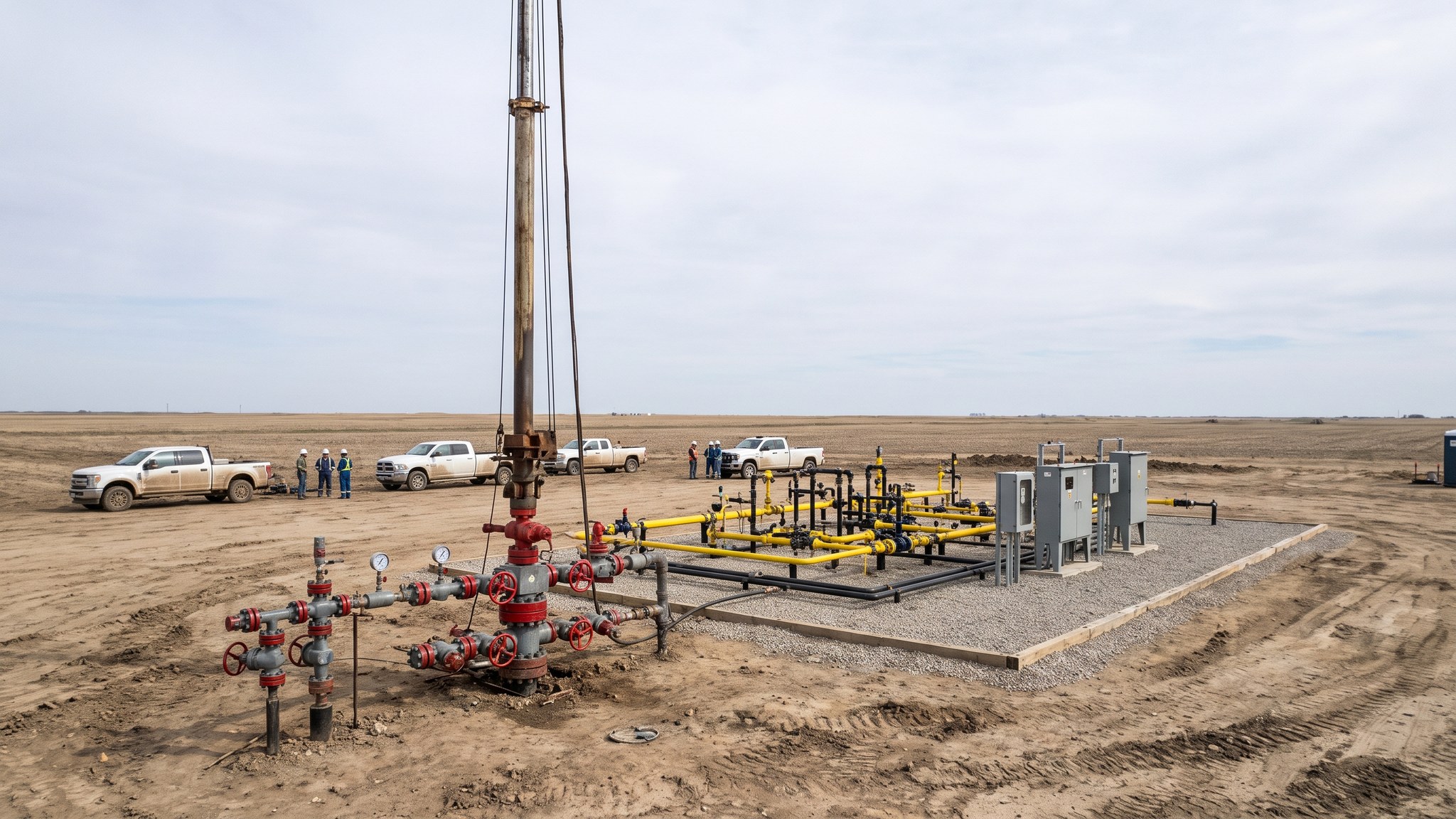
A subsea wellhead needs structures and protection against trawling and dropped objects, and it needs to be laid out so remotely operated equipment can reach everything it might have to. A platform wellhead needs deck space, structural provision and safe access for the crew. An onshore wellhead needs a compound with security, containment, hardstanding and services. Each is a different design discipline, and the choice made earlier determines which one the project needs.
- 5
Step 5: Build or install the host arrangement
Construction diverges completely at this point. Subsea equipment is fabricated, tested onshore and installed from a vessel. A platform is fabricated in a yard, transported and installed offshore, or an existing structure is modified for the new duty. An onshore compound is ordinary civil construction with foundations, hardstanding, drainage, fencing and services. The contractor base, the plant and the programme risk are entirely different in each case.
- 6
Step 6: Install and connect the wellhead
The wellhead and its control equipment are installed and connected to the pipeline and to the control system. Subsea installation and tie-in is a planned marine operation with remotely operated equipment and a weather window; platform and onshore connection is conventional mechanical and electrical work. In every case the interface between the well and the facilities is agreed long in advance, because it is where two different design teams and often two different contracts meet.
- 7
Step 7: Prove the control, safety and intervention arrangements
Before injection the control and safety systems are proven end to end - from the wellhead to wherever the operator sits. For subsea arrangements that includes proving the umbilical and the remote control, and demonstrating that the planned intervention methods actually work with the installed layout. For platform and onshore arrangements it includes proving the local safety systems and access. Discovering an access problem after the equipment is on the seabed is not recoverable.
- 8
Step 8: Hand over with the intervention strategy defined
The operator inherits the wellhead with an intervention strategy that matches its location - what can be done without a vessel or a rig, what triggers mobilising one, what the expected lead time is, and what spares are held against it. A subsea arrangement lives or dies on how well that strategy has been thought through, because the alternative to a plan is an unplanned campaign at short notice. Onshore, the same discipline applies with far lower stakes.
What are the benefits of Subsea versus platform or onshore wellhead?
- Subsea: avoids the capital cost of a fixed structure and suits wells spread over a wide area
- Subsea: no manning, no visual presence and no structure to maintain above water
- Platform: direct access to the wells, with intervention possible from the structure itself
- Platform: facilities can be maintained conventionally and several wells can share one host
- Onshore: lowest cost by a wide margin, with road access and ordinary maintenance crews
- Onshore: intervention arranged in days rather than as a marine campaign
What are the limitations of Subsea versus platform or onshore wellhead?
- Subsea: every intervention needs a vessel and remotely operated equipment, so it is slow and expensive
- Subsea: the umbilical is a long-lead, high-value asset that is difficult to repair
- Platform: very high capital cost, only justified where several wells or an existing structure are available
- Platform: manning, marine access and structural maintenance for the life of the site
- Onshore: only available where the formation can be reached from land
- Onshore: planning, neighbours and long-term acceptability of a compound that will be there for decades
What is Subsea versus platform or onshore wellhead best suited for?
What plant does Subsea versus platform or onshore wellhead need?
- Subsea wellhead, control module, protection structures and the umbilical, with installation and tie-in vessels
- Remotely operated equipment for installation, inspection and intervention
- Platform structure fabricated in a yard, with transport and installation spread, or modification works to an existing structure
- Onshore compound civils - foundations, hardstanding, drainage, containment, fencing and services
- Wellhead control and safety systems appropriate to the location
- Communications and power infrastructure linking the wellhead to the control point
How is Subsea versus platform or onshore wellhead quality-checked?
- Location options assessed on whole-life cost including intervention, with the decision recorded
- Control and umbilical philosophy fixed and its implications carried into the electrical and safety design
- Subsea equipment factory tested and integration tested onshore before installation
- Umbilical routing, protection and installation surveyed and recorded as built
- Protection structures and remotely operated equipment access verified against the intervention plan
- Wellhead to facilities interface agreed between the well and facilities teams before installation
- Control and safety systems proven end to end from wellhead to control point before injection
- Intervention strategy, expected lead times and spares holding documented and issued at handover