Post-mounted and wall-mounted slower units
Cheap, small and unobtrusive - the destination and workplace answer, where the vehicle is parked for hours anyway.
Last updated 2026-09-06
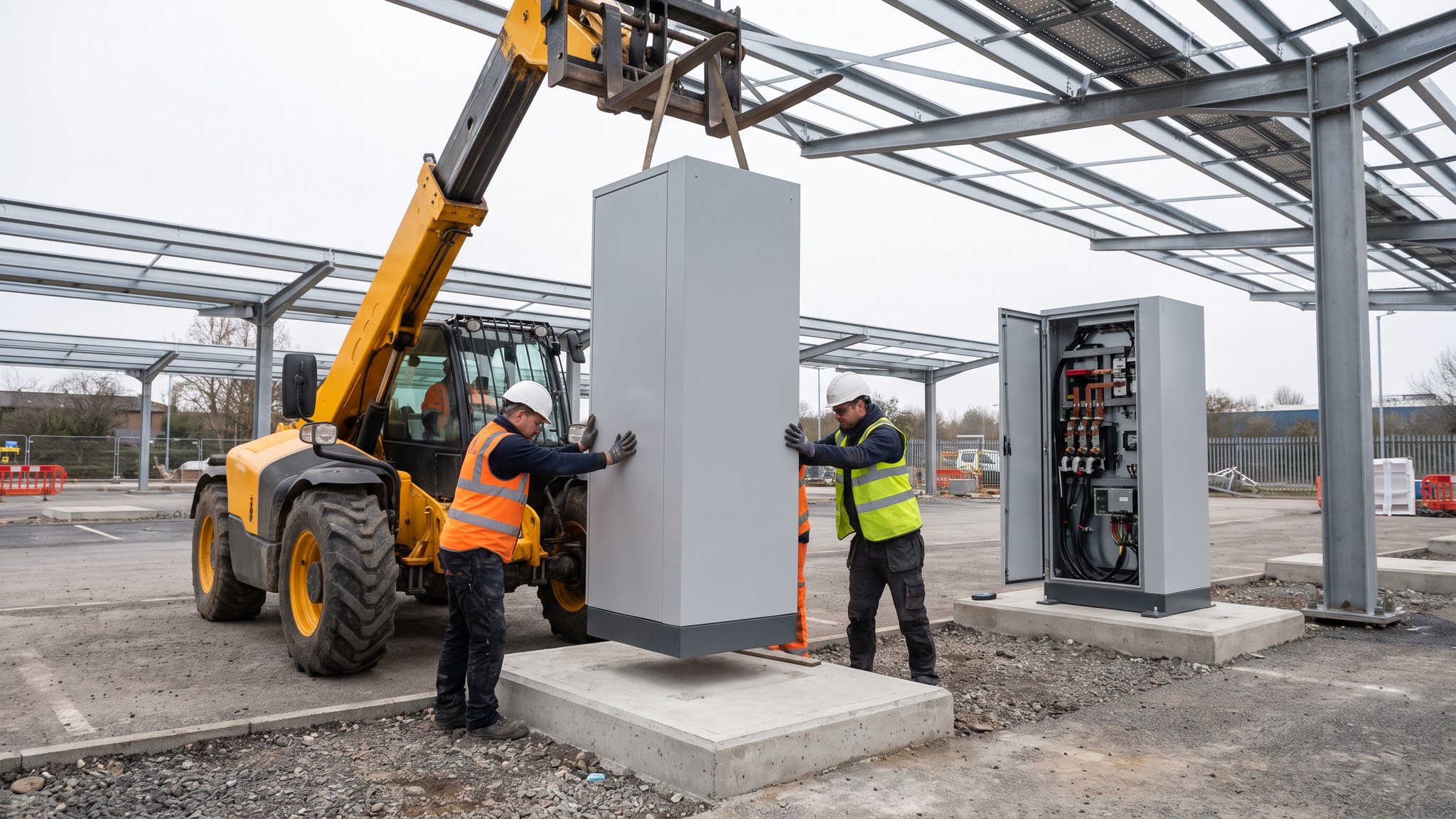
What is Post-mounted and wall-mounted slower units?
Post-mounted and wall-mounted units are the quiet majority of charging equipment. They are small enclosures, typically holding a few kilograms rather than a few hundred, fixed either to a slim post at the head of a bay or directly to a wall, a column or a structure behind it. They deliver alternating current to the vehicle and leave the conversion to the equipment on board, which is why they are so much simpler and smaller than a rapid unit. Outputs on most projects sit in the order of 7 kW for a single-phase unit and around 22 kW where a three-phase supply is available, and the vehicle's own on-board equipment often caps what it will actually accept below the rating of the unit.
The logic of the arrangement is dwell time. A vehicle parked at a workplace for a working day, at a hotel overnight, at a leisure centre for an evening or in a residential parking court until morning does not need to be charged in twenty minutes. It needs to be charged by the time the driver comes back. Once that is accepted, everything gets cheaper: the supply requirement per bay drops enormously against a rapid unit, the equipment costs a fraction as much, the civils are minor, the units are quiet and small enough to disappear into a car park, and a large number of bays can be provided from a supply that would have served only one or two fast bays. That is why the great majority of charging bays being installed are of this kind, even though the ones people notice are the rapid units on the forecourt.
The limitations follow from the same logic. These units are useless to a driver who needs to leave in half an hour, so they suit destinations and not journeys. Even at low output, a car park full of them still adds up to real demand, so the supply capacity and how the units behave when many are in use together are design questions from the first day rather than the last. Wall mounting brings its own considerations - the substrate has to be capable of carrying the unit and the pull of a cable, the fixing has to suit it, and on any building where the fabric is protected or the wall performs a fire or weather function the fixing arrangement is the designer's decision. Post mounting brings a base, a duct and impact protection. Cable management is the everyday problem: leads left trailing across bays and footways are the commonest complaint on sites like these, and the answer is designed in rather than added afterwards.
How does Post-mounted and wall-mounted slower units work, step by step?
- 1
Step 1: Set the bay strategy and the number of units
The client decides how many bays are being provided now and what proportion of the car park is to be made ready for later, and the designer sizes the supply and the distribution to match. Providing ducting and capacity for future bays during the same works is far cheaper than returning to dig up a finished car park, and on most projects it is the single best value decision made. Accessible bay provision, the routes to and from those bays and the layout around them are set by the designer against the standards applying to the project.
- 2
Step 2: Survey the supply, the structure and the routes
The existing supply and its spare capacity are established, along with the distribution arrangement inside the building or across the car park. Where units are to be wall or column mounted, the substrate is surveyed for what it is made of and what it can carry, and any protected fabric, weathering layer or fire-rated construction is identified so the designer can settle the fixing arrangement. Cable routes are walked, existing containment is assessed for spare capacity, and buried services are traced on any route that will be excavated.
- 3
Step 3: Install distribution and containment
Distribution is run from the point of supply out to the bays, in existing containment where there is room, in new surface containment in a multi-storey or covered car park, or buried in ducts across an open car park. Runs are planned so that later bays can be picked up without opening up the works again. Containment in a car park is exposed to vehicle impact, water and cleaning, so its position and its fixing are chosen with that in mind rather than for the shortest route.
- 4
Step 4: Fix the units - post or wall
Posts are set on a small designed base with cast-in ducting and given whatever impact protection the layout calls for. Wall-mounted units are fixed to the arrangement the designer has specified for that substrate, at a mounting position that suits the users of the bay and keeps the unit clear of vehicle contact. Every penetration through an external wall is made good and weathered properly, and any penetration through fire-rated construction is sealed by the appropriate trade. Cheap fixings and unsealed penetrations are the two defects that come back on this type of installation.
- 5
Step 5: Terminate, protect and prepare for commissioning
Final connections, protective arrangements and earthing are designed by the designer and carried out by competent qualified electrical people under the principal contractor's regime. Communications are installed and proved, whether by fixed cabling or by a wireless arrangement, and signal coverage in a basement or a steel-framed car park is checked before the units are closed up rather than discovered to be absent at commissioning.
- 6
Step 6: Solve cable management and bay marking
A trailing lead across a bay or a footway is the defect users report most often, so cable holsters, retractors, hooks or an overhead arrangement are designed in and installed as part of the works. Bays are marked, signage installed and lighting confirmed as adequate for someone plugging in after dark. In a covered or basement car park, headroom, drainage and ventilation are checked against what the design assumed.
- 7
Step 7: Phase around a car park that stays open
Workplace and destination car parks rarely close, so the works run bay by bay or row by row behind barriers, with pedestrian routes maintained and reinstatement completed as each section finishes. Because each unit is small and quick to install, the phasing is usually easier than on a rapid charging project, but the coordination with the occupier over their parking demand is just as necessary.
- 8
Step 8: Hand over for commissioning and for operation
The installation is presented for electrical commissioning and functional testing, carried out by competent qualified people. The handover pack covers the unit positions and identifiers, the distribution arrangement, the containment and duct routes, the fixing details on any wall-mounted unit, the ducting and capacity left for future bays, and the product documentation. On a large car park the mapping of unit identifier to bay number is what the operator will rely on for the rest of the installation's life, so it is worth getting right.
What are the benefits of Post-mounted and wall-mounted slower units?
- Low cost per bay in both equipment and civils, so a large number of bays can be provided
- Modest supply demand per unit, which suits sites with limited spare capacity
- Small and quiet, disappearing into a car park where a rapid unit would dominate it
- Wall and column mounting avoids a base and keeps the bay itself completely clear
- Well matched to long dwell times at workplaces, hotels, leisure sites and residential parking
- Simple to install, to replace and to extend, especially where ducting was laid for future bays
What are the limitations of Post-mounted and wall-mounted slower units?
- Far too slow for a driver who needs to leave shortly - no use as journey charging
- Actual charging speed is often capped by the vehicle rather than by the unit
- A car park full of units still adds up to significant demand, so supply capacity must be designed for the whole
- Wall mounting depends on the substrate, and protected, weathering or fire-rated construction constrains the fixing
- Trailing leads and poor cable management are the most common user complaint
- Exposed units in public car parks are vulnerable to impact, vandalism and cable theft
What is Post-mounted and wall-mounted slower units best suited for?
What plant does Post-mounted and wall-mounted slower units need?
- Small excavator or breaker for post bases and for any buried distribution
- Access equipment for wall and column mounting at height in car parks
- Drilling and fixing equipment suited to the substrate, with sealing and making-good materials
- Containment installation gear for surface-run distribution in covered car parks
- Ducting, draw pits and service location equipment for open car park routes
- Line marking and signage equipment, barriers and pedestrian management for phased working
How is Post-mounted and wall-mounted slower units quality-checked?
- Substrate and fixing arrangement confirmed with the designer before any wall-mounted unit is installed
- External and fire-rated penetrations sealed and recorded by the appropriate trade
- Containment and duct routes recorded, with spare capacity for future bays documented
- Unit identifier mapped to bay number and recorded, and the mapping verified on site
- Cable management, bay marking, signage and lighting inspected as a set before handover
- Communications coverage proved at every unit position before enclosures are closed