Open-cut trenching and reinstatement
The default way to get cable across a site - and a running argument with buried services, traffic and the surfaces you have to put back.
Last updated 2026-09-06
What is Open-cut trenching and reinstatement?
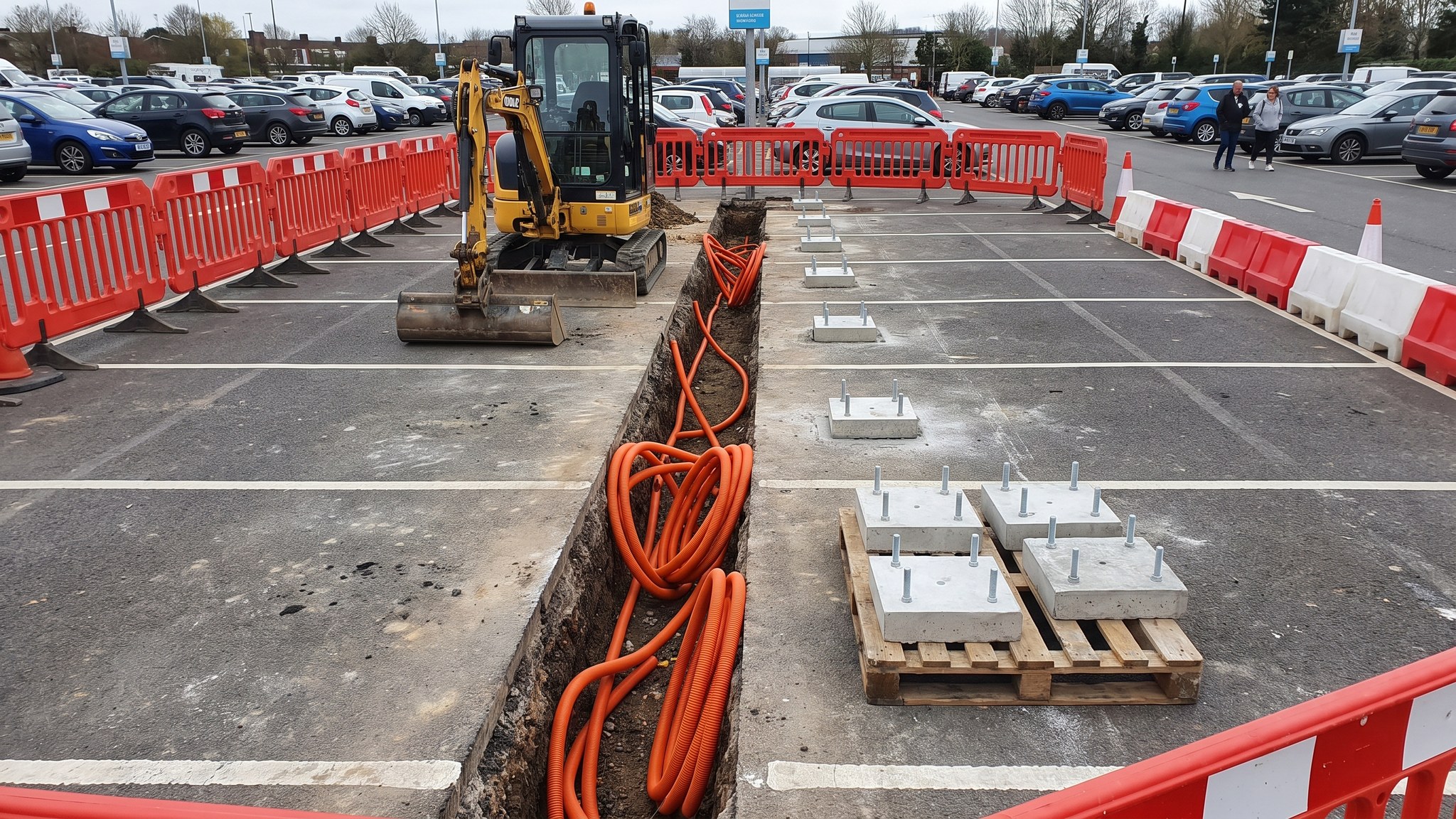
Open-cut trenching is the standard method of running cable and ducts from the intake or substation to the charging bays. A trench is excavated along the designed route, ducts and cables are installed with their bedding, surround and marker tape to the specification, the trench is backfilled in compacted layers and the surface is reinstated. It is well understood, needs no specialist plant beyond a small excavator, and it is by a wide margin the cheapest way of moving cable across open ground. On a car park being built from scratch it is barely worth discussing - the ducts go in before the surfacing and nobody notices.
On an operational site it is a different proposition. Charging infrastructure is usually retrofitted into a live forecourt, car park or depot that has to keep trading, and an open trench across it takes away parking, blocks routes, and puts an excavation next to moving vehicles and pedestrians. The works therefore become as much an exercise in traffic management and phasing as in groundworks. Routes are often driven by what can be closed rather than by what is shortest, and the programme is built around trading hours, delivery windows and the periods when the site is quiet.
The dominant hazard is what is already buried. Existing sites are full of electrical, water, drainage, gas and communications services, and the records for them are frequently incomplete, out of date or simply wrong. Striking a buried service can kill. Work near buried services is therefore treated as work for competent people under a permit system, using service records, detection equipment and safe digging practice, with the arrangements set by the designer and the site's own procedures. Reinstatement is the other running cost: putting back a surface so that it matches, drains and lasts is skilled work, and on a highway or a customer forecourt it is judged by an unforgiving audience.
How does Open-cut trenching and reinstatement work, step by step?
- 1
Step 1: Design the route around the constraints
The route is chosen from the intake or substation to the charging bays, and the shortest line is rarely the right one. The designer weighs the known and suspected buried services, the surfaces to be crossed and what each costs to reinstate, the trees and their root protection, the drainage falls, and the parts of the site that cannot be closed at all. Crossings of roads and high-value surfaces are identified, since those are the points where a trenchless method may earn its keep. The route is drawn, agreed with the site operator and marked out.
- 2
Step 2: Establish what is buried before anything is opened
Service records are obtained for every utility that may be present, and they are treated as an indication rather than the truth. Detection equipment is used to trace and mark what is actually there, and trial holes are dug by hand or by vacuum excavation to confirm the position of anything the route approaches. Marking is transferred to the ground and to the drawings, and it is refreshed as it wears off. This is work for competent people under permit, and no mechanical excavation starts in the vicinity of a known or suspected service without that permit in place.
- 3
Step 3: Set up the traffic management and the working area
The working area is separated from vehicles and pedestrians by barriers that suit the site, with signed diversions for both. On a forecourt or a car park that means agreeing with the operator which bays and which routes are lost and for how long, and pedestrian routes are designed to be usable rather than merely marked. Where the works reach the highway, the arrangements follow the permissions granted for that work. The layout is checked at night and in the wet, because that is when the temporary arrangement is tested hardest.
- 4
Step 4: Excavate the trench
The surface is cut cleanly along the marked lines and the excavation proceeds to the depth and width the specification requires. Arisings are separated so that material fit for reuse is kept and the rest is removed. Any support to the sides of the excavation, and the arrangements for people working in or near it, are designed for the particular trench by a competent person and are not a matter of site custom. Hand digging is used wherever a service is known to be close. Spoil is kept back from the edge, and the open length is limited to what can be closed the same shift.
- 5
Step 5: Install ducts and cables with bedding and protection
Ducts and cables are laid on the bedding material the specification calls for, surrounded and protected as specified, and marked with tape or tiles so that the next person to dig here finds a warning before they find a cable. Draw ropes are left in every spare duct. Separations between services, and the depth and cover for each, come from the specification for the particular route and are checked before backfilling. Duct ends are sealed against water and vermin immediately, because an open duct end fills with silt within days on a working site.
- 6
Step 6: Backfill and compact in layers
Backfill is placed in layers of the thickness the specification allows and compacted, with the material appropriate to what sits above - a trafficked car park has different requirements from a grass verge. Compaction is the step that decides whether the reinstatement settles, and a trench that is filled in one lift will announce itself as a trough within a season. Records are kept of material, layer thickness and compaction, since the reinstatement is often subject to inspection long after it has been covered up.
- 7
Step 7: Reinstate the surface to match
Reinstatement puts back the construction that was there, in the layers specified, finished to line and level and drained so that water runs where it did before. Where the surface is a highway, reinstatement follows the requirements attached to the permission for the works and is subject to inspection. Where it is a customer-facing forecourt, appearance matters commercially as well as technically, and a patched surface that looks like a patch is a complaint waiting to happen. Line marking, tactile paving and any other surface features are replaced.
- 8
Step 8: Record what was installed and where
The as-built position of every duct and cable is surveyed before it is covered, not sketched afterwards. That record - route, depth, what is in each duct, which ducts are spare and where the draw ropes are - is the single most valuable document the civils package produces, because it is what makes the next phase of the site affordable. Duct proving with a mandrel and rope, before the electrical contractor arrives, closes out the work and finds any collapse or blockage while the plant is still on site.
What are the benefits of Open-cut trenching and reinstatement?
- The cheapest and most familiar way of moving cable across a site
- Needs only small general plant, so it can be resourced quickly and by most contractors
- The trench is open and visible, so what is installed can be inspected before covering
- Easy to install multiple ducts and spare capacity at negligible extra cost
- Route and depth can be adjusted on the ground when an obstruction is found
- Straightforward on new-build sites where ducts go in before the surfacing
What are the limitations of Open-cut trenching and reinstatement?
- Takes the surface out of use, which on a trading site means lost bays and blocked routes
- Carries the serious hazard of striking unknown or mis-recorded buried services
- Reinstatement is a significant cost, and on high-value surfaces it can exceed the excavation
- Poorly compacted backfill settles, leaving a trough and a long-term maintenance liability
- Weather-dependent, with open trenches in wet ground quickly becoming unworkable
- Not practical under roads, structures or mature trees where the surface cannot be opened
What is Open-cut trenching and reinstatement best suited for?
What plant does Open-cut trenching and reinstatement need?
- Tracked or wheeled excavator sized to the trench, with a banksman
- Vacuum excavation unit and hand tools for trial holes and work near services
- Cable avoidance tools and ground penetrating detection equipment
- Compaction plant appropriate to the layer thickness and the material
- Dumpers, muck-away transport and stockpile management for arisings
- Barriers, signing and traffic management equipment for a live site
How is Open-cut trenching and reinstatement quality-checked?
- Service records obtained, detection carried out and trial holes confirming position before excavation
- Permit to dig in place, with safe digging practice applied near every known service
- Bedding, surround, marker tape and separations checked against the specification before backfill
- Backfill placed in specified layers with compaction recorded
- Ducts proved with mandrel and draw rope, and every duct end sealed
- As-built survey of route and depth completed before covering, and issued with the handover
More civils & groundworks methods
Next method
Trenchless crossings