Trenchless crossings
Getting under a road, a forecourt or a landscaped area without opening it up, where the reinstatement would cost more than the crossing.
Last updated 2026-09-06
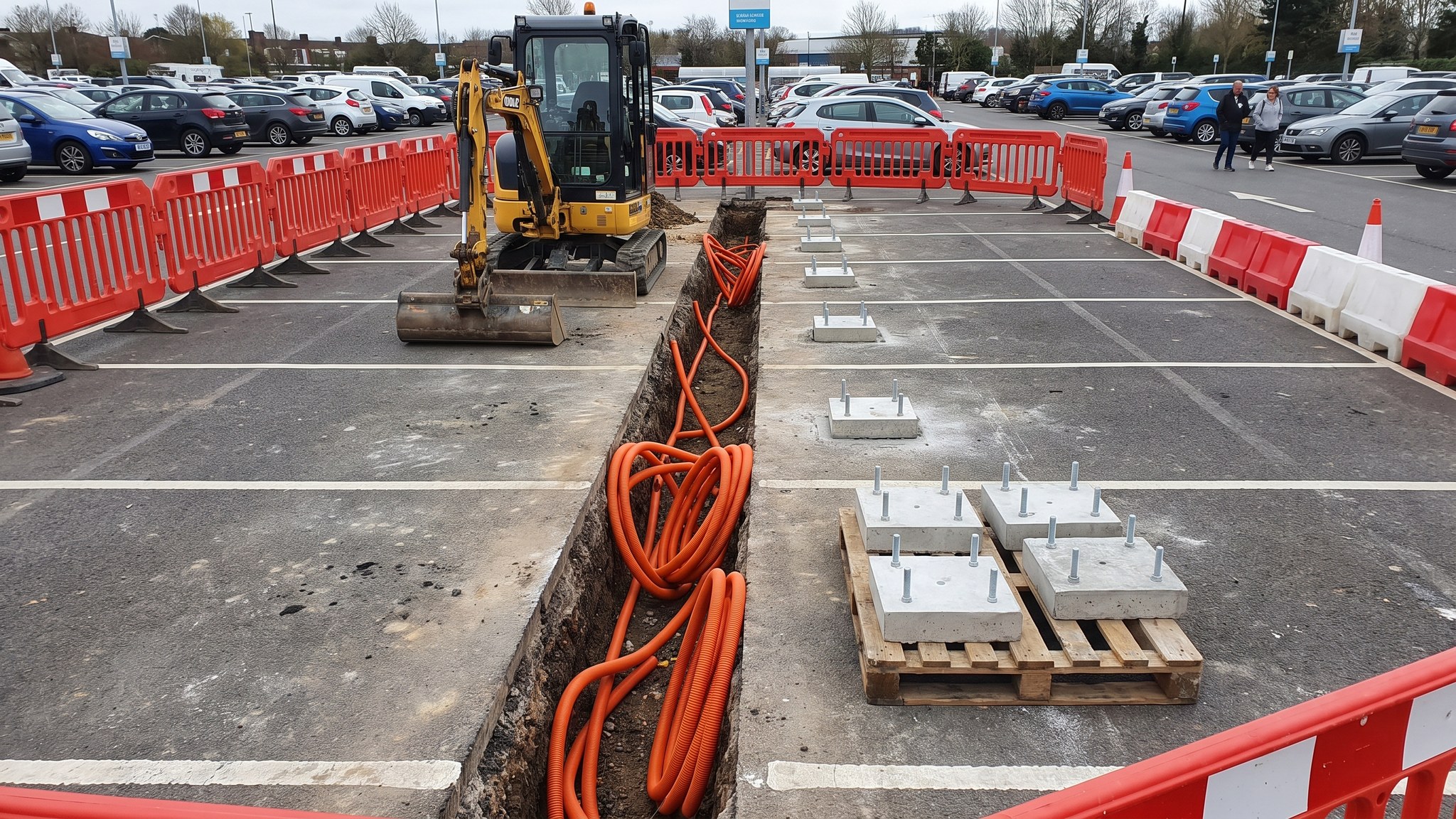
What is Trenchless crossings?
Trenchless crossing installs a duct beneath an obstacle without excavating along its length. A launch pit is dug on one side and a reception pit on the other, and the duct is driven, bored or pulled between them. The surface in between is never opened. On charging projects the obstacle is usually a road, an access route that cannot be closed, a customer forecourt whose surfacing is expensive and conspicuous, a landscaped area with mature trees, or a rail or watercourse crossing where opening up is not an option at all.
The economics are simple to describe and easy to misjudge. Trenchless work costs more per metre than open-cut and needs specialist plant and crews. It saves money only when what it avoids - reinstatement, closure, disruption, lost trade, or the impossibility of getting permission to dig at all - exceeds that premium. On a short crossing of a cheap surface it does not pay. On a crossing of a busy access road serving an operating site, or under a forecourt canopy that would otherwise have to close, it very often does. The decision is made route by route rather than for the project as a whole, and a typical scheme uses open-cut for most of the run with trenchless only at the crossings.
The risk profile is different rather than lower. There is no open trench and no long exposure of the public to the works, but the bore is blind. Buried services along the line of the crossing cannot be seen, so they have to be located and confirmed before the bore starts, and the depth and alignment of the crossing are set to avoid them. Ground conditions govern which technique is feasible, and obstructions, made ground and boulders can stop a bore or push it off line. On most projects a ground investigation along the crossing is money well spent, because a bore abandoned halfway is an expensive thing to recover from.
How does Trenchless crossings work, step by step?
- 1
Step 1: Decide crossing by crossing whether it is justified
The designer identifies each point on the route where open-cut is expensive, disruptive or impossible, and prices the alternatives. What is being compared is the trenchless premium against the reinstatement, the closure, the traffic management and the commercial cost of disruption. Some crossings are decided by permission rather than by cost, where the owner of the road, the railway or the watercourse will not allow it to be opened. The output is a schedule of crossings with a method chosen for each, not a blanket decision.
- 2
Step 2: Investigate the ground along the line
The technique that can be used depends on what is under the obstacle. Boreholes or probes along the crossing establish the strata, the water level and whether obstructions, made ground or boulders are present. Made ground is the usual difficulty on developed sites, because it is unpredictable and full of the remains of previous construction. The investigation also confirms the depth at which a clean bore is achievable. A crossing designed without this information is a gamble on ground nobody has looked at.
- 3
Step 3: Locate every service the bore will pass
A blind bore cannot see what it is heading towards, so everything in its path is located beforehand. Records are obtained, detection is carried out from the surface, and trial holes are dug to confirm the position and depth of anything crossing the line. The alignment and depth of the bore are then set to pass clear of them by the separation the designer requires. Where a service cannot be confidently located, the crossing is redesigned rather than attempted. Work near buried services remains permit-controlled work for competent people throughout.
- 4
Step 4: Choose the technique to suit the ground and the crossing
Short straight crossings in reasonable ground are commonly made by impact moling or by thrust boring, which drive or push a duct or casing through. Longer crossings, or those needing a controlled path around obstacles, use directional drilling, where a steerable head is tracked from the surface and a pilot bore is then reamed and the duct pulled back through. Auger boring suits larger diameters in suitable ground. The choice belongs to the specialist contractor and follows the ground, the length, the diameter and the accuracy required.
- 5
Step 5: Construct the launch and reception pits
Pits are excavated at each end, sized for the plant and for the people working in them, and positioned clear of the surface being protected. The support to the sides of these excavations, and the arrangements for working in them, are designed by a competent person for the particular pit. Access, edge protection, pumping and the means of escape are all part of that design. The pits are frequently the only open excavation on the crossing, and they take the safety attention that would otherwise be spread along a trench.
- 6
Step 6: Drive the bore under control
The bore proceeds with its position monitored - by locating the head from the surface on a directional drill, or by controlling line and level of the drive on a thrust bore. Progress, alignment and any resistance encountered are recorded. Where the bore deviates or meets an obstruction, it is stopped and assessed rather than forced, because forcing a bore is how services get struck and how surfaces above get heaved. Where drilling fluid is used, its containment, recovery and disposal are arranged before the bore starts.
- 7
Step 7: Install and prove the duct
The duct or casing is pulled or pushed into the completed bore, with draw ropes installed and every end sealed. The duct is then proved along its full length with a mandrel and rope to confirm it is clear, continuous and of full bore. Installing spare ducts on the same crossing costs very little at this stage and is worth a great deal later, because repeating a trenchless crossing to add a single duct is out of all proportion to the value of that duct.
- 8
Step 8: Monitor the surface, then record the crossing
The surface above the crossing is checked for settlement or heave during the bore and afterwards, particularly where the crossing passes beneath a road, a structure or anything sensitive. Pits are backfilled and compacted in layers and their surfaces reinstated. The as-built alignment and depth of the crossing are surveyed and recorded, and this record matters more than most, because a trenchless duct leaves no trace on the surface between the pits and is otherwise entirely invisible to whoever digs here next.
What are the benefits of Trenchless crossings?
- The surface between the pits is never opened, so reinstatement is limited to the pits
- Roads, access routes and forecourts stay open, which protects trade and reduces disruption
- The only practical method where permission to open the surface will not be granted
- Avoids damage to mature trees and their roots, and to high-value landscaped areas
- Much shorter exposure of the public to open excavation than an equivalent open-cut route
- Spare ducts can be installed on the same crossing at very little additional cost
What are the limitations of Trenchless crossings?
- Costs more per metre than open-cut, so it only pays where it avoids a larger cost
- The bore is blind, so undetected services along the line remain a serious hazard
- Ground conditions govern feasibility, and obstructions can stop or divert a bore
- Needs specialist plant and crews, which affects both cost and availability
- Launch and reception pits are still excavations needing designed support and safe access
- A crossing that fails partway is expensive and disruptive to recover
What is Trenchless crossings best suited for?
What plant does Trenchless crossings need?
- Directional drilling rig with surface locating equipment, or an impact mole or thrust bore rig
- Drilling fluid mixing, containment and recovery equipment where fluid is used
- Excavator and support system for the launch and reception pits
- Vacuum excavation and detection equipment for locating services along the line
- Winches and duct handling equipment for installation and proving
- Survey equipment for as-built alignment and for monitoring the surface above
How is Trenchless crossings quality-checked?
- Ground investigation along the crossing completed before the technique is fixed
- All services along the line located and confirmed by trial hole, with clearances set by the designer
- Pit support and access designed by a competent person for the particular excavation
- Bore alignment monitored and recorded throughout, with a stop-and-assess rule on deviation
- Duct proved full bore with mandrel and rope, draw ropes left and ends sealed
- Surface monitored for settlement or heave, and as-built alignment and depth surveyed and issued