Back-office, load management and remote operation proving
Proving the site reports, updates and can be run from somewhere else - the difference between a network and a pile of chargers.
Last updated 2026-09-06
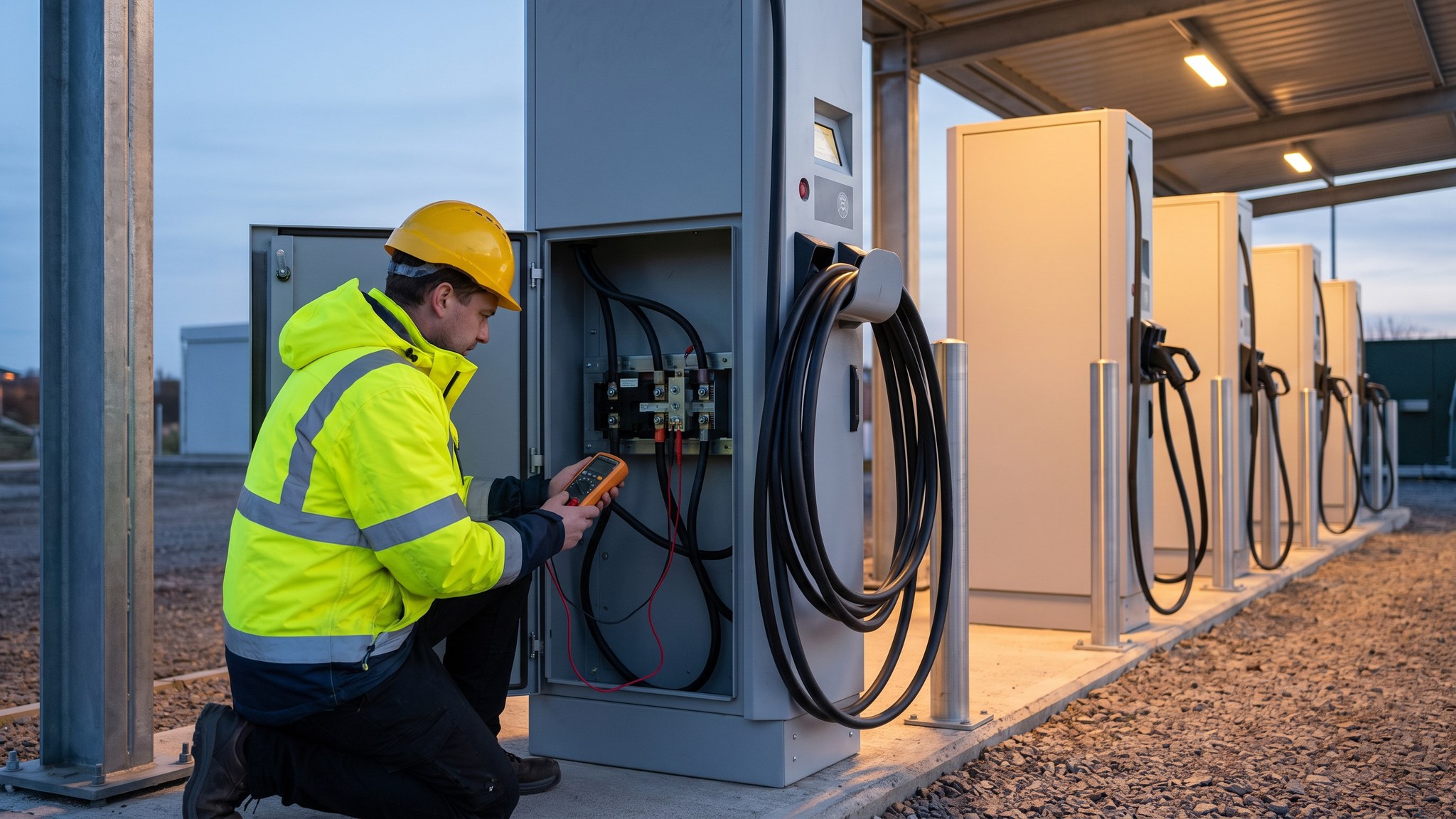
What is Back-office, load management and remote operation proving?
A charging site is not operated by anybody standing next to it. It is operated remotely, through a management system that shows which bays are available, which are faulty, what each one is doing and how much energy the site is drawing, and that can start, stop, reset, reconfigure and update the equipment without anyone attending. Proving that this works is a distinct commissioning exercise, and it is the one that separates a manageable network from a collection of chargers that somebody has to drive to whenever anything goes wrong.
There are three things being proved. The first is reporting: that every unit appears in the system with the right identity, in the right position, showing the right status, and that a change on site appears remotely within a sensible time. The second is control: that a bay can be started, stopped, reset and taken out of service from the management system, and that firmware and configuration can be updated remotely without attending. The third is load management, which on most sites is the one that really matters. Where the supply capacity is less than the sum of what every bay could draw at once - and that is the normal condition, not the exception - the system has to limit the total draw by allocating what is available between the vehicles present. Proving that this behaves as designed, under real simultaneous load, is the whole reason the site can have as many bays as it has.
The proving depends entirely on connectivity, so that is the first thing tested and the first thing that fails. Signal strength in a basement car park, behind a steel-framed canopy or on a rural forecourt is checked at every unit position, and where a wireless arrangement is marginal a fixed connection is installed instead. Beyond connectivity, this stage also settles the handover to whoever will actually operate the site: their access to the system, the alarms they receive, who is called when a unit faults, what the response times are and what maintenance is contracted. Those arrangements are as much part of the deliverable as the equipment, because a site nobody is monitoring will quietly degrade until a driver complains publicly.
How does Back-office, load management and remote operation proving work, step by step?
- 1
Step 1: Prove connectivity at every unit position
Communications are tested at each unit individually, not at the site entrance. Signal strength, stability over time and behaviour under load are all checked, and any position that is marginal is dealt with by improving the arrangement or by installing a fixed connection rather than by hoping. Basements, steel-framed structures, canopies and remote sites are the usual problem locations. Connectivity proved before the enclosures were closed saves opening them again.
- 2
Step 2: Verify that every unit reports correctly
Each unit is confirmed to appear in the management system with the right identifier, mapped to the right bay in the right location, showing the right status. The mapping is checked physically - somebody stands at the bay and confirms the system agrees. Mis-mapping is very common on a phased site and it sends engineers and drivers to the wrong place for years afterwards if it is not caught now.
- 3
Step 3: Prove status and fault reporting
A change at the bay is made deliberately and the time it takes to appear remotely is observed. Faults are induced within the equipment's designed test provisions so that the alarm path can be proved end to end, from the unit to the system to the person who is supposed to receive it. An alarm that is generated but never reaches anybody is worse than no alarm, because it creates a false sense of coverage.
- 4
Step 4: Prove remote control of the bays
Starting, stopping, resetting and taking a bay out of service are each exercised from the management system, with the effect confirmed at the bay. Remote control is what avoids most site visits over the operating life, and each function is proved rather than assumed to be present. Where a function is not available on this equipment, that limitation is recorded so the operator knows it.
- 5
Step 5: Prove remote update of firmware and configuration
A firmware or configuration update is pushed remotely and confirmed to have applied, and the behaviour of the unit during and after the update is observed. Charging equipment is updated repeatedly over its life, and an installation where updates require an attendance is an installation with a permanent cost attached. Any unit that fails to update is investigated now rather than left as an exception.
- 6
Step 6: Prove load management under real simultaneous load
The load management arrangement is tested with several vehicles charging at once, because that is the only condition in which it does anything. The total site draw is observed against the limit the design set, and the way capacity is allocated between vehicles is compared with the designed strategy. Behaviour as vehicles arrive and leave, and as one finishes and releases capacity, is watched through the transitions rather than sampled. This is the test that proves the site can safely have the number of bays it has.
- 7
Step 7: Prove reporting, data and any external interfaces
The reports the operator will rely on - energy, sessions, availability, faults, revenue - are generated and checked against what was actually done on site during the proving. Any interface to a wider network, a payment platform, an energy arrangement or the client's own systems is exercised. Data protection and access arrangements are confirmed with the client, since session data relates to identifiable customers.
- 8
Step 8: Hand over the operating arrangements
System access is set up for the people who will operate the site, with the right permissions. Alarm routing, escalation, on-call responsibilities, response times and the maintenance arrangement are all confirmed and documented. Training is given to the operator's people, and the proving records - connectivity results, mapping verification, control and update tests, load management results and report checks - are issued as part of the handover documentation.
What are the benefits of Back-office, load management and remote operation proving?
- Turns the site into something that can be run remotely rather than visited
- Proves that faults reach a person, which is what keeps availability up
- Confirms the load management that allows more bays than the raw supply would support
- Remote firmware and configuration updates avoid a permanent attendance cost
- Catches unit-to-bay mapping errors before they mislead engineers and drivers for years
- Establishes the operating and maintenance arrangements at handover rather than after a failure
What are the limitations of Back-office, load management and remote operation proving?
- Entirely dependent on connectivity, which is often poor exactly where the units are
- Load management can only be proved with several vehicles present at once, which needs organising
- Comes last in the sequence and is the first thing compressed when the programme is late
- The management system may be outside the contractor's control, adding a third party to the testing
- Some functions are limited by the equipment, so the proving may only document what cannot be done
- Session data relates to identifiable customers, so access and retention arrangements need settling
What is Back-office, load management and remote operation proving best suited for?
What plant does Back-office, load management and remote operation proving need?
- Signal strength testing equipment for verifying connectivity at each unit position
- Access to the management system with administrative permissions for the proving team
- Several test vehicles available simultaneously for load management proving
- Site energy metering visible in real time for observing total draw against the limit
- Fixed connectivity materials - cabling, containment and terminations - where wireless proves marginal
- Recording arrangements for logging every test, result and outstanding item
How is Back-office, load management and remote operation proving quality-checked?
- Connectivity measured and recorded at every unit position, not at the site entrance
- Unit identifier to bay mapping verified physically on site against the management system
- Fault and alarm path proved end to end, through to the person who receives it
- Remote start, stop, reset, out-of-service and update functions each exercised and recorded
- Load management proved with simultaneous vehicles, with total draw observed against the design limit
- Reports reconciled against the proving activity, and operator access, alarm routing and maintenance arrangements documented at handover