Electrical commissioning and functional testing
Proving the installation is safe and works - competent qualified people, and the records that go into the handover file.
Last updated 2026-09-06
What is Electrical commissioning and functional testing?
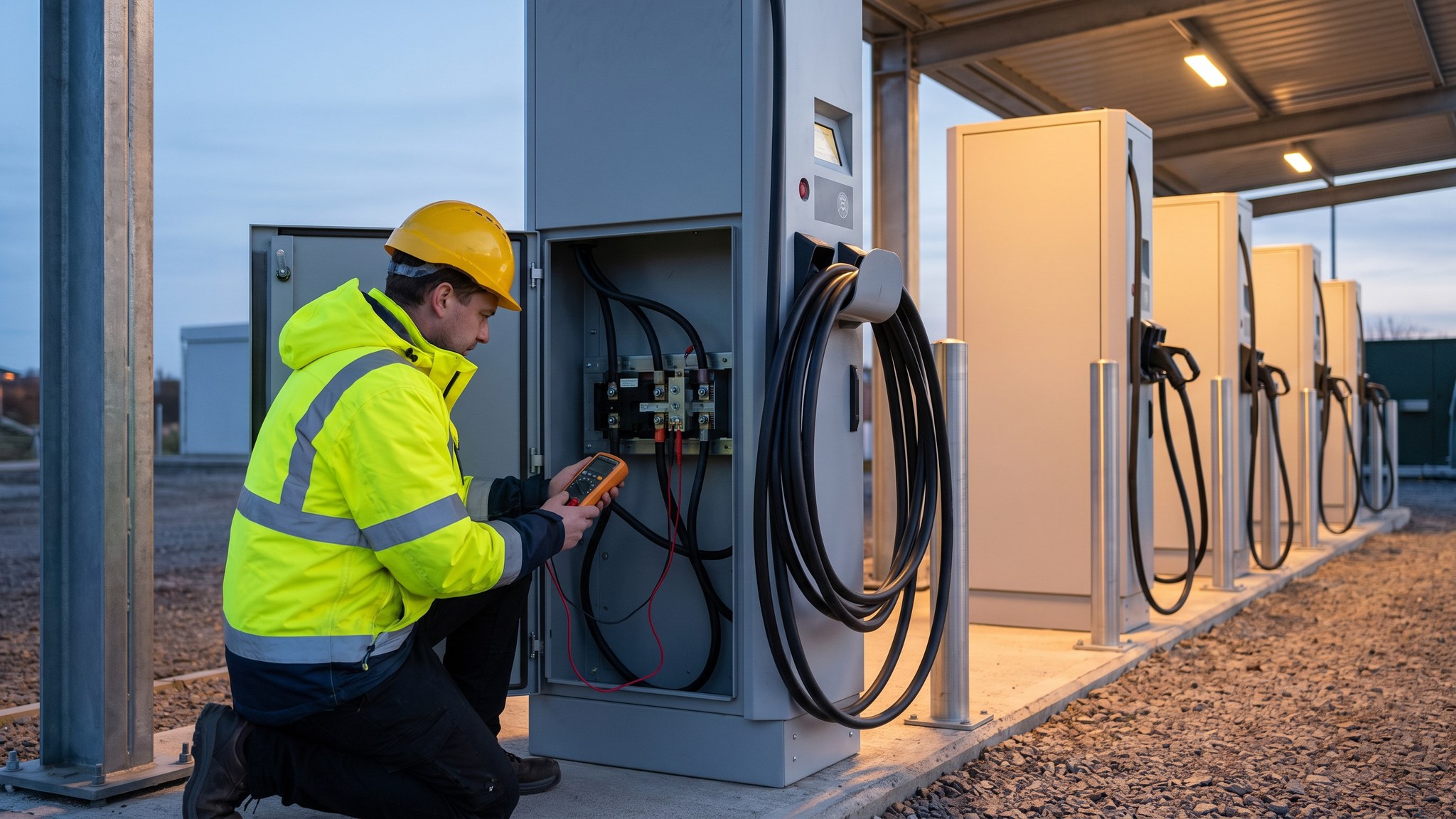
Electrical commissioning is the stage at which the installation stops being an assembly of equipment and becomes a proven system. It has two halves that are easy to confuse and should not be. The first is the electrical work: inspection and testing of the installation by competent qualified people, to satisfy themselves and the client that it is safe and that it has been built as designed. The second is functional testing: proving that the equipment does what it is supposed to do - that units start and stop, that protective functions operate, that faults are detected and reported, that the system behaves as expected when something is wrong as well as when everything is right.
Both halves are the work of competent qualified people, working under the principal contractor's regime and to the designer's documentation. This is not an area where a general site team can help by working through a list. Much of it takes place on live equipment or on equipment that is being made live and dead in sequence, and access to the area is controlled while it happens. The people doing it are appointed for their competence, the sequence they follow is set out in advance, and the outcome is a set of records rather than an opinion.
Those records are the deliverable. The certification and test results for the installation, the manufacturer's commissioning records for each unit, the settings as applied, the schedules identifying every unit and every circuit, the as-installed drawings, and the operating and maintenance information all go into the handover file that the site operator will hold for the life of the installation. Incomplete records are a real defect and not a paperwork nuisance: they are what the next person to work on the installation depends on, they are what any insurer or duty holder will ask for, and they are the evidence that the work was done properly. Commissioning is also where the practical problems finally surface - a unit that will not communicate, a setting that does not match the design, a bay wrongly labelled - so the programme has to allow time for finding those things and putting them right rather than assuming a clean run.
How does Electrical commissioning and functional testing work, step by step?
- 1
Step 1: Plan the commissioning before the installation finishes
The commissioning sequence, the people who will carry it out, the equipment they need, the documentation they will produce and the areas that will be closed while they work are all planned while installation is still under way. Manufacturer attendance is booked, because on most charging equipment part of the commissioning must be carried out or witnessed by the manufacturer for the warranty to stand. Commissioning planned at the last minute is commissioning that runs late.
- 2
Step 2: Confirm the installation is complete and the documentation is present
Before any testing starts, the installation is checked as complete: enclosures closed and sealed, labelling in place, schedules and as-installed drawings available, and the designer's documentation to hand. Any outstanding installation work is finished first. Testing an incomplete installation produces results that have to be repeated, and repeating them costs more than waiting did.
- 3
Step 3: Carry out inspection and testing of the installation
Competent qualified people inspect and test the installation to establish that it is safe and has been constructed in accordance with the design. What is tested, in what sequence, and what constitutes a satisfactory result are matters for those people working to the specification and to the design documentation. The work is carried out under the principal contractor's regime with the area controlled, and it produces the certification and results that form part of the handover file.
- 4
Step 4: Commission each unit to the manufacturer's procedure
Each charging unit has its own commissioning procedure covering its firmware, its identification, its configuration, its output settings and its self-checks. This is carried out by people trained on that equipment, frequently the manufacturer's own engineers, and it produces a commissioning record for every unit. The settings applied are checked against the design intent rather than accepted as delivered, because equipment does not always arrive configured as ordered.
- 5
Step 5: Prove the protective and safety functions
Functional testing covers the behaviour of the installation when things go wrong as well as when they go right - that faults are detected, that protective functions operate, that the equipment shuts down safely and reports what happened. These tests are designed and carried out by competent qualified people to the designer's and the manufacturer's requirements. Each result is recorded, and a function that does not behave as expected stops the sequence until it is resolved.
- 6
Step 6: Verify identification, labelling and schedules on site
Every unit, bay, circuit and enclosure is checked against the schedules and the drawings, physically on site. Mislabelling is extremely common after a phased installation and it causes real harm later, when someone works on the wrong item or an operator sends an engineer to the wrong bay. Discrepancies are corrected on the equipment and on the records at the same time.
- 7
Step 7: Close out defects and re-test
Commissioning generates a defect list, and time for it is allowed in the programme. Each item is assigned, corrected and re-tested by competent people, and the re-test result is recorded alongside the original. Items that cannot be closed before opening are recorded explicitly with an agreed date and an assessment of whether they prevent the site from operating.
- 8
Step 8: Assemble and issue the handover file
The certification and test results, the per-unit commissioning records, the applied settings, the schedules, the as-installed drawings, the product documentation and the operating and maintenance information are assembled into the handover file and issued to the client and to the site operator. The file is checked for completeness before issue rather than after, because the missing document is always found at the worst moment. Any residual work or agreed deviation is listed on the face of it.
What are the benefits of Electrical commissioning and functional testing?
- Establishes that the installation is safe and built as designed before anyone uses it
- Proves behaviour under fault conditions, not just normal operation
- Produces the records the site operator will rely on for the life of the installation
- Surfaces configuration and labelling errors while they are still cheap to correct
- Manufacturer involvement protects the equipment warranty from the outset
- Gives the client independent, documented evidence rather than an assurance
What are the limitations of Electrical commissioning and functional testing?
- Cannot start in earnest until the supply is live, so it inherits any energisation delay
- Requires competent qualified people and specialist attendance, both of which need booking
- Areas must be closed while live testing proceeds, which conflicts with a trading site
- Defects found here are found late, when the remedy is most disruptive
- Manufacturer engineer availability can be the binding constraint on a multi-unit site
- Documentation assembly is routinely underestimated and delays practical completion
What is Electrical commissioning and functional testing best suited for?
What plant does Electrical commissioning and functional testing need?
- Test and inspection equipment appropriate to the installation, calibrated and in date
- Manufacturer commissioning tools, laptops and configuration equipment for each unit type
- Temporary lighting, access equipment and area control barriers for the commissioning zones
- Communications equipment for verifying connectivity at every unit position
- Labelling and identification equipment for correcting discrepancies on the spot
- Document control arrangements for assembling and issuing the handover file
How is Electrical commissioning and functional testing quality-checked?
- Commissioning plan, personnel competence and manufacturer attendance confirmed before starting
- Installation confirmed complete, sealed and labelled before any testing begins
- Certification and test results recorded by competent qualified people and retained in full
- Per-unit manufacturer commissioning records completed, with applied settings checked against the design
- Identification, labelling and schedules verified physically against the drawings
- Defect list tracked to closure with re-test records, and the handover file checked for completeness before issue