Charging and payment proving
Actually charging vehicles and actually taking money - because a unit that charges but will not take a card is not open.
Last updated 2026-09-06
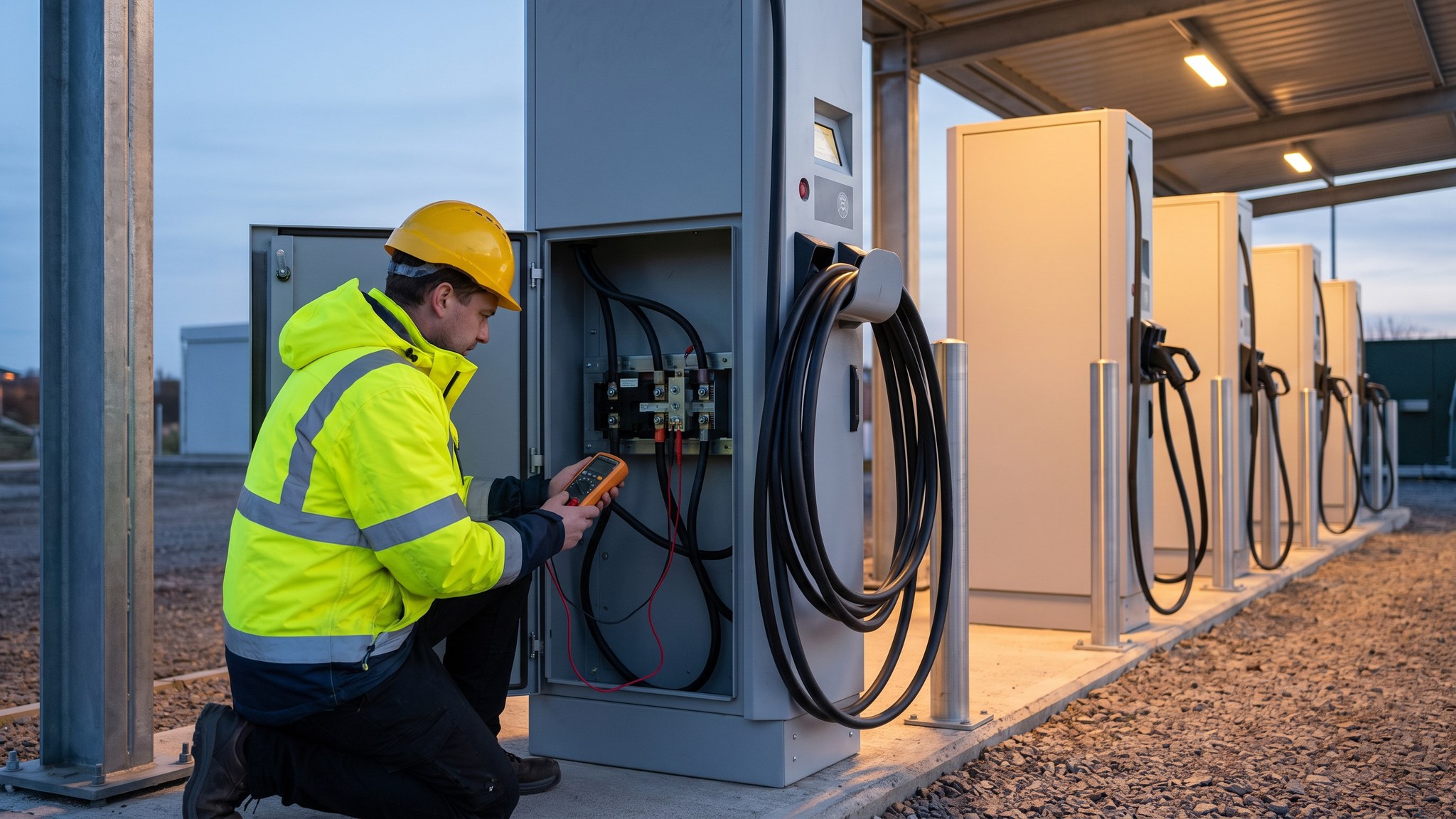
What is Charging and payment proving?
Charging and payment proving is the stage where somebody puts a real vehicle on a real bay and pays for real electricity. Everything up to this point has proved that the installation is safe and that the equipment functions. This stage proves that the site works as a service. It is a distinct exercise because the two things fail independently: a unit can deliver power flawlessly and still be useless because the card reader will not authorise, the tariff has not been loaded, the screen shows the wrong price or the session never closes and the driver is never charged.
The proving covers the whole transaction from the driver's side. A vehicle arrives, the driver identifies themselves or simply presents a card, the session authorises, charging starts, the screen and any application show what is happening, the session ends when the driver unplugs, the amount is calculated correctly against the tariff on display, and the money reaches the account it is supposed to reach. Each of those steps has somewhere it can fail, and each of them is checked. Refunds, failed authorisations, interrupted sessions and a driver who walks away mid-session all have to be tested too, because they will all happen in the first week.
On a real site there is more than one way to pay and more than one type of vehicle, and the proving has to reflect that. Different vehicles negotiate differently with the same unit, so testing with a single car proves less than testing with several. Different payment routes - contactless, an application, an account, a fleet arrangement - each have their own path through the system, and the ones that were not tested are the ones that fail. Accessibility of the payment interface, the legibility of the screen in bright sunlight and after dark, and whether the displayed price matches what is actually charged are all part of the same exercise. This is also the point at which the site operator's staff learn the equipment, because the first person a confused driver asks is whoever is behind the counter.
How does Charging and payment proving work, step by step?
- 1
Step 1: Confirm the tariff and the commercial configuration
The prices, the units they are charged in, any minimum or session fees, any idle or overstay arrangement and the way all of it is displayed are confirmed with the client and loaded into the system before testing. What is shown on the screen and in any application must match what is actually taken, and the two are checked against each other rather than assumed to agree. Getting the commercial configuration settled before testing avoids retesting the whole sequence afterwards.
- 2
Step 2: Prove a full session with a real vehicle
A vehicle is connected and a complete session is run from start to finish: authorisation, start of charge, energy delivered, session end, and the record produced. It is done on every bay rather than on a sample, because a bay that was never tested is a bay that will fail in front of a customer. Energy delivered as recorded is compared with the metering, and the session record is checked for the right bay, the right time and the right amount.
- 3
Step 3: Test with more than one vehicle type
Different vehicles communicate differently with the same equipment, so proving is carried out with a range of vehicles rather than with the one the commissioning engineer happens to drive. On a commercial vehicle or fleet site the actual fleet vehicles are used, because those are the only ones that matter. Any vehicle that behaves unexpectedly is recorded and referred to the equipment supplier rather than dismissed.
- 4
Step 4: Prove every payment route
Each way a driver can pay is tested end to end: contactless payment at the unit, any application-based route, account and fleet arrangements, and any local or promotional access the site offers. Each route has its own path through the system and its own points of failure. An untested route is an untested route, and the first driver to use it is doing the testing on the operator's behalf.
- 5
Step 5: Test the failure cases
Declined authorisations, sessions interrupted part way, a driver who unplugs early, a vehicle that stops accepting charge, a loss of connectivity mid-session and a request for a refund are all exercised deliberately. These are the cases that generate complaints and lost money in the first weeks of operation, and they are far cheaper to find now. Each case is checked for what the driver sees as well as for what the system records.
- 6
Step 6: Reconcile the money
Test transactions are followed all the way through to settlement, and the amounts reaching the account are reconciled against the sessions recorded and against the tariff. Any test refunds are checked through the same route. Reconciliation is what proves the commercial arrangement, and it is the step most often skipped because it takes days rather than minutes to complete.
- 7
Step 7: Check the driver experience at the bay
Screen legibility in bright sun and after dark, the readability and correctness of the displayed price, the reach and handling of the cable, the clarity of the instructions, the accessibility of the payment interface and the adequacy of lighting and signage are all assessed on site with somebody standing at the bay. Problems found here are cheap to fix now and expensive to fix once the site is open and being reviewed publicly.
- 8
Step 8: Train the site operator's people and record the results
Whoever is on site when a driver has a problem is shown how the equipment works, how to start and stop a session, what the common failures look like and who to call. The results of the whole proving exercise - every bay, every payment route, every failure case, the reconciliation - are recorded and issued with the handover documentation, along with anything left outstanding and the date by which it is to be resolved.
What are the benefits of Charging and payment proving?
- Proves the site works as a service and not merely as an installation
- Finds tariff, display and settlement errors before a customer does
- Exercises failure cases deliberately rather than discovering them in the first busy week
- Multi-vehicle testing exposes compatibility problems while the supplier is still on site
- Verifies the driver experience at the bay, which is what public reviews will judge
- Leaves the site operator's staff able to help a driver from day one
What are the limitations of Charging and payment proving?
- Needs real vehicles and real transactions, so it cannot be simulated at a desk
- Reconciliation runs to settlement timescales, so results arrive days after the tests
- Only takes place after energisation and electrical commissioning, so it is squeezed by any earlier delay
- Testing every bay and every payment route is time-consuming and often cut short under programme pressure
- Vehicle availability, particularly of varied types, is a genuine practical constraint
- Fixes to tariff or payment configuration may require the whole sequence to be re-run
What is Charging and payment proving best suited for?
What plant does Charging and payment proving need?
- Test vehicles of more than one type, with drivers available for the duration
- Payment cards and accounts for each route being proved, including fleet and account arrangements
- Metering and energy measurement references for comparing against recorded sessions
- Access to the management system and to the settlement reporting for reconciliation
- Lighting assessment equipment and a means of viewing screens in bright and dark conditions
- Recording arrangements for logging every bay, route and failure case tested
How is Charging and payment proving quality-checked?
- Tariff and displayed price checked against the amount actually taken, before wider testing
- A complete session proved on every bay, not on a sample, with the record checked for bay, time and energy
- Every payment route tested end to end and recorded
- Failure cases - declines, interruptions, early disconnection, refunds - exercised and recorded
- Test transactions reconciled through to settlement against the session records
- Driver experience at the bay assessed in daylight and after dark, with findings closed out