Load-managed distribution with storage or generation support
The distribution system actively decides what each charger may draw, and the controls end up mattering as much as the copper.
Last updated 2026-09-06
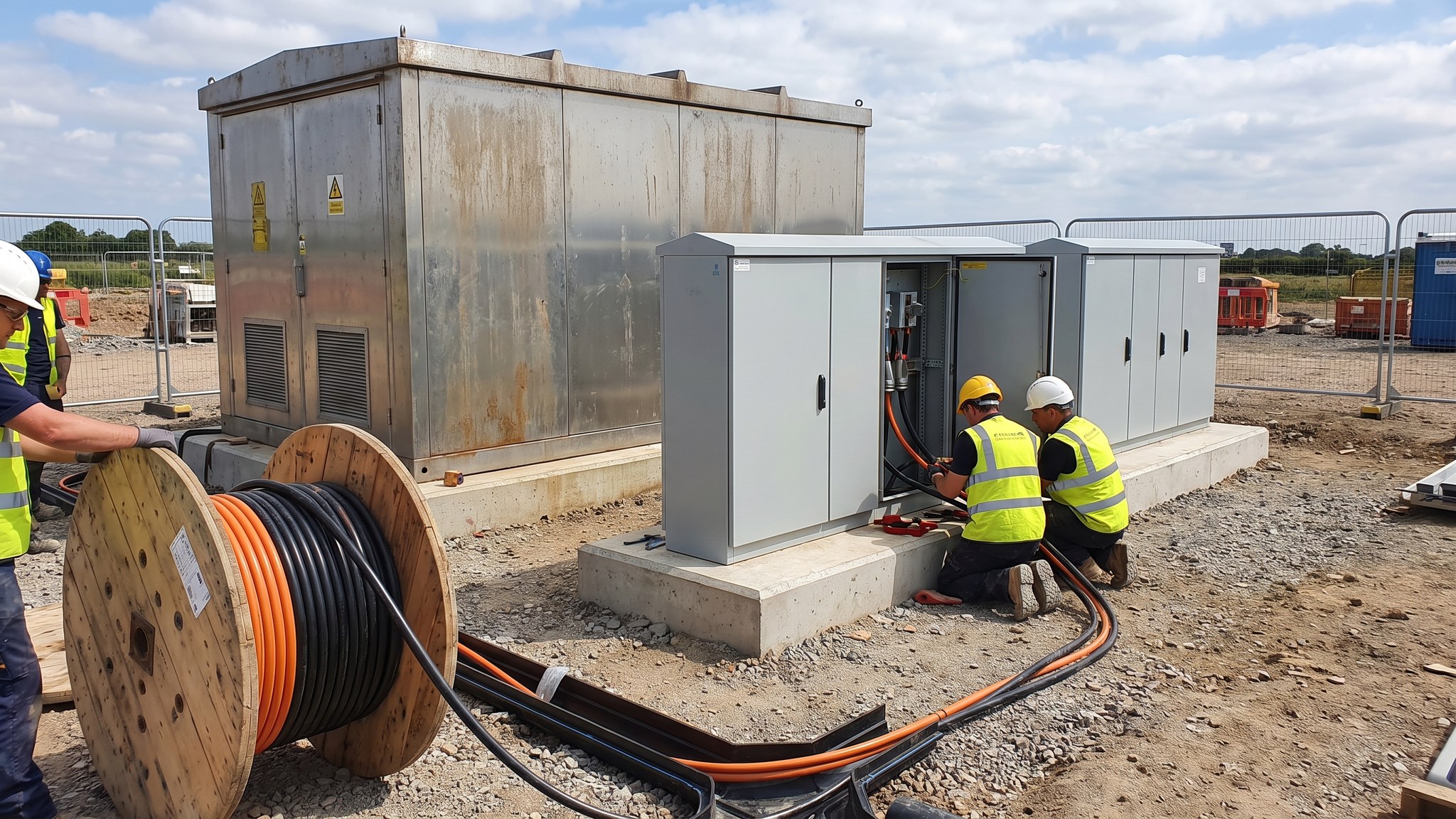
What is Load-managed distribution with storage or generation support?
In a conventional scheme the distribution is passive: each charger has a circuit and draws what it wants up to its rating. In a load-managed scheme the distribution is active. A controller monitors demand at the intake and across the site and continuously decides what each charger may draw, holding total demand below the site limit. Where storage or on-site generation is present, the same controller also decides when to charge and discharge it, so that the peak the connection sees is smaller than the peak the drivers experience.
This is the arrangement that lets a constrained site deliver more than its connection alone would allow, and it is increasingly the default on sites of any size. The engineering consequence is that the control system moves from being an accessory to being part of the infrastructure. The metering, the communications routes, the controller and its configuration are as critical to the site working as the cables are, and they need the same standard of design, installation, testing and documentation. A charging site whose control system has failed is not a site running at reduced output; it is a site that either shuts down or exceeds its connection limit, depending on how carefully somebody designed the failure behaviour.
That failure behaviour is the heart of the design. What the site does when the controller stops responding, when a meter drops out, when communications to a group of chargers are lost, or when the storage is depleted at the worst moment, is set out by the designer in the specification, and the fallback state must be one that cannot exceed the connection limit under any combination of demand. The protective measures behind that fallback are the designer's, for the specific installation. None of it is adjustable on site, and none of it is left to be worked out during commissioning.
How does Load-managed distribution with storage or generation support work, step by step?
- 1
Step 1: Define the control philosophy before anything is procured
The control philosophy is a written document that states what the system does. It defines the site limit and where it is measured, how capacity is allocated between chargers, what minimum output a connected vehicle is guaranteed, how storage and generation are dispatched, what priority different user groups receive, and how the system behaves on every failure it might encounter. It is agreed with the client before equipment is selected, because it determines what equipment is capable of doing the job. Writing it afterwards means discovering the gaps at commissioning.
- 2
Step 2: Design the metering and the measurement points
The controller acts on what it can measure, so measurement is designed first. Metering at the intake captures total site demand including the building. Metering at the charging distribution captures what the chargers are doing. Where storage or generation is present, its flows are metered too. The accuracy and the reporting interval of that metering determine how tightly the site can be run against its limit, and a system that measures slowly has to leave a larger margin, which wastes capacity.
- 3
Step 3: Design the communications as infrastructure
Every link between meters, controller, storage, generation and chargers is designed, routed and installed with the same care as the power distribution. Containment is provided on the same routes, with spare capacity. Where communications leave the site to reach a management platform, the dependency that creates is understood and the site is designed to keep working sensibly without it. Communications that were run as an afterthought through whatever route was left over become the recurring fault on the site.
- 4
Step 4: Design the fallback state
The designer determines what each part of the system does when it loses the controller or its measurement. The requirement is absolute: in every failure combination, total demand must stay below the connection limit. On most schemes that means each charger reverts to a restricted output that is safe in aggregate even with every bay occupied. The measures that enforce this, and any protective arrangements behind them, are set by the designer for the specific installation, are proved at commissioning, and are not altered by anyone on site afterwards.
- 5
Step 5: Integrate the storage and generation dispatch
Where storage or on-site generation supports the site, the controller decides when each charges, discharges or contributes, and how that interacts with the allocation to chargers. The rules cover the depleted-storage case, the case where generation is unavailable, and the priority between recharging the storage and serving vehicles. These are commercial as well as technical decisions and are settled with the client. The dispatch rules form part of the same written control philosophy rather than living inside a supplier's configuration.
- 6
Step 6: Install the power and control together
The physical installation covers the distribution boards and pillars, the cable routes, the metering positions, the controller and its enclosure, and the containment for the control and communications infrastructure. All electrical work is carried out by competent qualified people, and any work involving existing live equipment proceeds under permit. Control and power containment are installed together so that routes are proved once and so that the control infrastructure is not squeezed into whatever space remains at the end.
- 7
Step 7: Commission the control system against the philosophy
Electrical testing and certification are carried out by competent qualified people. Then the control system is commissioned against the written philosophy, line by line: the site limit holds under deliberate load, allocation behaves as specified, the guaranteed minimum output is delivered, storage dispatches as intended, and every failure case produces the fallback state that was designed. Failure cases are induced deliberately - communications interrupted, meters disconnected - rather than assumed. A control system that has only been tested working has not been tested.
- 8
Step 8: Hand over the configuration and the means to change it
Handover includes the control philosophy as built, the configuration as commissioned, the records of the failure tests, and a clear statement of what may be adjusted in service, by whom, and within what limits. The site limit itself is not an adjustable operational parameter. Monitoring data is reviewed at a defined interval so that allocation rules can be refined against real utilisation. Without that documentation the next person to touch the configuration is guessing, and the thing they are guessing about is the site's connection limit.
What are the benefits of Load-managed distribution with storage or generation support?
- Delivers more usable charging from a given connection than passive distribution can
- Holds the site within its connection limit continuously and automatically
- Takes building demand into account when measured at the intake
- Allows storage and generation to be dispatched against the actual site condition
- Supports commercial priority between user groups without physical reconfiguration
- Generates operational data that informs the next capacity and layout decision
What are the limitations of Load-managed distribution with storage or generation support?
- The control system becomes critical infrastructure that must be maintained and understood
- Failure behaviour has to be designed rigorously or the connection limit is at risk
- Adds metering, communications and containment cost to every part of the distribution
- Commissioning is longer and more demanding than for a passive scheme
- Depends on communications, so route design and resilience matter more than usual
- Configuration knowledge sits with a few people, and poor documentation makes the site fragile
What is Load-managed distribution with storage or generation support best suited for?
What plant does Load-managed distribution with storage or generation support need?
- Metering equipment at the intake, the charging distribution and any storage or generation
- Load management controller with its enclosure and power supply arrangements
- Communications infrastructure with dedicated containment on the power routes
- Cable installation and containment plant for both power and control
- Temporary load banks or a means of deliberately loading the site for commissioning
- Test instruments used by competent qualified people for electrical certification
How is Load-managed distribution with storage or generation support quality-checked?
- Written control philosophy agreed with the client before equipment selection
- Metering points, accuracy and reporting interval specified and verified at commissioning
- Control and communications containment installed and proved on designed routes
- Site limit proved to hold under deliberate load at full occupancy
- Every failure case induced deliberately at commissioning and the fallback state recorded
- Configuration, adjustable parameters and change authority documented in the handover pack