New or upgraded supply into existing infrastructure
Extending or reinforcing what is already there - cheaper than starting again, and constrained by every decision someone else made years ago.
Last updated 2026-09-06
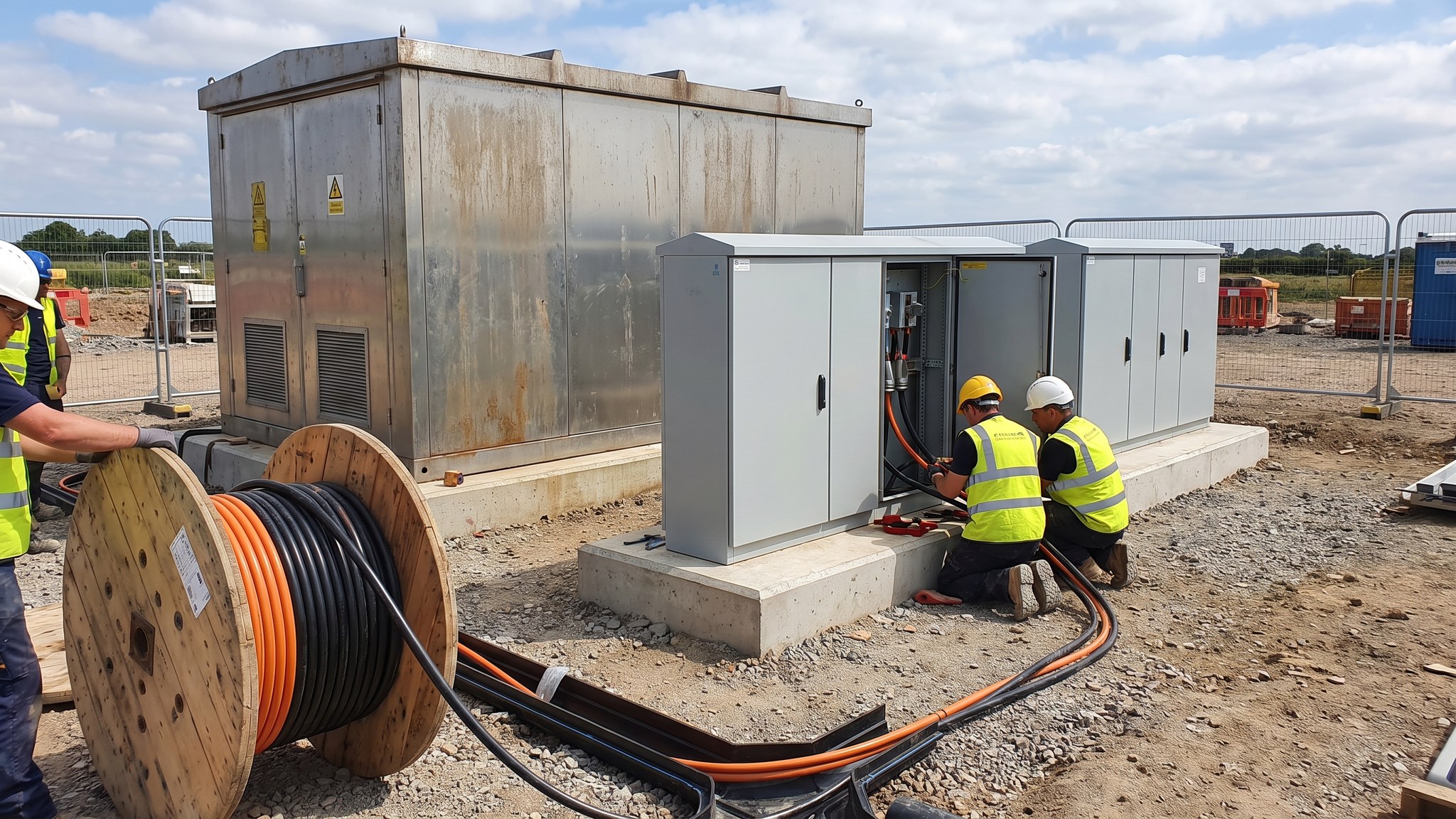
What is New or upgraded supply into existing infrastructure?
Most charging installations are retrofits. The site has an intake, a main board and a distribution system that were designed for a building, and the charging load has to be added to them. Where the existing arrangement has capacity and the equipment can accept it, extending or reinforcing what is there is much cheaper and much faster than building a new substation and a new private network. The works are contained, the disruption is limited, and much of the existing asset is reused rather than replaced.
The constraints all come from decisions taken years ago by people who were not thinking about charging. The main board may have no spare ways, or ways that cannot be used, or a physical arrangement that leaves no room to add anything. The equipment may be old enough that spares are no longer obtainable, which turns a straightforward addition into a replacement. The intake room may be too small, in the wrong place, or shared with another occupier. The existing records may not describe what is actually installed. Each of these is discoverable by survey, and each of them can change the scheme fundamentally.
The other constraint is that the site is live and in use. The existing installation is feeding a building that has to keep operating, so the work has to be planned around what can be switched off and when. Any outage is negotiated with the occupier, often for nights or weekends, and sometimes it cannot be had at all without temporary arrangements. All work on or near the existing installation is work for competent qualified people, carried out under permit, with everything treated as live until proven otherwise by those people. The survey, the outage plan and the sequence matter more on this route than the design does.
How does New or upgraded supply into existing infrastructure work, step by step?
- 1
Step 1: Survey what is actually installed
The starting point is a physical survey of the existing installation by competent qualified people: what equipment is there, its age and condition, what capacity it has, how many usable spare ways remain, whether spares and accessories are still obtainable, and how the whole thing is actually arranged as opposed to how the records describe it. Records on older sites are commonly incomplete or contradictory. The survey supersedes them, and the drawings are corrected to match what was found before any design work proceeds.
- 2
Step 2: Establish the available capacity and where it can be taken from
Having capacity at the intake is not the same as being able to get at it. The designer establishes the spare capacity in the existing supply from measured demand data, and then establishes from which point in the existing distribution the charging load can actually be taken. Sometimes the answer is the main board, sometimes a sub-distribution board nearer the car park, and sometimes there is no suitable point and a new one has to be created. That question is answered before the charging layout is fixed, because it often determines where the chargers can economically go.
- 3
Step 3: Decide what is reused, what is reinforced and what is replaced
With the survey complete, the designer decides. Reuse where the equipment is sound, has capacity and can accept the addition. Reinforce where the arrangement can be extended - a new board fed from an existing one, additional distribution to serve the bays. Replace where the equipment is at the end of its life, is unobtainable, or simply has nowhere left to connect. The temptation is to reuse everything to save money, and the discipline is to replace anything whose failure would take the charging installation and the building down together.
- 4
Step 4: Plan the outages before the works
Work on the existing installation needs it dead, and the site needs it live. The outage plan sets out what has to be switched off, for how long, and when the occupier can tolerate it. On retail, hospitality and healthcare sites that usually means nights or specific closed periods, and sometimes it means providing a temporary supply so the building can keep running. The plan is agreed in writing with the occupier well ahead. The switching itself is carried out by competent qualified people under permit, following a procedure that belongs to them.
- 5
Step 5: Design the extension to the distribution
The new distribution is designed from the agreed point of connection to the charging bays: the boards or pillars, the routes, the grouping of bays, the metering, and the control and communications provision. Every parameter of that design is the designer's for the specific installation. Because this is a retrofit, the routes are usually constrained - existing risers, existing containment, existing ceiling voids - and the survey of those routes is as important as the electrical design. Spare provision is built in where it is cheap to do so.
- 6
Step 6: Install the new work with the site operating
Installation proceeds around the occupier. New containment, cable routes and boards go in while the building trades, with the connection to the existing installation reserved for the agreed outage. Areas are handed back clean and safe at the end of every shift, because the customers and staff who use them are there the next morning. Coordination with the civils - ducts, bases, trenches across the car park - matters, since the same live site is being disrupted by both.
- 7
Step 7: Make the connection during the outage
The connection into the existing installation is made during the agreed outage by competent qualified people under permit. The sequence, the isolation, the proving and the restoration all belong to them and to the procedure written for the particular installation. The outage window is planned with contingency, and with a defined point at which, if the work is not progressing, it is made safe and the supply restored rather than pushed on into the working day. Occupiers remember the overrun far longer than they remember the project.
- 8
Step 8: Test, commission and update the records
The new installation is tested and certified by competent qualified people and the charging equipment is commissioned. The step that is most often skipped is updating the record of the existing installation. The site now has a distribution system that differs from its drawings, and the next person to work on it - possibly in an emergency - depends on those drawings being right. Revised schedules, drawings and labelling are issued as part of the handover, not offered afterwards.
What are the benefits of New or upgraded supply into existing infrastructure?
- Much cheaper than a new substation and private network where the existing capacity allows
- Reuses sound existing equipment rather than replacing serviceable assets
- Contained works with limited civils and a shorter programme
- Avoids the land rights, consents and compound that a new substation would require
- Can often be delivered without a network application, keeping the programme in the client's hands
- Well suited to adding modest charging provision to an occupied building
What are the limitations of New or upgraded supply into existing infrastructure?
- Constrained entirely by an existing arrangement designed for something else
- Spare ways, physical space and obtainable spares frequently run out before capacity does
- Existing records are often wrong, so the scheme can change after survey
- Requires outages on a live site, which the occupier may be unwilling or unable to grant
- Caps the ultimate size of the charging offer at whatever the existing supply allows
- Ageing equipment reused to save money becomes a shared failure point later
What is New or upgraded supply into existing infrastructure best suited for?
What plant does New or upgraded supply into existing infrastructure need?
- Access equipment for survey and installation in intake rooms, risers and ceiling voids
- Containment installation tools and cable pulling equipment for constrained routes
- Temporary supply equipment where the occupier cannot accept a full outage
- Small excavation plant for the distribution routes across the car park
- Test instruments used by competent qualified people for certification
- Barriers, signing and protection for works within an occupied building
How is New or upgraded supply into existing infrastructure quality-checked?
- Physical survey of the existing installation completed by competent qualified people before design
- Existing drawings and schedules corrected to match what was found on site
- Spare capacity established from measured demand data, not from equipment ratings
- Decisions on reuse, reinforcement and replacement recorded with reasons
- Outage plan agreed in writing with the occupier, with contingency and an abort point
- Revised as-built drawings, schedules and labelling issued as part of the handover