New customer substation with a private low voltage network
The site takes a high voltage supply and distributes its own low voltage - control and headroom, at a higher cost and with obligations that last.
Last updated 2026-09-06
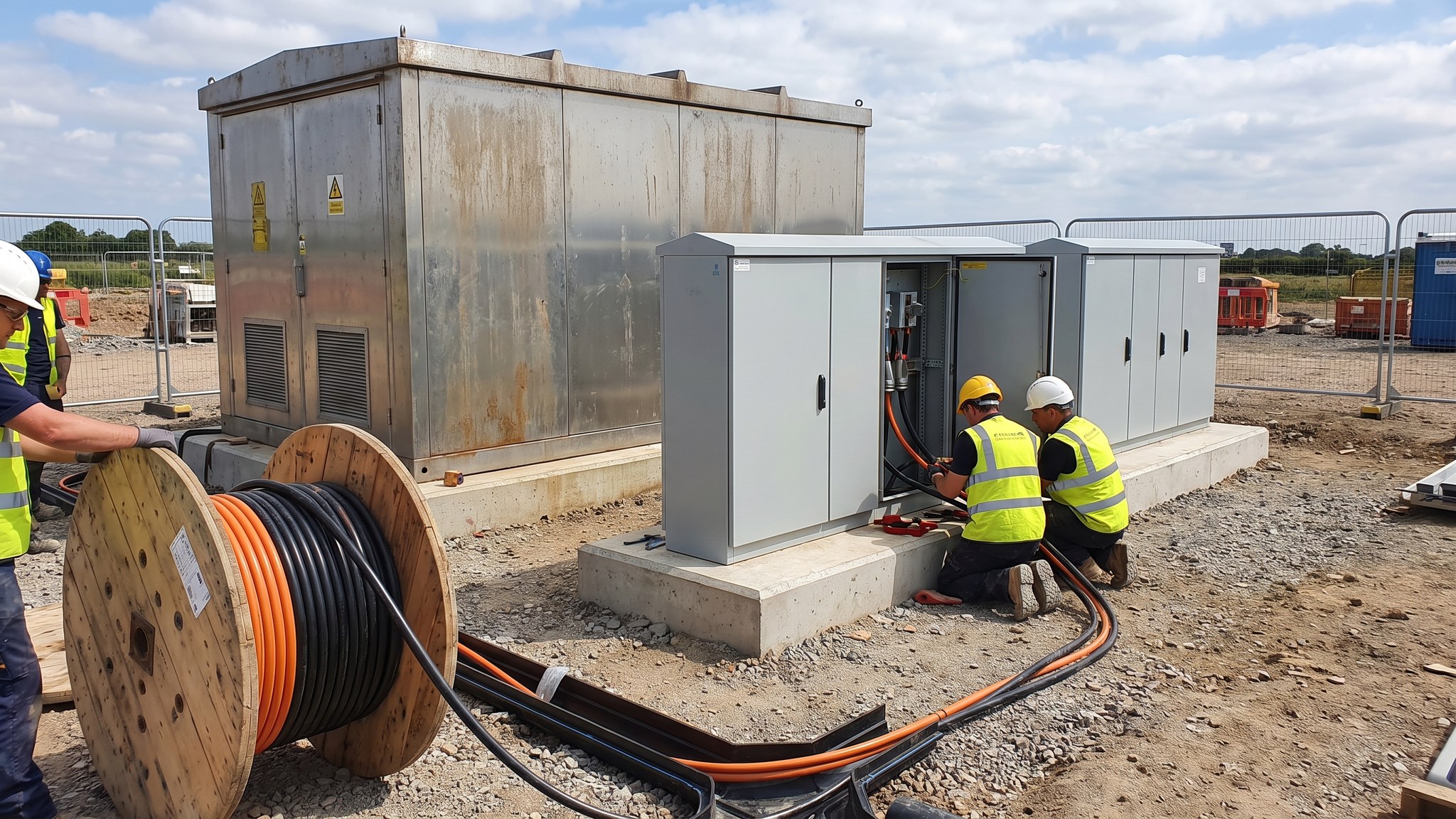
What is New customer substation with a private low voltage network?
A site that needs a lot of capacity is usually better served by taking a high voltage supply and converting it itself than by asking for a very large low voltage connection. The network operator brings its high voltage supply to a point on the site, and from there the customer owns a substation and a private low voltage network distributing to the charging bays. This is the arrangement behind most large charging hubs, most depot electrification projects and most sites where a substantial number of high-powered units is the point of the scheme.
What the client gets is control and headroom. The substation can be sized with capacity for a later phase, so that adding units in two years is a distribution exercise rather than a fresh application to the operator. The private network can be arranged to suit the site rather than to suit a connection point inherited from somewhere else. The client decides the equipment, the layout and the resilience. On a site that intends to grow, that flexibility is often worth more than the capital it costs.
What the client takes on is ownership. Everything on the customer side of the boundary belongs to the site: it has to be maintained, inspected, insured and eventually replaced, and someone competent has to be responsible for it. That responsibility is real and continuing, and it is often the part that is least well understood at the point the arrangement is chosen. The capital cost is higher, the compound is larger, the consent requirements are greater, and the operational obligations do not end at handover. All high voltage work, and all work on the private network, is work for competent qualified people under permit throughout the life of the installation.
How does New customer substation with a private low voltage network work, step by step?
- 1
Step 1: Establish the arrangement with the operator
The designer and the operator agree where the high voltage supply will be brought to, where the ownership boundary sits, what equipment each party provides, and what access the operator requires to its own assets. That boundary determines who maintains what for the next thirty years, so it is documented precisely rather than described loosely. The operator will also state its requirements for the arrangement of its equipment, its separation from customer plant and its access at any hour, and those requirements shape the compound before anything else does.
- 2
Step 2: Size the substation for the scheme and its future
Sizing is a decision about the future as much as the present. The immediate charging load sets the minimum, but on most projects it is worth sizing for a planned second phase, because the marginal cost of additional capacity at the time of installation is far below the cost of revisiting the arrangement later. The designer establishes the demand, the diversity and any load management intended, and produces a capacity that the client signs off knowing what it does and does not allow for.
- 3
Step 3: Design the private low voltage network
From the substation, the private network distributes to the charging bays. The designer sets out the distribution arrangement - how many circuits, where they run, how the bays are grouped, where the boards and pillars sit - together with the metering and the provision for the control and communications the operator of the chargers needs. Every parameter of that design, including protection, is determined by the designer for the specific installation. The design also decides what spare provision is built in, because spare ways in a board are cheap and adding them later is not.
- 4
Step 4: Design the compound and the civils around it
The substation and the associated equipment need their compound: hardstanding, bases, ducts, drainage, security, delivery access and maintenance clearances. The operator's equipment and the customer's equipment sit within it under the separation the operator requires. Duct routes from the compound to the charging areas are set out with spare capacity, and everything below ground is coordinated with the existing services on site. The compound is a substantial construction item and is programmed as such.
- 5
Step 5: Secure the land rights and the consents
The operator will normally require a lease or transfer of the ground its equipment occupies, together with rights of access at any time and rights to bring its cables across the land to reach it. On leasehold or multi-owner sites that involves parties who have no interest in the project's programme, and it routinely takes longer than the technical work. Planning and other consents for the compound run alongside. These matters are started early because they are the ones most likely to delay energisation.
- 6
Step 6: Build the civils and install the equipment
The compound, bases, ducts and cable routes are constructed, surveyed as built and proved clear before the equipment arrives. The substation and switchgear are delivered under a lift plan and set on their bases. Cables are pulled and terminated. All of this electrical work is carried out by competent qualified people, and where it involves any existing live equipment on the site it proceeds under permit with the equipment treated as live until proven otherwise. Sequencing matters, because the operator's programme and the site programme have to meet at energisation.
- 7
Step 7: Commission the substation and the private network
Commissioning covers the high voltage equipment, the transformation, the low voltage distribution, the metering and the control and communications, and it is carried out by competent qualified people to the designer's specification with the results recorded. Energisation is a planned operation agreed with the operator in advance. Nothing is left to be sorted out afterwards, because a private network that is energised with outstanding items becomes a live installation with defects in it.
- 8
Step 8: Hand over the asset with its obligations
Handover is not just drawings. The client receives the as-built records, the operating and maintenance information, the schedule of what is owned by whom, the connection agreement, and the inspection and maintenance regime the installation requires. Someone competent has to be nominated as responsible for the high voltage installation, and the arrangements for access, for emergency response and for periodic inspection are set out and understood. This is the step that turns a construction project into an asset that can be safely operated.
What are the benefits of New customer substation with a private low voltage network?
- Supports the large capacity that a hub of high-powered units requires
- Can be sized with headroom so later phases are a distribution job, not a new application
- The private network is arranged to suit the site rather than an inherited connection point
- The client controls the equipment, the layout and the level of resilience
- Simplifies future expansion and reconfiguration within the capacity provided
- Often the most economic route once the required capacity passes a certain scale
What are the limitations of New customer substation with a private low voltage network?
- High capital cost, and a compound that consumes a significant area of the site
- The client owns, maintains, insures and eventually replaces everything on its side
- Requires a competent responsible person for the high voltage installation, permanently
- Land rights, leases and operator access arrangements involve third parties and take time
- Consent and planning requirements are greater than for a low voltage connection
- Long lead times on both the operator works and the equipment procurement
What is New customer substation with a private low voltage network best suited for?
What plant does New customer substation with a private low voltage network need?
- Groundworks and compaction plant for the compound hardstanding and bases
- Mobile crane and low loader for delivery and placing of substation equipment
- Excavation, ducting and cable installation plant for the private network routes
- Cable pulling winches, rollers and jointing facilities
- Survey equipment for as-built records of all buried infrastructure
- High voltage and low voltage test equipment used by competent qualified people
How is New customer substation with a private low voltage network quality-checked?
- Ownership boundary and operator access requirements agreed and documented before design freeze
- Substation capacity signed off by the client against the current and planned phases
- Land rights, lease and consents secured before the operator mobilises
- Ducts and routes proved clear and surveyed as built before cable installation
- Commissioning by competent qualified people, with all results recorded before energisation
- Handover pack including as-builts, maintenance regime, asset schedule and nominated responsible person
More electrical infrastructure methods
Next method
New or upgraded supply into existing infrastructure