A new or upgraded network connection
Applying for more capacity, then living with the quotation, the lead time and the reinforcement cost that decide whether the scheme happens at all.
Last updated 2026-09-06
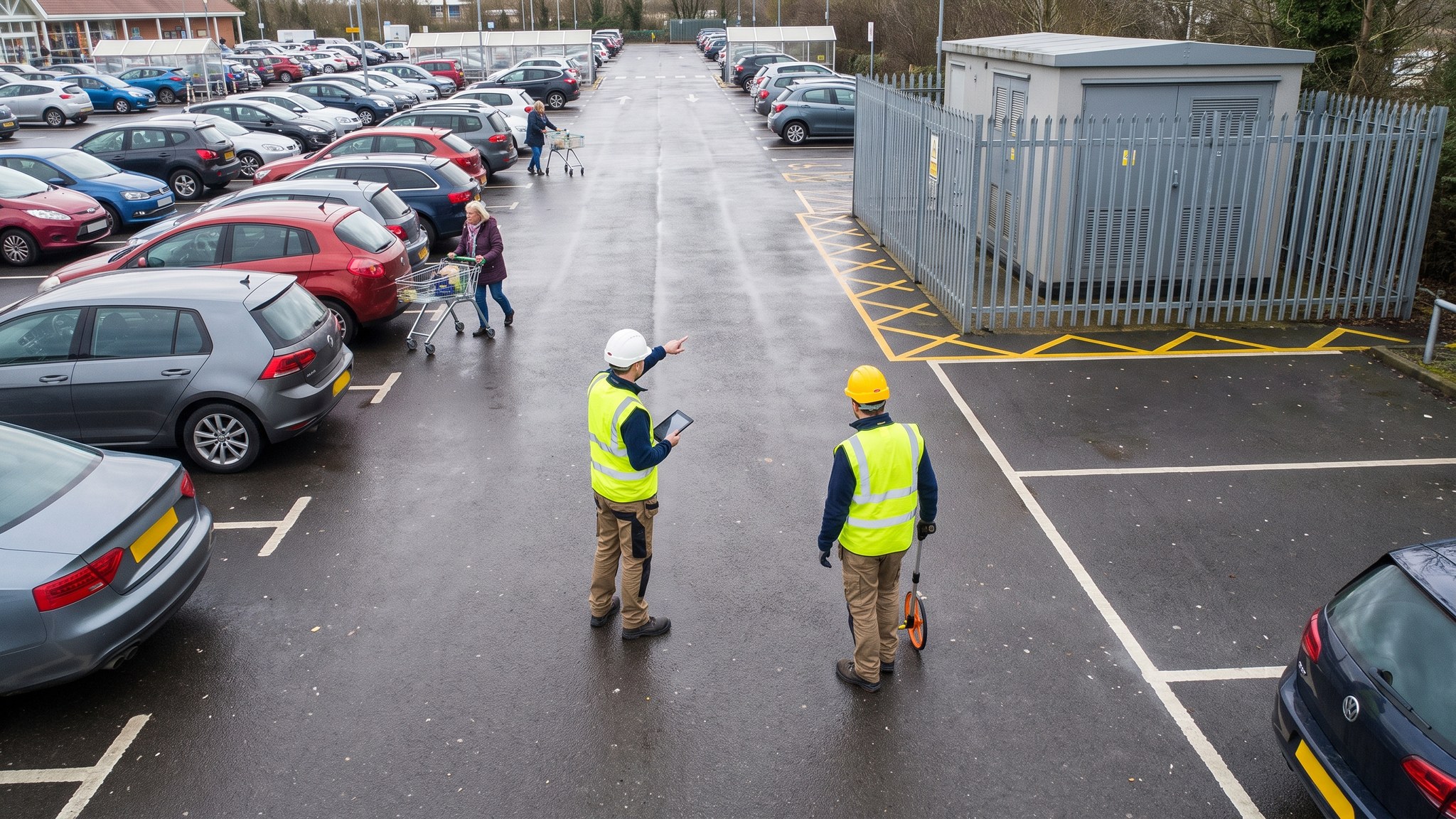
What is A new or upgraded network connection?
When the existing supply cannot carry the charging load, the project applies to the network operator for a new connection or for an increase to the capacity of the one already there. This is the route that unlocks high-powered charging, and it is also the route that most often kills a scheme. The application produces a quotation covering the work the operator must do at the site, the work it must do on its own network, and any reinforcement needed further back where the local network cannot support the additional demand. The first two are usually predictable. The third is not, and it is the reason two apparently similar sites a short distance apart can return quotations that differ by an order of magnitude.
The connection date governs everything else on the project. Lead times are set by the operator, by the design and consent work it must complete, by the availability of its own equipment and by its programme for outages on the existing network. On most projects that period is measured in many months and often longer, and it is entirely outside the client's control. Every other activity - the civils, the plant compound, the chargers, the commercial arrangements, even the opening date advertised to customers - has to be planned backwards from it. Projects that treat the connection as one procurement item among many, rather than as the fixed point the programme hangs from, tend to finish with completed civils sitting idle waiting for energisation.
Because the cost and the date are both uncertain until the quotation arrives, the sensible sequence is to establish them early and cheaply. Most network operators publish indicative capacity information and offer a budget or pre-application enquiry that gives an approximate answer without commitment. That answer is enough to test whether a site is viable, to compare candidate sites against each other, and to decide whether to design for the capacity wanted or the capacity affordable. It also creates the space to consider the alternatives honestly - a smaller connection with load management, or storage smoothing the peak - before the project is emotionally and financially committed to a number it cannot afford.
How does A new or upgraded network connection work, step by step?
- 1
Step 1: Define the capacity the scheme actually needs
The application asks for a figure, and that figure has consequences in both directions. Ask for too little and the site is capped for its whole life or has to reapply later at full cost. Ask for too much and the quotation may include reinforcement the scheme does not need and cannot afford. The designer builds the requirement from the proposed charger mix, a realistic utilisation assumption, any load management intended and an allowance for a planned future phase. On most projects it is worth pricing two or three capacity options rather than one, because the relationship between capacity requested and cost quoted is rarely a straight line.
- 2
Step 2: Test viability with a budget or pre-application enquiry
Before committing to a formal application, an informal enquiry establishes roughly what is available locally and roughly what it would cost. This is cheap, comparatively quick and non-binding, and on multi-site programmes it is the tool that ranks candidate sites. Published network capacity information gives a first indication, but it is indicative only and the operator's own answer supersedes it. A site that looks well served on a map can still return a quotation dominated by reinforcement, and the enquiry is how that is found out before money is spent on design.
- 3
Step 3: Make the formal application
The formal application sets out the capacity requested, the location and boundary of the site, the nature of the load, the intended date and the on-site arrangement proposed. Accuracy matters, because the quotation is priced against what was described and a later change to the load, the layout or the position of the intake can require the application to be revisited. The application also has to state clearly which parts of the work the client wishes the operator to carry out and which parts are to be delivered by others, because that split affects both the price and the programme.
- 4
Step 4: Receive and interrogate the quotation
The quotation separates the work at the site, the work on the network and any reinforcement. It carries a validity period, payment terms and conditions, and it will state the operator's indicative programme. This is the moment for scrutiny rather than acceptance. The designer checks what has been assumed about the point of connection, what land or easements the arrangement requires, what is excluded, and what would change if the requested capacity were altered. Where reinforcement dominates the price, it is worth asking what a smaller request would produce, because a modest reduction in capacity sometimes removes a disproportionate cost.
- 5
Step 5: Decide the route, or redesign the scheme
With a real number and a real date, the project takes a decision it could not take before. Accept the quotation and build the scheme as designed. Reduce the capacity and add load management so the reduced connection still serves the intended number of bays. Add storage or generation to smooth the peak. Phase the scheme so a smaller first connection proves the demand. Or move to a different site. All of these remain open until the quotation is accepted, and all of them close afterwards, so this is the last cheap decision point on the project.
- 6
Step 6: Accept, pay and secure the land rights
Acceptance is normally accompanied by payment on the operator's terms and by the legal work the connection needs. That commonly includes rights for the operator to bring its cables across land, and where the arrangement includes an operator substation, a lease or transfer of the ground it stands on together with rights of access to it at any hour. On leasehold sites this involves the landlord and can take longer than the technical work. Land rights that are left until the operator is ready to start on site are a familiar and avoidable cause of delay.
- 7
Step 7: Coordinate the operator's works with the site works
From acceptance onwards, two programmes have to be reconciled. The operator has its own design, consent, street works and outage arrangements, and its dates are its own. The site has civils, ducts, bases, plant compounds and the chargers themselves. The practical discipline is to have every duct, chamber and base complete, surveyed, proved clear and available in good time, so that nothing on site is the reason the operator cannot proceed. Interface points - who pulls which cable, who terminates it, who provides the enclosure - are agreed in writing rather than assumed.
- 8
Step 8: Energise, then hold the operator to the agreement
Energisation is carried out by the operator and by competent qualified people on the customer side, in a sequence agreed beforehand. Once live, the client holds a connection agreement with a stated capacity, and exceeding it has commercial consequences. The site therefore needs to know what it is drawing, which means metering and, on many charging sites, some means of limiting total demand. The agreement, the drawings of what was actually built and the record of what is owned by whom are handed over as a set, because the next project on this site will start by asking for exactly those documents.
What are the benefits of A new or upgraded network connection?
- Unlocks the capacity high-powered charging needs, which no amount of management can create
- Gives the site a firm agreed capacity rather than a shared or conditional arrangement
- Creates headroom for later phases if the requested capacity includes an allowance for them
- Puts the network equipment and its maintenance in the operator's hands rather than the client's
- Produces a documented connection agreement that supports the commercial case for the site
- Suits sites where the charging offer is the whole business rather than an addition to one
What are the limitations of A new or upgraded network connection?
- The connection date governs the whole programme and is outside the client's control
- Reinforcement costs are unpredictable and can make an otherwise sound scheme unviable
- Lead times are commonly many months and can be considerably longer in constrained areas
- Requires land rights and often a lease for operator equipment, which involves third parties
- The quotation has a validity period, so indecision can mean starting the process again
- Once accepted, changes to the load or the layout can require the application to be reworked
What is A new or upgraded network connection best suited for?
What plant does A new or upgraded network connection need?
- Survey equipment for establishing the point of connection and the cable route
- Ground investigation and buried service detection along the proposed route
- Excavation, ducting and chamber installation plant for the customer-side civils
- Craneage and transport for the delivery of substation and switchgear enclosures
- Traffic management and highway works equipment where the route leaves the site
- Test and commissioning instruments used by competent qualified people at energisation
How is A new or upgraded network connection quality-checked?
- Capacity requested derived from a documented load assessment, with options priced
- Budget or pre-application answer obtained before formal commitment
- Quotation reviewed clause by clause, with exclusions and assumptions listed and closed out
- Land rights, leases and access arrangements secured before the operator mobilises
- Ducts, chambers and bases proved clear and surveyed before the operator's cable pull
- Connection agreement, as-built records and asset ownership schedule handed over as a set