Connection supported by on-site storage or generation
A battery or on-site generation smooths the peak so a smaller connection suffices - more capital cost and complexity, and sometimes the only route there is.
Last updated 2026-09-06
What is Connection supported by on-site storage or generation?
Charging demand is peaky. A site can be quiet for hours and then draw heavily for twenty minutes when several vehicles arrive together. A network connection, by contrast, has to be sized for the peak and is paid for accordingly. On-site storage exploits that mismatch. A battery charges slowly from a modest connection during the quiet hours and discharges quickly to support the chargers during the busy ones, so that the site can deliver a peak output well above what its connection alone could provide. On-site generation, where it exists, contributes in the same direction by supplying part of the demand behind the meter.
This route is chosen for one of two reasons. Either it is cheaper over the life of the scheme than the connection it avoids, which happens where reinforcement costs are high, or it is simply the only way the site can be built, which happens where the capacity is not available at any price within the programme. In both cases it converts a network problem into a capital and control problem. The cost moves from the operator's quotation to the client's balance sheet, the lead time moves from the connections queue to procurement and installation, and the complexity moves from the application form to the site.
The complexity is real and should not be understated. The site gains substantial equipment that needs space, a compound, access for delivery and maintenance, ventilation, fire and safety measures appropriate to what is installed, and a control system that decides moment by moment what charges, what discharges and what the site draws. Storage and generation equipment introduces hazards that are specific to the technology, and the arrangements for them are set by the designer and the specification and are managed by competent qualified people. It also introduces an ongoing operational responsibility that a simple connection does not, since the system has to be maintained, monitored and eventually replaced.
How does Connection supported by on-site storage or generation work, step by step?
- 1
Step 1: Establish the shape of the demand, not just its size
Storage is only worth installing where the demand profile is peaky enough to justify it. The designer builds an hourly or half-hourly profile of the expected charging demand across a typical week, including the worst days, and overlays the building demand where relevant. What matters is the height and the duration of the peaks and the length of the quiet periods between them. A site with short sharp peaks and long quiet nights is an excellent candidate. A site that draws heavily and continuously is not, because there is no window in which to recharge the storage.
- 2
Step 2: Compare the options on whole-life cost
The decision between a larger connection and a smaller connection with storage is a commercial one made on the whole life of the scheme. The comparison covers the connection quotations for each option, the capital cost of the storage and its associated works, the space it occupies and what else that space could have been used for, the maintenance and replacement it will need, and the value of being able to open earlier. On many sites the answer is close, and it turns on the reinforcement cost in the quotation. Where capacity is simply unavailable, the comparison is not needed.
- 3
Step 3: Size the storage against the duty it must perform
Sizing has two dimensions that are often confused. Power determines how much support the storage can provide at the instant of peak demand. Energy determines how long it can keep providing it. A system sized for power but not energy supports the first few vehicles and then stops. The designer sizes both against the modelled duty, with an allowance for the fact that the capacity of storage reduces over its life. Assumptions about the depth to which the system is worked and the number of cycles per day feed directly into how long the equipment will last.
- 4
Step 4: Find and design the compound
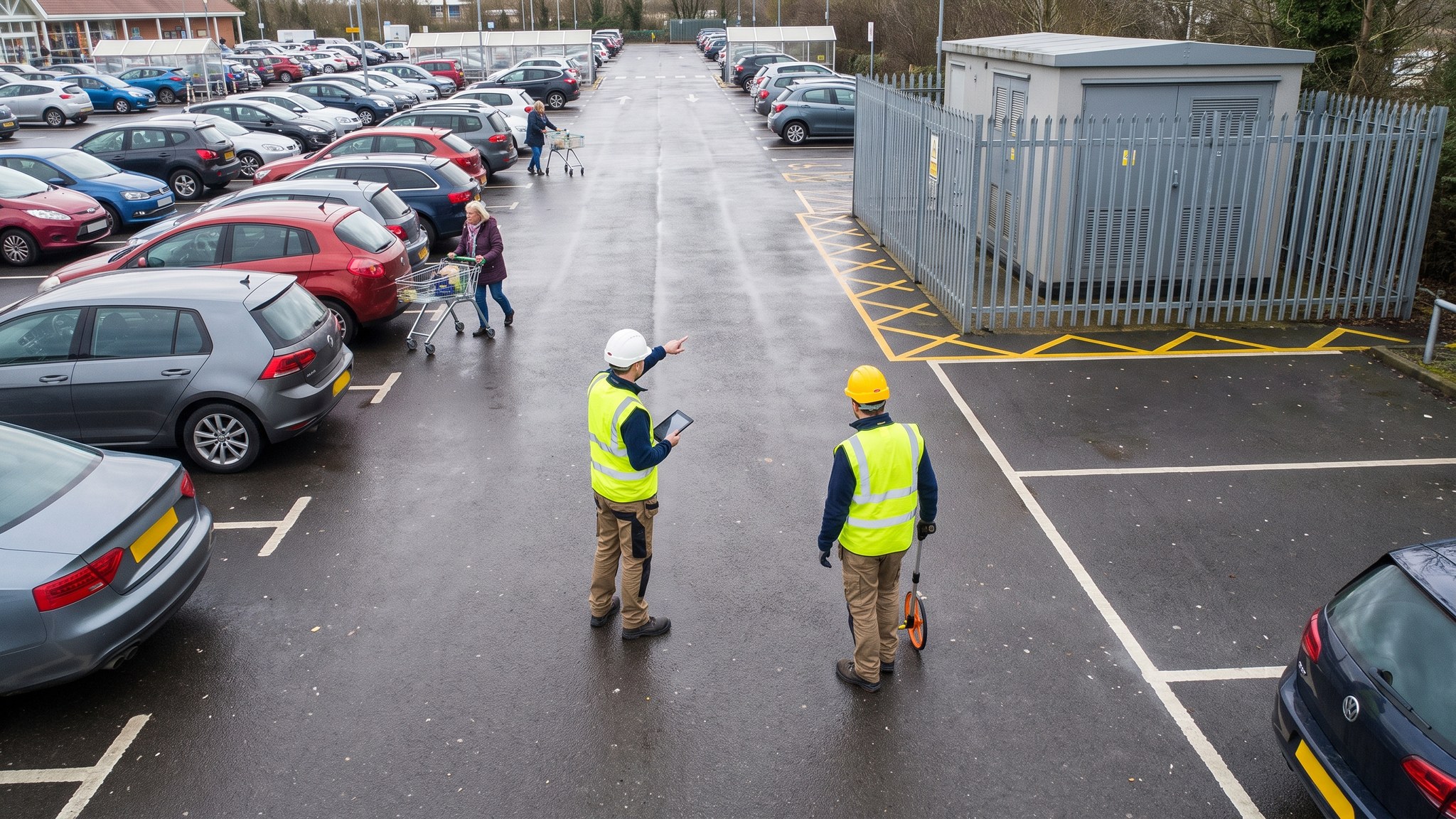
Storage and any conversion or generation plant need a physical home: a level hardstanding, a secure enclosure, room to open every door and withdraw every module, and access for the vehicle that will deliver and eventually remove the equipment. The compound has to sit where its noise and appearance are acceptable and where the separations the designer sets can be achieved. On constrained sites this is frequently the hardest part of the scheme, and it is discovered late by projects that treat storage as an electrical item rather than a building.
- 5
Step 5: Address safety and consent for what is being installed
Storage and generation equipment bring hazards specific to the technology, and the measures for them - separations, containment, detection, ventilation, emergency access and the information the emergency services need - are set by the designer and the specification for the particular installation. The same equipment commonly attracts planning and consent requirements that a set of chargers alone would not, covering appearance, noise and sometimes the emergency arrangements themselves. These conversations start early, because a compound that cannot be consented is a scheme that cannot be built.
- 6
Step 6: Design the control that ties it together
The control system is what makes the scheme work. It decides when to charge the storage, when to discharge it, how to allocate output between chargers, and how to hold the site within its connection limit at all times. It has to handle the case where the storage is depleted at a busy moment, and the case where it or its communications fail. As with any load-managed site, the fallback state must be one that cannot exceed the connection limit. The control philosophy is written down and agreed before installation, not developed during commissioning.
- 7
Step 7: Install and commission the whole system
Installation covers the compound and its civils, the storage and conversion equipment, the connection between them and the site distribution, and the control and communications. All of the electrical work is for competent qualified people, under permit where existing live equipment is involved. Commissioning proves the complete system rather than its parts: that the storage charges and discharges as intended, that the site limit holds under deliberate load, that the fallback engages on failure, and that the safety systems function.
- 8
Step 8: Operate, monitor and plan for replacement
The site now owns an operating asset. It needs monitoring, periodic maintenance, and a plan for what happens as the storage ages and its capacity falls. The commercial case built at the outset assumed a certain number of cycles and a certain rate of degradation, and the monitored data will show whether those assumptions were right. Replacement is planned for rather than discovered, and the access designed into the compound at the beginning is what makes that replacement affordable when it comes.
What are the benefits of Connection supported by on-site storage or generation?
- Allows a peak output well above what the connection alone could deliver
- Avoids or reduces reinforcement costs that can otherwise make a scheme unviable
- Can be the only viable route where network capacity is unavailable within the programme
- Shortens the effective lead time by moving the constraint from the queue to procurement
- Lets the site take energy at quiet times, which can carry a commercial advantage
- Adds resilience and flexibility that a fixed connection does not provide
What are the limitations of Connection supported by on-site storage or generation?
- Significant capital cost, moved from the operator's quotation to the client's own budget
- Needs land for a compound, with access, separations and space to maintain and replace
- Introduces hazards specific to the technology, with consent and safety measures to match
- Adds a control system whose failure behaviour must be designed with real care
- Storage capacity degrades over time, so the duty it supports reduces across its life
- Creates a permanent operational and maintenance responsibility for the site
What is Connection supported by on-site storage or generation best suited for?
What plant does Connection supported by on-site storage or generation need?
- Craneage and transport for delivery and positioning of storage and conversion equipment
- Groundworks plant for the compound hardstanding, bases and drainage
- Fencing, enclosure and security installation equipment
- Cable installation plant for the connection between the compound and the site distribution
- Control, metering and communications equipment with its containment
- Test and commissioning instruments used by competent qualified people
How is Connection supported by on-site storage or generation quality-checked?
- Demand profile modelled at half-hourly resolution, with the worst-case day identified
- Whole-life comparison against the larger-connection option documented and signed off
- Storage sized for both power and energy duty, with degradation allowance stated
- Compound layout checked for delivery, maintenance withdrawal and replacement access
- Safety, consent and emergency information requirements closed out before installation
- Complete system commissioned under deliberate load, including fallback on control failure