Connection using spare capacity in the existing supply
The cheapest and fastest route to a working charging site - if the capacity is really there, and proving it is the whole exercise.
Last updated 2026-09-06
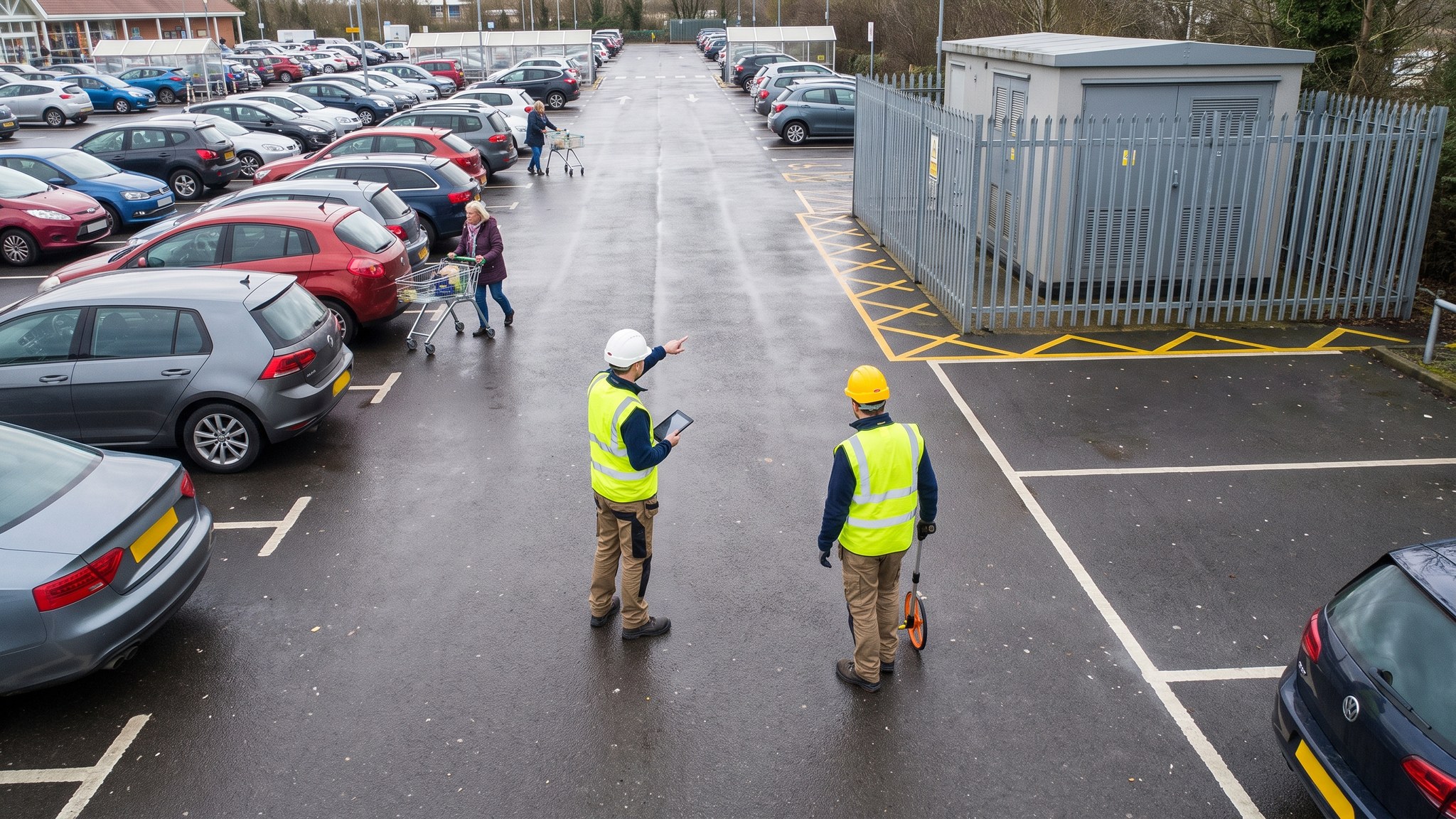
What is Connection using spare capacity in the existing supply?
Every charging project starts with the same question: how much electrical capacity does this site already have, and how much of it is spare. A retail park, a depot, a hotel or an office already takes a supply sized for its lighting, heating, refrigeration and machinery. If the peak demand of that existing operation sits well below the agreed capacity of the connection, the difference can in principle feed chargers without any application to the network operator for more. That is by a wide margin the cheapest and quickest outcome. There is no reinforcement to pay for, no quotation to accept, no long wait in a connections queue, and the works reduce to a distribution project inside the site boundary rather than a network project outside it.
The catch is that capacity is almost always the binding constraint, and that spare capacity on paper is not the same as spare capacity in use. Charging load is large relative to most building loads. A fast charger of the kind installed in a car park draws a fraction of what a rapid unit draws, a rapid charger commonly draws in the order of 50 kW, and an ultra-rapid several times that - so a handful of high-powered units can exceed the entire demand of the building they sit beside. It is also load that arrives without warning and at the least helpful moment. The worst case is not the average day. It is the cold winter evening when the building is at full demand and every charging bay is occupied, and that is the case the assessment has to survive.
So the route is only opened by evidence. On most projects that means metered half-hourly demand data over a full year rather than a nameplate figure, a check on what the existing agreed capacity actually is with the network operator, and an assessment by the designer of the headroom left once the true peak, a diversity allowance and a margin for the building's own future growth are taken off. Where the answer is generous, the project proceeds quickly and cheaply. Where it is marginal, the honest options are fewer or lower-powered chargers, active load management to share what exists, or an application for more capacity. What must not happen is capacity being assumed from a drawing, a rating plate or an optimistic memory of what the building uses, because the cost of discovering the error is a site that trips under load after it has opened.
How does Connection using spare capacity in the existing supply work, step by step?
- 1
Step 1: Establish what the existing connection actually is
The first task is documentary. The designer establishes the agreed capacity of the existing connection with the network operator, the form the supply takes, who owns which part of the equipment on site, and where the boundary between network and customer assets sits. On older sites the paperwork is often thin, contradictory or describes an arrangement that has since been altered. Where records and reality disagree, reality wins and the records are corrected. This step is desk and enquiry work, and it is worth doing thoroughly because every later decision rests on the number it produces.
- 2
Step 2: Measure real demand over a full year
Nameplate ratings describe what equipment could draw, not what the site does draw, and the gap between the two is usually large. On most projects the assessment uses metered half-hourly consumption data across at least twelve months, so that seasonal peaks, weekday and weekend patterns and holiday shutdowns are all visible. Where that data is not available - an unmetered supply, a recently altered site, a new tenant - temporary monitoring is installed for a representative period. The output is a demand profile, not a single figure, because the shape of the day is what decides whether charging load can be fitted around the existing operation.
- 3
Step 3: Model the charging load honestly
The designer then adds the proposed charging demand to the measured profile. Charging load is modelled from the number of connection points, their rated output and a realistic view of how many are drawing at once. Diversity is genuine on a large car park of slower units where cars sit for hours; it is thin on a small bank of high-powered units where every arriving vehicle wants full output immediately. Assumptions are stated explicitly and agreed with the client, because the difference between an optimistic and a conservative diversity assumption can be the difference between this route and an expensive network application.
- 4
Step 4: Test the combined worst case
The combined profile is tested against the agreed capacity at the worst coincidence rather than the average. That means the day of highest building demand overlaid with full occupancy of the charging bays. A margin is added for the building's own known future growth, since a scheme that consumes every last unit of headroom leaves the occupier unable to change anything afterwards. Where the combined case sits comfortably inside the agreed capacity, the route is confirmed. Where it does not, the project moves to load management, to a reduced scheme or to an application for more capacity.
- 5
Step 5: Confirm the existing equipment can carry the new load
Having enough capacity at the meter is not the same as having equipment fit to distribute it. The designer surveys the existing switchgear and distribution equipment for condition, age, remaining spare ways, available space and the practicality of adding to it. Assessment of the existing installation, and any decision about what may be reused, is work for competent qualified people, carried out under permit with the equipment treated as live until proven otherwise. It is common for this survey to be the point at which the cheap route stops being cheap, because the capacity exists but the board it would come from does not have room for it.
- 6
Step 6: Agree the position with the network operator
Even where no increase in capacity is sought, the network operator is normally notified of what is being connected, and on many projects that notification is a formal requirement rather than a courtesy. The operator decides whether the proposal is acceptable within the existing agreement, whether any conditions attach to it, and whether the load type triggers any additional assessment. Getting that position in writing early protects the programme. Discovering after installation that the operator takes a different view of the same connection is an expensive way to learn the same fact.
- 7
Step 7: Design and build the distribution within the site
With the route confirmed, the project becomes a straightforward one of taking the available capacity from the existing intake to the charging bays. That means the distribution equipment, the routes for cable across the site, the bases the chargers stand on and the metering and communications the operator of the chargers needs. Because the supply already exists and is in use, this work happens on a live site and around an occupier who has to keep trading. Sequencing, temporary arrangements and clear agreement on any planned outages matter as much as the electrical design.
- 8
Step 8: Commission, then verify against the model
Commissioning is carried out by competent qualified people to the designer's specification, and the results are recorded. The step that is most often skipped is the one after: monitoring actual combined demand once the chargers are in service and comparing it with the model that justified the scheme. Real utilisation almost never matches the forecast exactly. Where it exceeds it, the site finds out from data rather than from a nuisance outage, and the operator has time to restrict output or apply load management before there is a problem.
What are the benefits of Connection using spare capacity in the existing supply?
- By far the cheapest route, because no reinforcement of the network is paid for
- By far the fastest route, because the project avoids the connections queue entirely
- Works stay inside the site boundary, so no highway opening or third-party land is needed
- Programme risk is largely under the client's control rather than the network operator's
- Makes productive use of capacity the site is already paying to have available
- Keeps the scheme small enough to be delivered while the site continues to trade
What are the limitations of Connection using spare capacity in the existing supply?
- Capacity is usually the binding constraint, and it caps the number and power of the chargers
- Spare capacity on paper often disappears once the true winter peak is measured
- Existing switchgear and distribution equipment may have no room to accept the new load
- Leaves little or no headroom for the building's own future growth unless a margin is reserved
- Any later expansion of the charging scheme will need the network application avoided this time
- Depends on demand data that is sometimes unavailable, incomplete or unrepresentative
What is Connection using spare capacity in the existing supply best suited for?
What plant does Connection using spare capacity in the existing supply need?
- Temporary demand monitoring equipment where metered data is unavailable
- Access equipment for survey of intake rooms, switch rooms and riser routes
- Thermal imaging and condition survey equipment for the existing installation
- Small excavation and cable installation plant for the distribution within the site
- Test instruments for commissioning by competent qualified people
- Traffic management for works within a live car park or forecourt
How is Connection using spare capacity in the existing supply quality-checked?
- Agreed capacity confirmed in writing with the network operator, not taken from site records alone
- Twelve months of half-hourly demand data obtained, or representative monitoring carried out
- Diversity and utilisation assumptions written down and signed off by the client
- Combined worst-case assessment carried out against winter peak, not average demand
- Condition and spare capacity of existing equipment surveyed by competent qualified people
- Post-energisation monitoring compared against the design model, with a defined review point
More site survey & grid application methods
Next method
A new or upgraded network connection