Containerised modular units on external plinths
The process arrives factory-built and tested in transportable enclosures, lands on prepared plinths, and site work is reduced to connections.
Last updated 2026-09-07
What is Containerised modular units on external plinths?
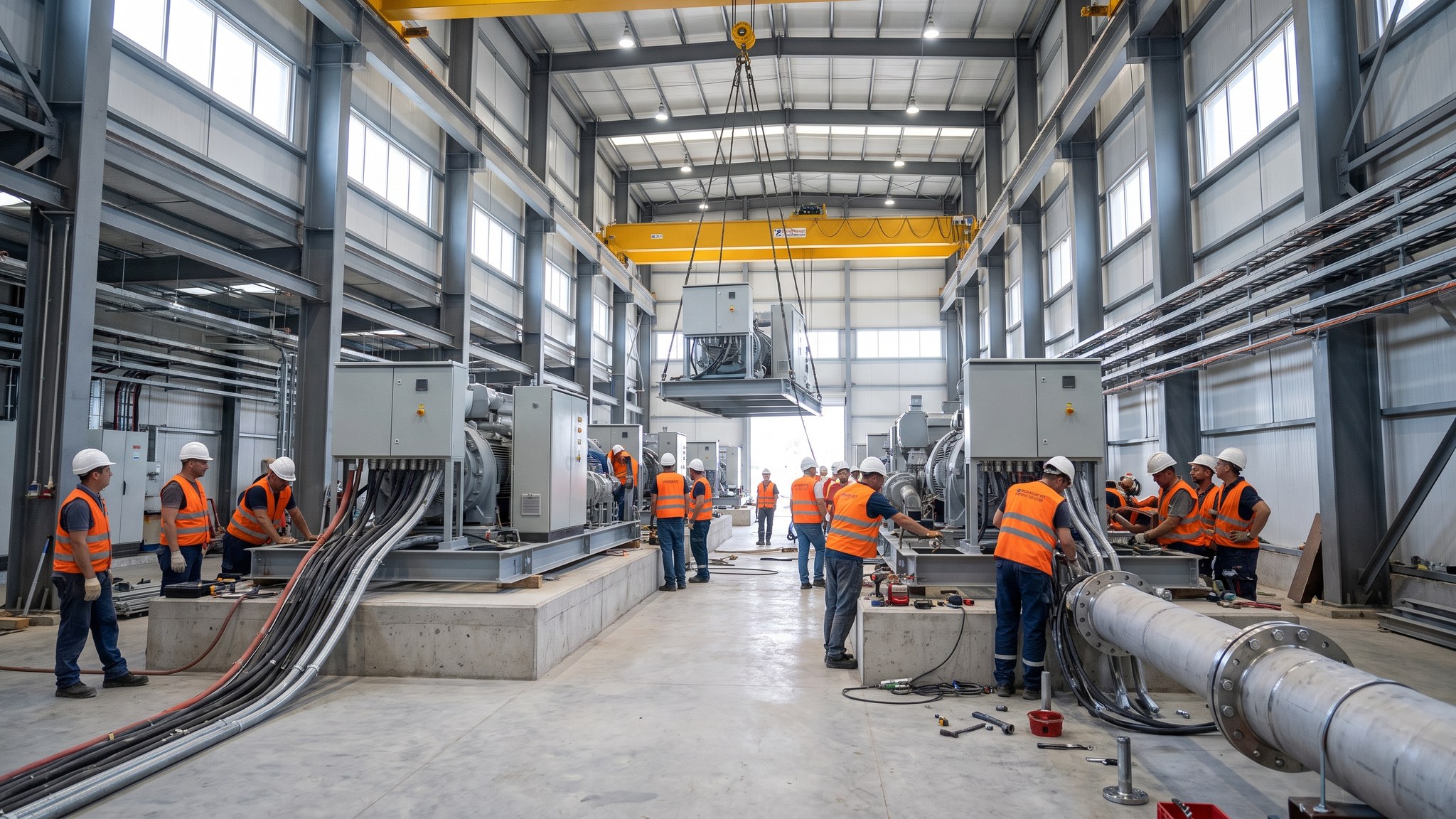
The dominant delivery model for electrolysis at present is the containerised module. The technology supplier builds the process inside a transportable enclosure in a factory, fits it out with its internal pipework, instrumentation, ventilation, detection and control, tests it before it leaves, and ships it to site as a unit. On site the module is lifted onto a prepared plinth, bolted down, and connected to power, water, gas, drainage, earthing and control. What would once have been months of site pipefitting and electrical installation inside a hazardous area becomes a lift, a set of connections and a commissioning programme.
The reason this model has taken hold is quality and risk. Work done in a factory is done in a controlled environment by people doing the same task repeatedly, with inspection and testing designed into the process. Hydrogen is unforgiving - it forms an explosive atmosphere over a very wide range, burns with an almost invisible flame and embrittles some steels - so the fewer connections made in the field, and the more of the system that has been tested before it arrives, the better the risk position. The technology supplier retains responsibility for what is inside the enclosure, which is also commercially cleaner: the supplier warrants a tested unit rather than an assembly built by others.
The cost is flexibility. The layout of the plant follows what the supplier can build and transport rather than what would be ideal for the site. Module dimensions are set by road transport limits, so the plant is arranged in units of that size whether or not the site suits it. Access and maintenance space around each enclosure is set by the supplier, and the spacing between modules is set by the designer, the technology supplier and the regulator together on hazard grounds rather than by the site planner. The civils package has almost no freedom here: the plinths, the interface points and the access arrangements are all dictated, and the contractor's job is to build them accurately and on the date the delivery programme requires.
How does Containerised modular units on external plinths work, step by step?
- 1
Step 1: Fix the interface with the technology supplier
Everything begins with the supplier's interface documents: module dimensions and weights, base frame and bolt geometry, lifting points, connection positions for power, water, gas, drainage, earthing and control, access and maintenance space, and the spacing between units. On most projects these are contractual documents and any change to them is managed as a formal revision. The civils and electrical packages design to those interfaces, and the sequence of the whole project is written around the supplier's delivery dates.
- 2
Step 2: Build and survey the plinths to the supplier drawing
The plinths are built to the bolt geometry and level tolerance the supplier states. On most projects bolts are set in templates, surveyed before the pour and surveyed again after it, and the results issued to the supplier before the module is despatched. Level tolerance across the plinth matters because the module's internal alignment assumes a flat support. A plinth built to ordinary industrial tolerance is not necessarily good enough, and finding that out on the day of the lift is the expensive way to discover it.
- 3
Step 3: Plan the delivery route and the lift
The module is an abnormal load with a fixed transport window. The route from the port or factory to the plinth is surveyed for width, height, turning and bridge capacity, and the on-site route is built as designed hardstanding. The lift is planned by the appointed person against the supplier's lifting points and weights, with crane positions on certified platforms. On most projects the lift plan is reviewed with the supplier, because using the wrong lifting arrangement on a tested process module can invalidate what the supplier has warranted.
- 4
Step 4: Receive, inspect and land the module
The module is inspected on arrival for transport damage before it is accepted, with the supplier present or represented. It is then lifted, guided onto the bolt group and landed. Packing, shimming and levelling follow the supplier's procedure, and the final position and level are surveyed and recorded. On most projects the module is not released for connection until that survey is accepted, because a module out of position moves every connection that follows.
- 5
Step 5: Make the mechanical and electrical connections
Power, water, gas, drainage, earthing, instrument air and control connections are made at the defined interface points. This is the field work that the modular approach exists to minimise, and it is done to the supplier's procedures under the site permit system. The technology supplier normally specifies the materials and methods for anything in hydrogen service, and the contractor follows that specification rather than substituting an equivalent, because material behaviour in hydrogen service is a matter for the supplier and the designer.
- 6
Step 6: Complete the external safety and detection systems
Outside the enclosure the project installs whatever the safety design calls for around it: detection, alarms, emergency shutdown links, firefighting provision, signage, barriers and the arrangements that keep ignition sources out of the areas the designer has identified as hazardous. The extent, positions and settings all come from the designer, the technology supplier and the regulator. The construction team installs and proves what is specified and does not adjust it.
- 7
Step 7: Test the interfaces before energising anything
Connections are tested to the specification before the system is brought into service - electrical, control, water and drainage first, with anything in gas service tested under the supplier's procedure. Earthing and bonding continuity is proved. Control and shutdown signals are verified end to end between the module and the site systems. On most projects this is a documented hold point, and the plant does not proceed to introduce gas until the interface testing is signed off.
- 8
Step 8: Hand the module to the supplier for commissioning
Once the interfaces are proved the module is handed to the technology supplier to commission. Commissioning of the process itself belongs to the supplier and follows its procedures, with the operator's and the regulator's involvement as required. The construction team's role becomes support and access. On most projects the handover is documented item by item, and the construction contractor retains responsibility only for what it built outside the enclosure.
What are the benefits of Containerised modular units on external plinths?
- The process is built and tested in a factory, so far fewer connections are made in the field
- Very short site installation period once the plinth is ready - a lift and a set of connections
- The technology supplier retains responsibility for the tested contents of the enclosure
- Repeatable, so quality improves and cost falls across successive units
- Reduces exposure of site personnel to work inside areas the designer treats as hazardous
- Units can be delivered and installed progressively rather than waiting for a whole plant to be built
What are the limitations of Containerised modular units on external plinths?
- The plant layout is dictated by what the supplier can build and transport, not by what suits the site
- Module size is capped by road transport limits, which sets the granularity of the whole plant
- Plinth and bolt tolerances are unforgiving, and errors stop a delivery rather than generating a snag
- Abnormal-load deliveries need designed routes, fixed transport windows and heavy lifting resource
- Maintenance access is limited to what the supplier designed into the enclosure
- Strong dependence on a single supplier for spares, support and future modification
What is Containerised modular units on external plinths best suited for?
What plant does Containerised modular units on external plinths need?
- Heavy mobile or crawler cranes with the rigging specified for the supplier's lifting points
- Abnormal-load transport, self-propelled trailers and escort arrangements
- Jacking, skating and packing equipment for final positioning and levelling
- Precise survey equipment for bolt groups, plinth levels and final module position
- Mechanical and electrical connection equipment to the supplier's specified methods
- Testing equipment for electrical, control, earthing and interface proving
How is Containerised modular units on external plinths quality-checked?
- Bolt geometry and plinth level surveyed before and after the pour and issued to the supplier before despatch
- Module inspected for transport damage on arrival, with the supplier present or represented
- Final module position and level surveyed and accepted before connections are made
- Connections made to the supplier's specified materials and methods, recorded joint by joint
- Earthing and bonding continuity proved and recorded
- Interface and shutdown signals verified end to end as a documented hold point before the system is brought into service
More electrolyser hall & installation methods
Next method
Modules installed inside a purpose-built hall