Hybrid - modular process packages with a site-built electrical installation
The arrangement most real projects end up with - the process arrives factory-tested, the substantial electrical installation is built on site.
Last updated 2026-09-07
What is Hybrid - modular process packages with a site-built electrical installation?
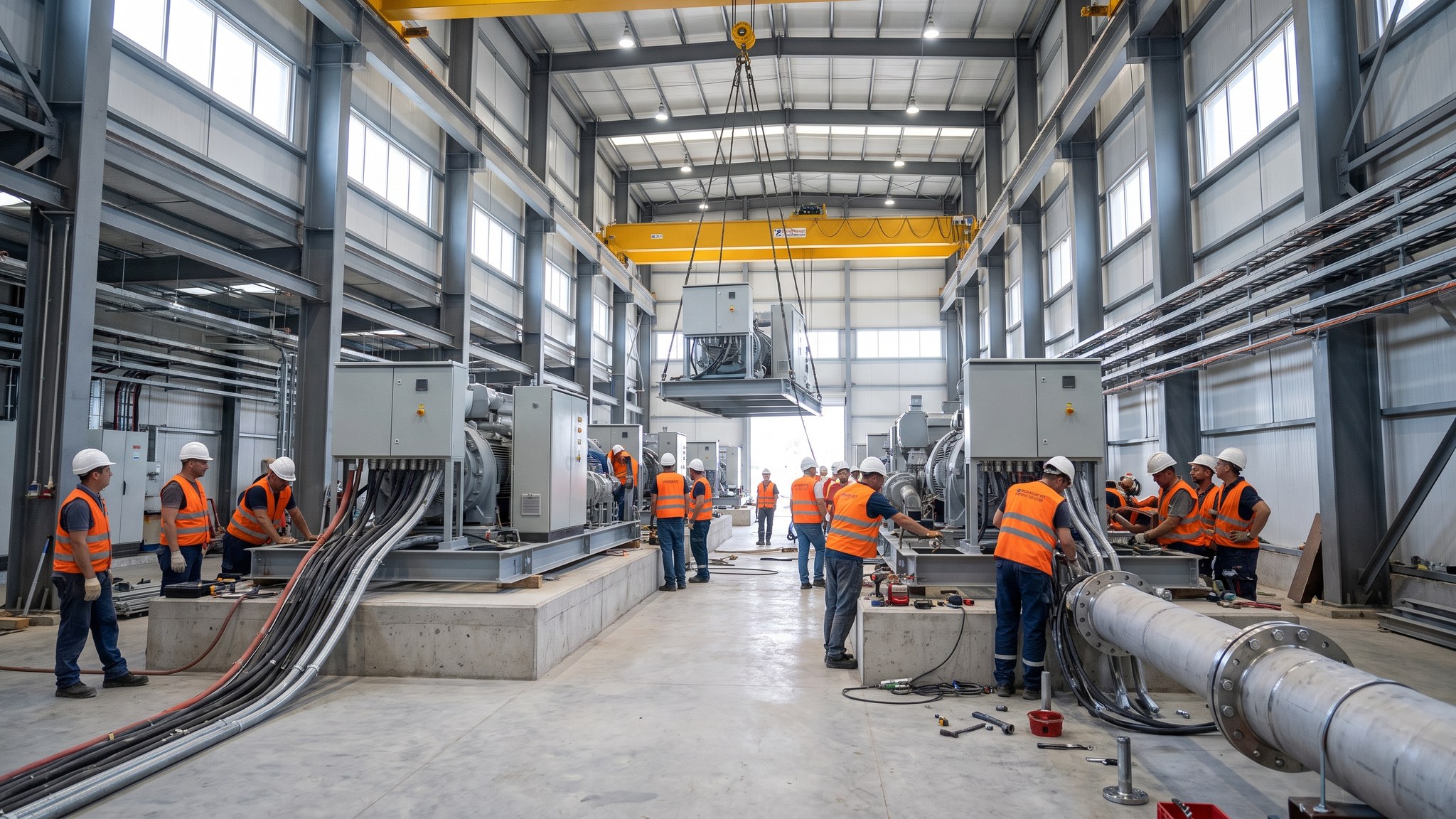
The pure modular model is tidier in a brochure than on a project. In practice the process packages arrive factory-built and tested, and a great deal of everything else is built in the field. The reason is scale. Electrolysis at production scale draws an enormous electrical load, and the equipment that delivers it - the incoming connection, the transformers, the rectifiers, the switchgear, the busbars and the cabling - is too large, too heavy and too site-specific to arrive as a container. Some of it is modular; much of it is delivered as major components and assembled, connected and tested on site.
That gives a project with two very different halves. The process side is a lift-and-connect operation on the supplier's programme, with the supplier carrying responsibility for what is inside the enclosures. The electrical side is a conventional heavy industrial installation with months of on-site work: cable pulling through the duct network, terminations, busbar assembly, protection and control installation, and a long testing and energisation sequence. The two halves have different contractors, different disciplines, different documentation and different risk profiles, and they have to arrive at commissioning together.
Managing the interface is the real work. The process modules cannot be commissioned until power is available; the electrical installation cannot be fully tested until there is something to energise. The grid connection date is fixed by others, the module delivery dates are fixed by the supplier, and the civils have to serve both. On most projects the answer is to sequence the site into areas, complete and release the electrical compound first, run the cabling infrastructure while the modules are still being built, and then bring the two together in a planned integration and commissioning programme. Coordination is heavier than either half would need alone, and the projects that struggle are usually the ones that treated the interface as somebody else's problem.
How does Hybrid - modular process packages with a site-built electrical installation work, step by step?
- 1
Step 1: Split the scope at a defined interface
The project defines exactly where the supplier's scope ends and the site installation begins - physically, electrically and contractually. Every connection point is identified: the terminal, the flange, the duct entry, the control signal. On most projects this is done early and in writing, because an undefined interface becomes a dispute at the worst possible moment. The interface schedule is then the document both halves of the project work to.
- 2
Step 2: Build and release the electrical compound first
The electrical compound is normally the first substantial structure completed, because the grid connection date is fixed by others and the electrical installation needs months of site work. Foundations, containment, ducts and earthing go in, and the compound is handed over to the electrical contractor while the process area civils are still under way. That release is documented, and the compound is then fenced and protected while construction continues around it.
- 3
Step 3: Install the heavy electrical equipment on site
Transformers, rectifiers and switchgear arrive as major components and are placed, assembled, connected and tested in the field. This is conventional heavy electrical installation work, with its own lifting, alignment and testing requirements. On most projects it takes far longer than the process module installation, which is precisely why it starts first. Progress is measured in terminations and tests rather than in lifts.
- 4
Step 4: Run the cabling and busbar infrastructure
Cables are pulled through the duct network built as part of the civils package, and busbars and cable support systems are installed along the routes. The volume of cable on a plant of this type is considerable and the pulling operation depends entirely on the ducts and pits having been built and proved correctly. On most projects this is where a defect in the buried infrastructure surfaces, so ducts are proved before backfill rather than trusted.
- 5
Step 5: Land the process modules on the supplier's programme
The process packages arrive on their own delivery dates and are landed on plinths built and surveyed to the supplier's drawings. This half of the project runs the modular sequence - route survey, lift plan, arrival inspection, landing, levelling, survey acceptance. It happens alongside, not after, the electrical works, so the site has to accommodate heavy lifting operations in areas where electrical installation is already under way.
- 6
Step 6: Coordinate two programmes in one live site
The heaviest management task is running two large work fronts together. Crane operations for module landing take place near live electrical installation work; cable pulling crosses routes needed for deliveries; and both halves want the same access at the same time. On most projects this is managed through a coordinated area-by-area plan with daily interface meetings, and the permit system does real work rather than paperwork. Areas are handed between contractors formally, not by custom.
- 7
Step 7: Make and test the interface connections
The connections at the defined interface - power, control, earthing, water, drainage and process - are made under the supplier's specified methods and materials and tested to the specification. Control and shutdown signals are verified end to end between the modules and the site systems. On most projects this is where the two documentation sets have to reconcile, and gaps between the supplier's test records and the site test records are closed before energisation rather than after.
- 8
Step 8: Energise and commission in a planned sequence
Energisation follows a planned sequence agreed between the electrical contractor, the technology supplier, the operator and the network operator, with the regulator involved as required. The electrical system is energised and proved before the process is commissioned, and process commissioning then follows the supplier's procedures. On most projects this integration period is longer than either party estimates alone, and the projects that finish on time are the ones that planned it as a distinct phase with its own programme.
What are the benefits of Hybrid - modular process packages with a site-built electrical installation?
- Keeps the factory testing and quality benefit for the process while allowing the electrical system to be built at the scale the site needs
- Lets the electrical works start early against a fixed grid connection date, off the module critical path
- Suits site-specific electrical arrangements that no supplier could deliver as a standard package
- Allows the two halves to progress in parallel, shortening the overall programme
- Gives the client a conventional, maintainable electrical installation rather than a proprietary one
- Reflects how these projects actually get built, so estimates and programmes based on it tend to hold
What are the limitations of Hybrid - modular process packages with a site-built electrical installation?
- Two contractors, two programmes and two documentation sets on one site - coordination is the dominant risk
- Interface responsibility gaps become disputes if the split is not defined in writing early
- Heavy lifting operations run alongside live electrical installation work, which is a demanding safety picture
- Much more site electrical labour, with the quality control burden that comes with fieldwork
- Integration and commissioning consistently take longer than either party allows for
- A delay in either half stalls the other, since neither can be commissioned alone
What is Hybrid - modular process packages with a site-built electrical installation best suited for?
What plant does Hybrid - modular process packages with a site-built electrical installation need?
- Heavy cranes for module landing and for placing transformers and switchgear
- Abnormal-load transport for both process packages and major electrical components
- Cable pulling equipment, winches, rollers and busbar installation gear
- Mobile elevating work platforms and access equipment for cable support and terminations
- Electrical testing equipment for terminations, protection, earthing and energisation
- Survey equipment for plinths, bolt groups and equipment alignment
How is Hybrid - modular process packages with a site-built electrical installation quality-checked?
- Written interface schedule identifying every physical, electrical and contractual connection point
- Documented area handovers between the civils, electrical and process contractors
- Duct and pit network proved before cable pulling begins
- Terminations, protection settings and earthing tested and recorded to the specification
- Supplier test records and site test records reconciled before energisation
- Energisation and commissioning sequence agreed in advance and executed against a written programme with hold points