Above-ground process pipework within the plant
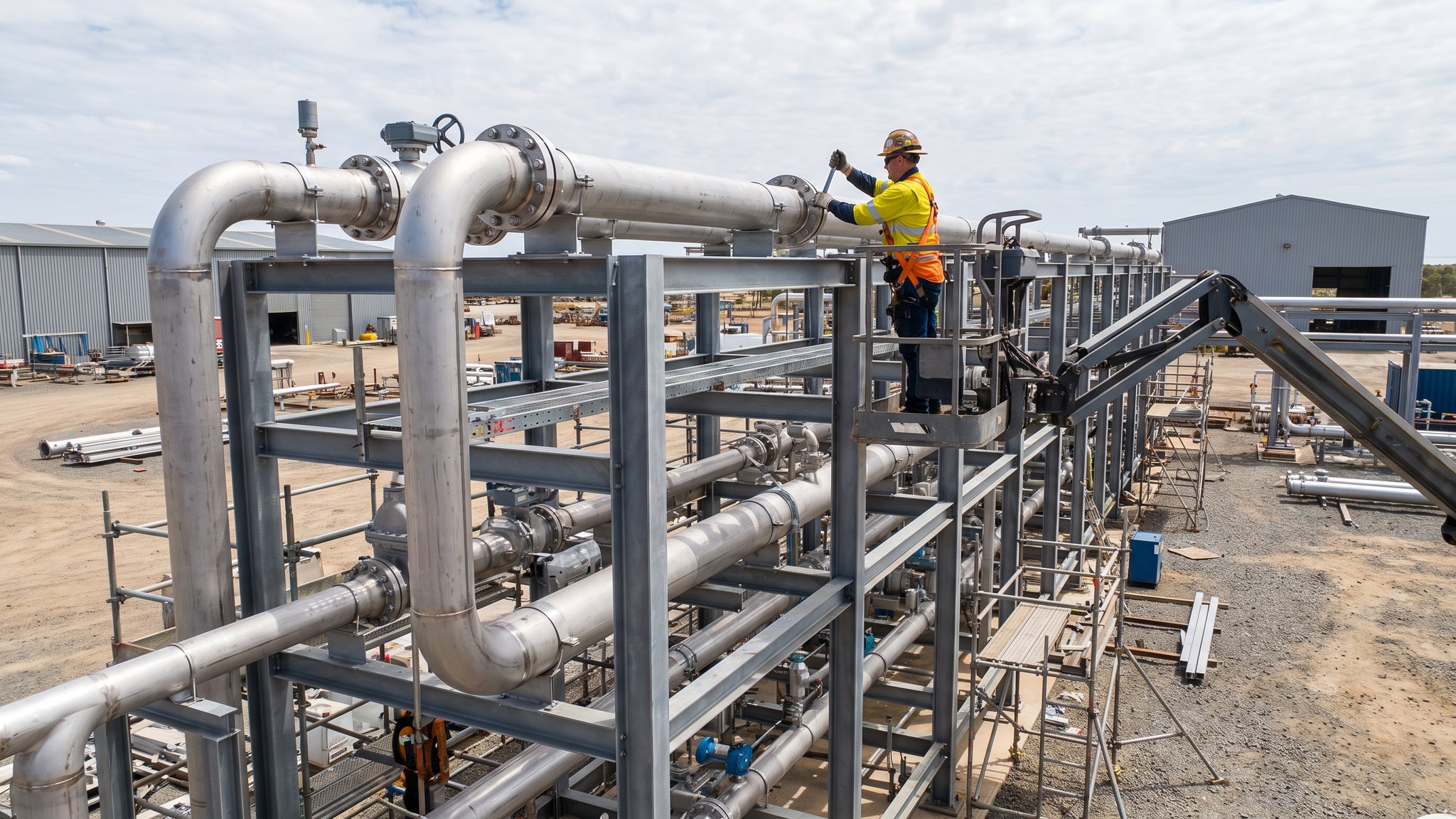
The visible pipework on racks and supports - preferred because a release disperses into the open and every joint can be reached and inspected.
Last updated 2026-09-07
What is Above-ground process pipework within the plant?
Walk around a hydrogen plant and most of what you see is pipework. It runs on racks between the electrolysis packages, the gas treatment, the compression, the storage and the export point, carrying process gas, cooling water, instrument air, nitrogen, drains and vents. Almost all of it is above ground and that is a deliberate choice. Hydrogen is very light and disperses upwards fast, so a release from an above-ground line in the open air dilutes quickly rather than accumulating. The same release from a buried line has nowhere obvious to go and may travel along the trench or into a chamber. Above ground, the plant also stays visible: every joint, support and fitting can be walked, looked at, monitored and worked on without excavation.
The engineering is governed by two things that run through the whole discipline. The first is material compatibility. Hydrogen affects some steels in ways that other gases do not, so the designer selects materials for hydrogen service specifically and the contractor does not substitute against them for reasons of availability or price. Traceability from mill to installed position is carried through, and any proposed change is a formal technical query. The second is joint integrity. Hydrogen finds its way through joints that would hold other gases comfortably, so the design minimises the number of joints, the specification sets how each one is made and by whom, and the contractor keeps a record connection by connection. This is the single most important quality regime on the project.
The practical work is precision fabrication and disciplined installation. Pipework is modelled, spooled and fabricated off site in controlled conditions wherever possible, which puts more of the jointing into a workshop and less of it on a rack at height. That only works if the plant is where the model says it is, so as-built survey of foundations, skids and vessels is issued before fabrication is released. Supports, guides and anchors are designed for thermal movement and vibration, and they are installed as designed - a support left slack or a guide moved to clear an obstruction transfers load into a joint that was never meant to carry it. Layout has to allow for access, for maintenance, and for the routine external inspection that the operator will carry out for decades.
How does Above-ground process pipework within the plant work, step by step?
- 1
Step 1: Route the pipework to the hazardous-area layout
Routing is not a drawing-office optimisation. The designer works within the hazardous-area layout agreed with the technology supplier and the regulator, keeping process lines away from occupied buildings, ignition sources and escape routes, and arranging racks so that any release goes upward into open air. Segregation between process, utility and electrical routes is set by the design. The contractor builds the route as drawn and raises clashes back through the designer.
- 2
Step 2: Select materials and prove their traceability
The designer specifies pipe, fittings, valves and gaskets for hydrogen service, and the contractor procures against that specification without substitution. Certification is obtained at order, checked on delivery, and traced through fabrication to the installed position so that every length in the plant can be identified from the records. On most projects material traceability is audited by the operator before the pipework is accepted, and gaps in it are expensive to close after the event.
- 3
Step 3: Model the plant and release spools against as-built survey
The pipework is modelled in three dimensions against the equipment, structures and civils, then split into spools for workshop fabrication. Spool release depends on the as-built survey of what is actually installed - foundations, bolt groups, skids and vessels - rather than on the design positions. Releasing fabrication before that survey exists is one of the most common and most expensive mistakes on plants of this type, because a spool that does not fit becomes site alteration work on hydrogen service.
- 4
Step 4: Fabricate in a workshop wherever possible
Fabrication is carried out in controlled conditions by qualified personnel working to the designer's specification, with the work inspected as it proceeds. Moving jointing off the rack and into a workshop improves both the quality and the record, because the conditions are repeatable and the inspection is easier. The specification sets the fabrication and inspection regime; it is not for the contractor to vary it, and the acceptance criteria are agreed before fabrication begins rather than negotiated after a result.
- 5
Step 5: Install racks, supports, guides and anchors
The rack structures and the supports on them are erected and surveyed before pipework is offered up. Supports, guides and anchors are designed for thermal movement, for vibration from the compression plant and for the weight of the line, and each is installed in the designed position and set as designed. Adjusting or omitting a support to clear an obstruction transfers load into joints and is treated as a design change, not a site decision.
- 6
Step 6: Erect the spools and make the site connections
Spools are lifted into position and connected, with the number of site-made joints kept to the minimum the design allows. Every site connection is made by qualified specialists to the specification and recorded individually, identifying the operative, the procedure and the inspection. That register is one of the principal documents the operator inherits, because it tells them where the site-made joints are on a plant where joint integrity governs everything.
- 7
Step 7: Install instrumentation, isolation and small-bore connections
Instrument connections, sample points, drains, vents and isolation arrangements are installed to the design. Small-bore connections deserve attention out of proportion to their size because they are numerous, they are easily damaged by site traffic and adjacent work, and they are a common source of leakage. The design sets their position, their support and their protection, and each is recorded like any other connection.
- 8
Step 8: Prepare, prove and hand over system by system
Pipework is cleaned, inspected and prepared for service system by system in the order the commissioning programme requires. The activities that follow - purging, inerting, leak testing and first fill - are the most hazardous on the whole project. They are carried out by specialists under the operator's permit system to procedures written for that plant, and nothing about them is generic. Handover is documented, with the material records, the joint register, the support records and the as-built model issued to the operator.
What are the benefits of Above-ground process pipework within the plant?
- A release disperses upwards into open air rather than accumulating in a trench or chamber
- Every joint, support and fitting can be inspected and maintained without excavation
- Leaks can be found and reached quickly, which matters on a gas that is hard to see burning
- Workshop fabrication puts most jointing into controlled conditions with a better record
- Routes can be modified or extended later without disturbing the ground
- Supports and guides are visible, so their condition can be monitored throughout the plant's life
What are the limitations of Above-ground process pipework within the plant?
- Pipe racks occupy space at ground and at height and constrain the plant layout
- Lines are exposed to weather, to impact from site and operational traffic and to external corrosion
- Racks are a visual feature of the plant and can be an issue in planning and community terms
- Working at height is a constant feature of both installation and maintenance
- Thermal movement and vibration from compression plant have to be designed for explicitly
- Spool fabrication depends on as-built survey, so survey error propagates straight into rework
What is Above-ground process pipework within the plant best suited for?
What plant does Above-ground process pipework within the plant need?
- Pipe fabrication workshop facilities with qualified personnel and inspection equipment
- Mobile cranes and telehandlers for rack erection and spool placement
- Mobile elevating work platforms and scaffolding for work at height
- Precise survey instruments and laser scanning for as-built capture and model verification
- Specialist jointing and inspection equipment operated under the designer's regime
- Cleaning and preparation equipment for system readiness before commissioning
How is Above-ground process pipework within the plant quality-checked?
- Material certification traced from order through fabrication to installed position
- As-built survey issued and accepted before spool fabrication is released
- Fabrication inspected to the specified regime with acceptance criteria agreed beforehand
- Supports, guides and anchors checked against the design position and setting, one by one
- Joint register recording every site-made connection with operative, procedure and inspection
- System readiness records and as-built model issued to the operator at handover
More pipework & distribution methods
Next method
Buried site distribution and export mains