Buried site distribution and export mains
Runs taken below ground where crossing a road or leaving the site demands it - protected, marked, recorded, and far harder to inspect.
Last updated 2026-09-07
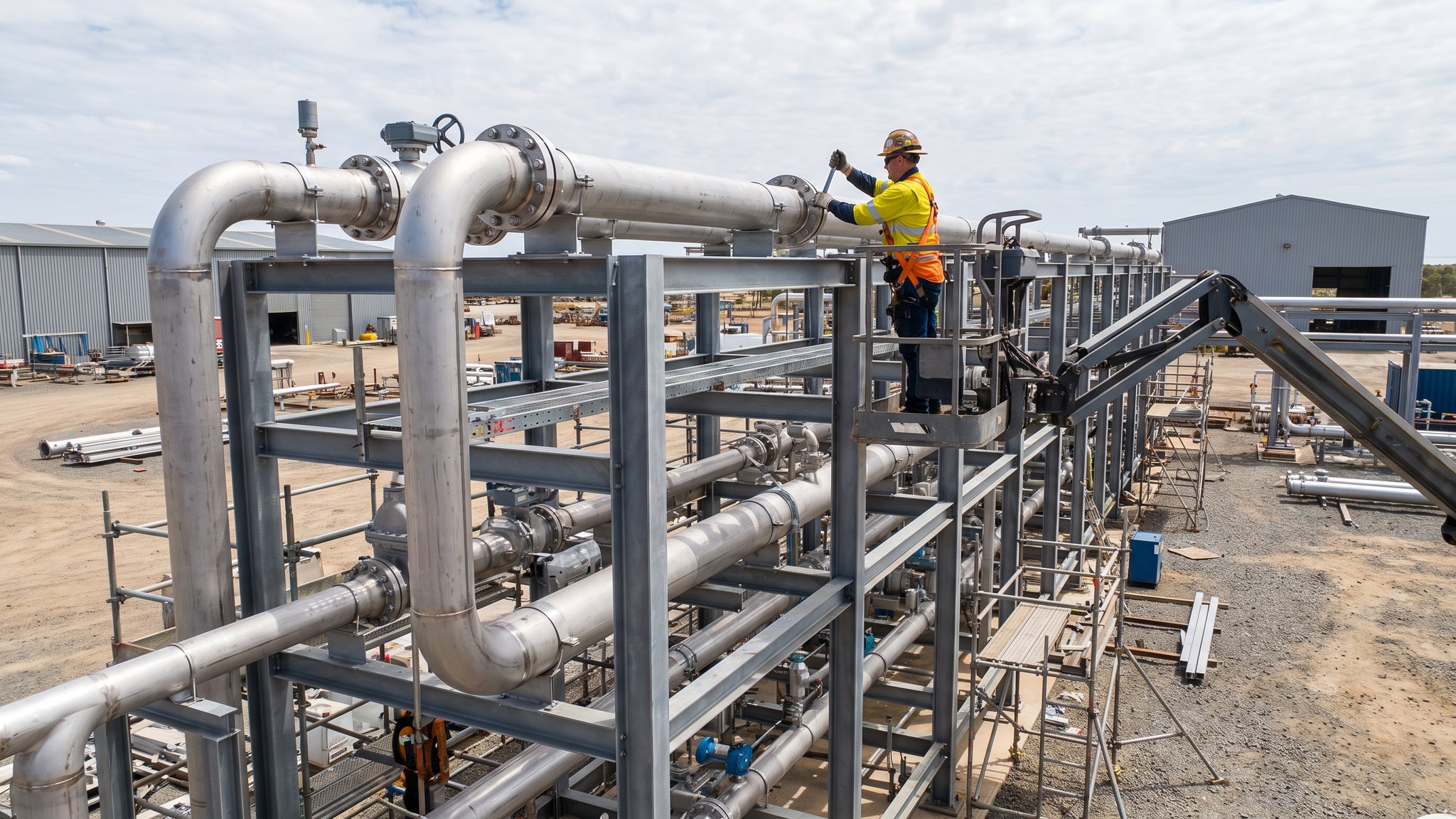
What is Buried site distribution and export mains?
Above ground is the default on a hydrogen plant, but some runs cannot stay there. A line has to cross a road or a rail siding, pass under a laydown area that needs to stay clear, or leave the fenced boundary altogether to reach a jetty, a neighbouring works or a network connection. In those situations the pipework goes below ground, and the design changes character. A buried line is protected from impact and from weather, it takes up no land at surface and it presents nothing to the eye, which matters where a route crosses land the developer does not control. In exchange the line becomes something that cannot be looked at.
That trade is the whole of the design problem. Above ground a leak disperses upward and a walking inspection finds a problem. Buried, a release has nowhere obvious to go, it may travel along the trench or the surround, and it may appear at a chamber or a joint bay some distance from where it started. The designer answers this with the arrangement rather than with inspection: routes are kept as straight and as simple as the ground allows, joints below ground are minimised because they are the points that cannot later be reached, the line is given protection appropriate to what is above it, and crossings of roads and other services are formalised. Marker arrangements, route records and a scheme for periodic assessment substitute for the walk-past that above-ground pipework gets for free.
The construction is civils-led but the pipework discipline still governs. Material compatibility and joint integrity apply exactly as they do above ground - the designer specifies materials for hydrogen service and the contractor does not substitute - and any joint that will be buried carries more consequence than one that will not, because it will never again be accessible. Where the route leaves the site, the project acquires easements, third-party consents, statutory undertaker interfaces and reinstatement obligations that have nothing to do with plant construction and everything to do with linear works. On most projects the off-site section of an export main is programmed and managed as a separate operation from the plant, because it behaves like one.
How does Buried site distribution and export mains work, step by step?
- 1
Step 1: Establish why the route has to be buried
The designer decides which runs go below ground and why - a road or rail crossing, an area that must stay clear at surface, a departure from the site, or land the developer does not control. On most projects that decision is made reluctantly, because the inspection advantage of above ground is real. Recording the reason matters, because it tells the operator later why a length of the plant is where they cannot see it.
- 2
Step 2: Survey the route and find what is already there
Ground investigation, service searches and detection surveys establish what the trench will meet: existing services, obstructions, old foundations, contamination and groundwater. On former industrial land, and particularly on port and refinery estate, records of buried services are frequently incomplete, so the route is proved on the ground rather than taken from a drawing. Trial holes at crossings and at any uncertainty are normal practice, and finding an unrecorded service by excavator is not.
- 3
Step 3: Secure the land, consents and third-party agreements
Where the route leaves the site, easements, wayleaves and consents are obtained from landowners, highway and rail authorities, statutory undertakers and the regulator, and reinstatement obligations are agreed. This is a legal and commercial programme running alongside the engineering, and on most projects it, rather than construction, sets the date the export main can be built. The construction team is given the route it has been granted, not the one it would choose.
- 4
Step 4: Select materials and design the protection
Materials are specified by the designer for hydrogen service and traced from order to installed position. Protection - external coating, bedding and surround, mechanical protection where loading demands it, and any additional measures the designer specifies at crossings - is designed for what will pass above and for the ground conditions along the route. The contractor builds the specified arrangement and does not vary it to suit ground that turns out to be different, but raises it as a technical query.
- 5
Step 5: Excavate, support and prepare the trench
Excavation is carried out with the excavation support the ground requires, with groundwater controlled and with the excavated material handled as a waste stream where the ground is contaminated. Formation is prepared and bedding placed to the design. Trench safety on a deep run in made ground is a significant risk in its own right, entirely separate from the hydrogen risk, and it is managed as such throughout.
- 6
Step 6: Weld and prove joints before anything is covered
The line is jointed by qualified specialists to the designer's specification, and every joint that will be buried is inspected and accepted before it is covered. Once backfilled it is beyond reach for the life of the plant, so the inspection point is the last opportunity. Joint bays and chambers are formed only where the design puts them, and their number is kept low, because a chamber is a confined space in which a release could collect.
- 7
Step 7: Backfill, mark and record the route accurately
Backfill and reinstatement follow the design and any agreement with the landowner or authority. Marker arrangements, warning layers and surface markers are installed so that anyone excavating in future finds the line before their machine does. The as-built route is surveyed accurately and recorded, and that record is issued to the operator and to the relevant service records. An inaccurate route record is a hazard handed forward to whoever digs next.
- 8
Step 8: Prepare, prove and hand over with a monitoring scheme
The line is cleaned, prepared and brought into service as part of the commissioning of the system it serves. Purging, inerting, leak testing and first fill are the most hazardous activities on the whole project, carried out by specialists under the operator's permit system to procedures written for that plant, and nothing about them is generic. Handover includes the joint records, the material traceability, the as-built route survey and the arrangement by which the operator will assess and monitor a line they cannot see.
What are the benefits of Buried site distribution and export mains?
- Allows routes to cross roads, rail and clear areas that above-ground pipework could not
- Protects the line from impact by site and operational traffic
- Takes up no land at surface, which matters on constrained sites and on third-party land
- Presents nothing to the eye, easing planning and community concerns on off-site routes
- Removes exposure to weather and to external damage from adjacent construction work
- Enables the plant to connect to a jetty, a neighbouring works or a network beyond the boundary
What are the limitations of Buried site distribution and export mains?
- The line cannot be inspected visually, so problems are found later and less directly
- A release below ground has nowhere to disperse and may travel along the trench
- Buried joints are beyond reach for the life of the plant once they are covered
- Off-site routes bring easements, consents and reinstatement obligations that dominate the programme
- Excavation on former industrial land meets unrecorded services, obstructions and contamination
- Repair or modification means excavation, disruption and a return to the consenting process
What is Buried site distribution and export mains best suited for?
What plant does Buried site distribution and export mains need?
- Excavators, dumpers and trench support systems suited to the depth and ground
- Service detection and survey equipment for route proving and trial holes
- Dewatering equipment where groundwater or tidal influence is present
- Pipe handling, jointing and inspection equipment operated by qualified specialists
- Trenchless crossing equipment where open-cut is not permitted at a road or rail crossing
- Compaction, reinstatement and surfacing plant for the route and for third-party land
How is Buried site distribution and export mains quality-checked?
- Route proved on the ground by detection survey and trial holes before excavation
- Material certification traced from order to installed position along the route
- Every buried joint inspected and accepted before it is covered, with records held
- Bedding, surround, protection and marker arrangements checked against the design as laid
- As-built route surveyed accurately and issued to the operator and to service records
- Reinstatement agreed and signed off with the landowner or authority for each section