Alternating current collector topside on a jacket
The standard arrangement, gathering the array circuits and stepping voltage up for export to shore.
Last updated 2026-09-07
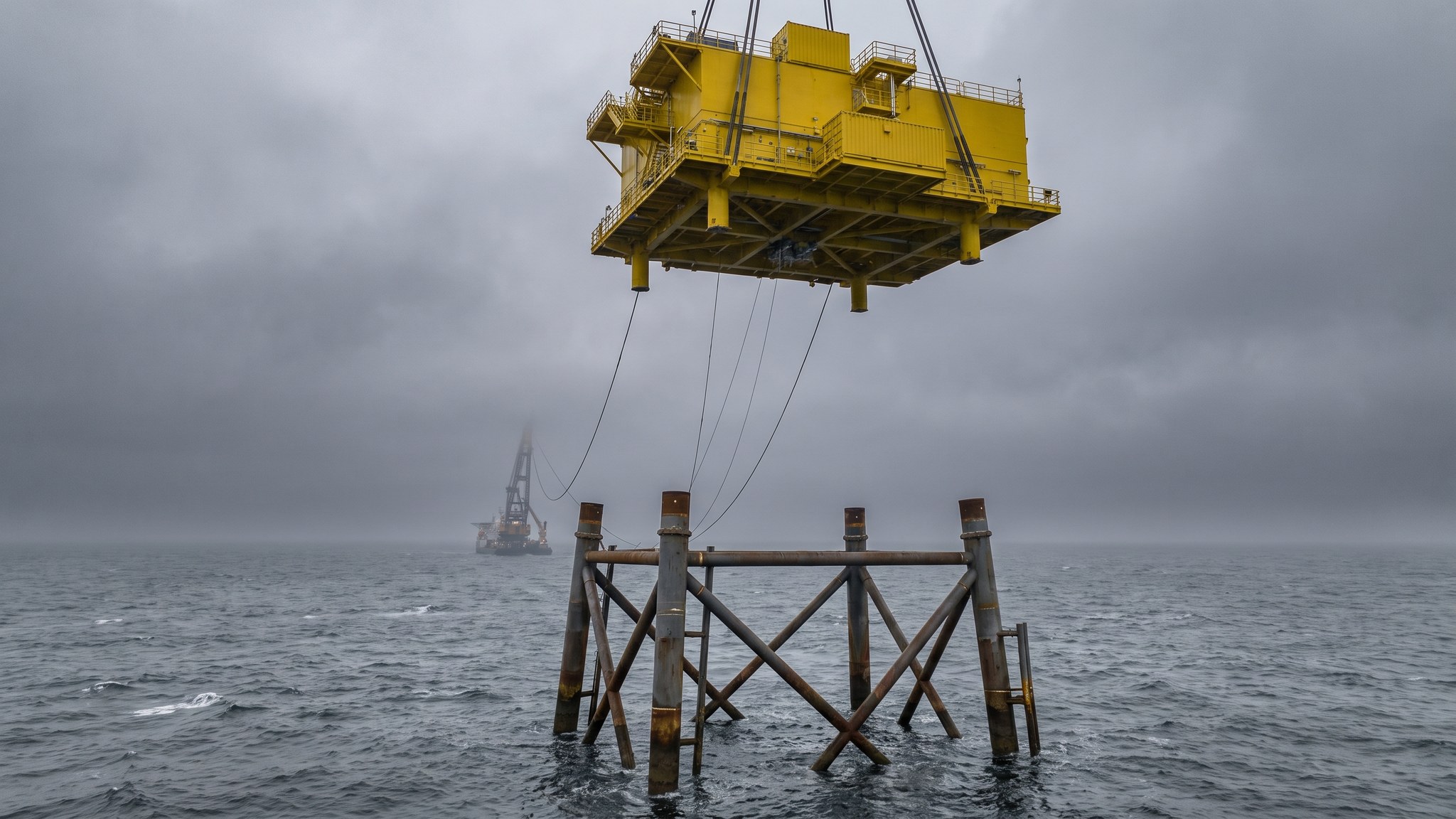
What is Alternating current collector topside on a jacket?
The alternating current collector platform is the default offshore substation for most fixed-bottom wind farms. Its job is simple to describe: take in all the array circuits from the turbine strings, bring them together, step the voltage up so that the power can be carried efficiently over a long export cable, and send it to shore. Physically it is a topside of switchgear, transformers, protection and control equipment, auxiliary systems and accommodation for visiting crews, sitting on a steel jacket founded on piles. It is the single most valuable object on the site and the point through which the entire project output passes.
The topside is built as a complete unit in a fabrication yard, not assembled offshore. Everything possible is installed, connected, tested and where practical commissioned while the structure is standing on land with unlimited access, mains power, weather protection and a full workforce. That principle drives the whole approach. Offshore work is slow, expensive and weather dependent, so the project spends money in the yard to avoid spending far more of it at sea. A well-run topside leaves the quay with its cabling in, its systems tested and a defined and short list of things that can only be done once it is in place.
Installation is a heavy lift, and the size of that lift shapes the design. The jacket goes in first, on piles, and is surveyed so that the interface is known. The topside is then lifted from a barge onto the jacket by a heavy-lift vessel, landed on the legs and secured. The weight and the reach that lift needs decides which vessels can do it, and vessel availability decides the season the project can install in. Once the topside is on, the array and export cables are pulled in, the terminations are made and the platform becomes the focus of the commissioning campaign that eventually takes the whole wind farm live under the network operator's control.
How does Alternating current collector topside on a jacket work, step by step?
- 1
Step 1: Fix the electrical arrangement and the topside layout
The designer sets the electrical arrangement from the number of array circuits, the export arrangement and the redundancy the project and the network operator require. That arrangement drives the equipment list, and the equipment list drives the layout: how many decks, how the rooms are arranged, where the heavy items sit, how equipment is brought in and taken out for maintenance and how people move around safely. Weight and centre of gravity are tracked from the first sketch, because the lift capacity of the available vessels is a hard limit and a topside that grows past it is a very expensive problem.
- 2
Step 2: Fabricate the jacket and the topside in parallel
The jacket is fabricated as a braced steel lattice with pile sleeves and the leg tops that will receive the topside, and its node welds carry the heaviest inspection regime on the structure. The topside is built as a steel frame with decks, then progressively fitted out with equipment, cable containment, piping, safety systems and architectural fit-out. The two are commonly built in different yards to different programmes, and the interface between them is controlled by a single agreed set of dimensions and tolerances. Weight control reporting runs through the whole build.
- 3
Step 3: Install the equipment and cable the topside in the yard
Heavy equipment is set on the deck early, while access is open, and the remainder of the fit-out is built around it. Cabling is installed, terminated and tested in the yard, along with the auxiliary systems the platform needs to run: power supplies, cooling, fire detection and suppression, lighting, ventilation, drainage and communications. Systems are handed over room by room to a commissioning team who test them and record the results. The intention is that the topside is functionally complete on land, with only the connections that cross the interface left for offshore.
- 4
Step 4: Weigh, load out and sea fasten
Before the topside leaves the yard it is weighed, and the measured weight and centre of gravity are compared against the values the lift has been planned around. Load-out onto the transport barge is either a skidded operation or a heavy lift, and it is engineered in its own right with the barge ballasted to hold the deck level as the load transfers. The topside is then sea fastened for the tow, and temporary bracing and protection are fitted for the passage. Every opening is closed and every loose item is secured, because a transit is harder on a structure than most of its working life.
- 5
Step 5: Install the jacket and pile it
The jacket is installed offshore first, either lowered onto pre-installed piles or set on the seabed and piled through its sleeves, and it is levelled and secured to the tolerance the specification sets. Once fixed, the leg tops are surveyed accurately, because the topside has to land on them and a mismatch discovered during the lift is not recoverable. Scour protection is placed and the boat landing, ladders and access arrangements are checked. The jacket is left with its interface confirmed and recorded, ready for the topside.
- 6
Step 6: Lift the topside onto the jacket
The heavy-lift vessel takes the topside off the barge and sets it onto the jacket legs in a single operation. Rigging, weight, centre of gravity, vessel motions and the weather window are all established beforehand, and the lift plan is independently reviewed before the campaign starts. Guides on the legs bring the topside into position as it lands, and once it is down it is immediately secured. This is the defining moment of the platform installation, it is planned in detail for months and it is over in hours.
- 7
Step 7: Complete the offshore hook-up
With the topside landed, the crew make the permanent connections that could not be made on land: structural connections at the legs, any bridging or piping across the interface, and the earthing and bonding of the structure. Temporary bracing and sea fastening are removed. Access arrangements, safety systems and navigation aids are made operational, and the platform is brought into a state where crews can work on it safely for extended periods. Only when that is done does the electrical work begin in earnest.
- 8
Step 8: Pull in the cables and hand over for commissioning
The array cables and the export cables are pulled up into the platform and terminated, each into its allotted position, by specialist crews working to a controlled procedure. Every cable is tested before it is taken any further. The platform, with its systems tested and its cables terminated, is then handed to the commissioning team, and everything after that point runs under the commissioning regime rather than the construction one. Energisation itself is a controlled step carried out with the network operator under a formal authorisation regime.
What are the benefits of Alternating current collector topside on a jacket?
- The established and best understood offshore substation arrangement, with a mature supply chain
- Alternating current equipment is simpler and cheaper than a converter arrangement over shorter export distances
- Almost all the work is done in the fabrication yard, where access, power and weather are not constraints
- A single heavy lift installs the whole topside, keeping the offshore campaign short
- A jacket founding suits a wide range of water depths and ground conditions
- Accommodation and workshop space on the platform supports the commissioning campaign and later operations
What are the limitations of Alternating current collector topside on a jacket?
- The whole project output passes through one platform, so its programme and its reliability are critical
- Topside weight is limited by the lift capacity of the available vessels, and weight growth is a serious risk
- Requires a heavy-lift vessel and a weather window, and those vessels are scarce and booked ahead
- The jacket and topside are often built in different yards, so interface control has to be rigorous
- Export distance is limited by what alternating current transmission can carry efficiently
- Any offshore rework is disproportionately expensive compared with the same work in the yard
What is Alternating current collector topside on a jacket best suited for?
What plant does Alternating current collector topside on a jacket need?
- Fabrication yard with heavy deck build capacity, a load-out quay and skidding or lifting facilities
- Transport barge with ballast control, plus tugs for the tow
- Heavy-lift vessel with the capacity and reach for the topside lift
- Piling spread for the jacket, with hammer, gripper and noise mitigation equipment
- Cable pull-in winches, tooling and specialist termination crews
- Survey spread for jacket levelling, interface survey and as-built recording
How is Alternating current collector topside on a jacket quality-checked?
- Weld inspection through jacket and topside fabrication, with the fatigue-critical details fully covered
- Weight and centre of gravity control reporting maintained through the build and confirmed by weighing before load-out
- System-by-system testing and handover in the yard, with recorded results carried forward to offshore
- Jacket level, position and interface survey confirmed and recorded before the topside lift
- Lift plan and rigging independently reviewed, with the weather window and vessel motions confirmed before starting
- Cable termination records and testing completed and filed before the platform is handed to the commissioning team
More offshore substation methods
Next method
Compact unmanned platform