Converter platform for long-distance export
Very large heavy platforms for direct current export, among the largest single offshore lifts undertaken.
Last updated 2026-09-07
What is Converter platform for long-distance export?
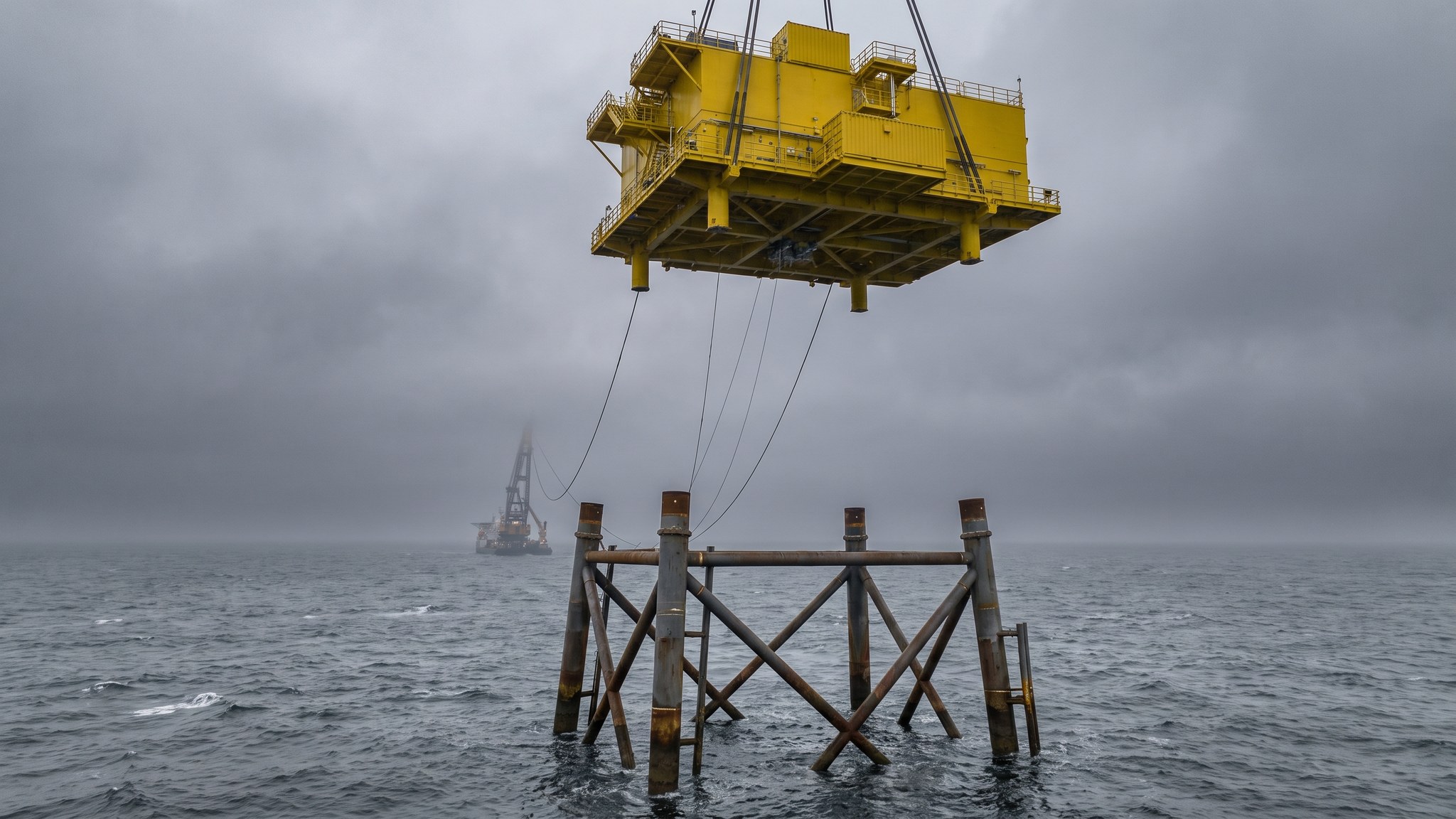
Beyond a certain distance from shore, alternating current export stops being practical. The losses in the cable rise, the cable itself becomes harder to make and install, and eventually the economics fall over. The answer is to convert the power to direct current offshore, carry it to shore on a direct current cable and convert it back on land. That requires a converter platform offshore, and a converter platform is a different order of object from a collector platform. It contains conversion equipment, transformers, cooling systems, harmonic filtering and control equipment on a scale that pushes the topside to many tens of thousands of tonnes and several decks.
These are among the largest single structures installed offshore anywhere, and installing them is a marine engineering exercise in its own right. There are two established approaches. The topside can be lifted onto a pre-installed jacket by the largest heavy-lift vessels in the world, which limits the project to a very small number of available vessels. Alternatively the topside can be floated over, brought into position on a barge between the legs of the substructure and transferred by ballasting the barge down until the substructure takes the weight. Float-over avoids the lift entirely, which is why it is used for the heaviest topsides, but it demands very tight tolerances and a benign weather window.
The commercial character of a converter platform is different too. It is a long-lead item with a small supply chain, it is frequently procured and owned separately from the wind farm by the party responsible for the transmission connection, and its programme sits on the critical path of the whole project. A converter platform that is late means a wind farm that is built and cannot export. That is why the interface between the generation project and the transmission project is managed formally and in detail, with agreed dates, agreed technical interfaces and agreed consequences, rather than as an engineering conversation.
How does Converter platform for long-distance export work, step by step?
- 1
Step 1: Establish the transmission case and the interface
The decision to convert offshore follows from the distance to shore, the capacity to be transmitted and the losses and cost of the alternatives, and it is taken jointly with whoever is responsible for the connection to the network. Once taken, the interface between the wind farm and the transmission asset is defined formally: what each party supplies, where the boundary sits physically and contractually, what the technical requirements are on each side, and the dates each party is committing to. That interface document governs the relationship for the whole project and is kept current rather than filed.
- 2
Step 2: Design the topside around very heavy equipment
The conversion equipment, its transformers, its cooling and its control systems are large, heavy and demanding of their environment, and the topside is arranged around them rather than the other way round. Multiple decks are needed, and the layout has to allow the heaviest items to be brought in during construction and removed for replacement during operation. Cooling capacity is a major design driver and it shapes the external form of the platform. Weight and centre of gravity are tracked obsessively, because the installation method depends on them and there is very little margin at this scale.
- 3
Step 3: Choose the installation method early
Whether the topside is lifted or floated over is decided at the start, not at the end, because it changes the design of both the topside and the substructure. A lifted topside needs lift points and a structure that can take the rigging loads. A float-over topside needs legs and mating units designed for the transfer, a substructure with the clearance for the barge to enter and a hull that can be ballasted precisely. The choice follows the weight, the availability of vessels, the water depth and the weather climate at the site, and the installation contractor is involved in the design from an early stage.
- 4
Step 4: Fabricate in a yard capable of the scale
Very few yards in the world can build a converter topside, and securing a slot is one of the earliest commercial actions on the project. The structure is built as a steel frame with multiple decks, equipment is set as the build progresses because much of it cannot be brought in later, and the fit-out proceeds around it. Cabling, piping, cooling, fire protection, ventilation and accommodation are all installed and tested on land. Fabrication commonly runs for years and its progress is monitored closely, because there is no way to recover a late topside.
- 5
Step 5: Commission as much as possible on land
At this scale the argument for finishing work in the yard is overwhelming. Systems are tested and handed over progressively, and equipment is commissioned as far as it can be without the platform being connected to anything. The project aims to leave the quay with a defined, short and well-understood offshore scope, because offshore work on a converter platform is slow, needs a large workforce living on or beside the platform, and is exposed to weather for months at a time. Every hour of testing avoided offshore is worth many in the yard.
- 6
Step 6: Install the substructure and confirm the interface
The jacket or substructure is installed and piled first, then levelled and surveyed to a tolerance appropriate to what will be set on top of it. For a float-over the tolerances are particularly tight, because the mating units have to receive the topside legs with very little margin as the barge ballasts down. Any deviation is measured and reported before the topside sails, so that the installation contractor knows exactly what the topside will be landing on. Scour protection and access arrangements are completed while the substructure is on its own.
- 7
Step 7: Lift or float over the topside
For a lifted installation, the largest heavy-lift vessel available takes the topside from its barge and sets it on the substructure in a single operation, planned in detail and independently reviewed. For a float-over, the barge carrying the topside is manoeuvred into position between the substructure legs, held there, and then ballasted down until the substructure takes the load and the barge is withdrawn. Both are single-shot operations requiring a good weather window and a great deal of preparation, and both are among the largest offshore installation operations undertaken anywhere.
- 8
Step 8: Hook up, terminate and hand over to the transmission owner
Offshore hook-up on a converter platform is a campaign rather than a visit, with a substantial workforce accommodated on or beside the platform for an extended period completing connections, finishing systems and closing out the fit-out. Array cables from the wind farm and the direct current export cables are pulled in and terminated by specialist crews, and every cable is tested. The platform is then handed over to the transmission owner and its commissioning proceeds under their regime. Energisation itself is a controlled step carried out with the network operator under a formal authorisation regime.
What are the benefits of Converter platform for long-distance export?
- Makes export practical over distances where alternating current transmission would not be viable
- Lower losses over long routes, and fewer export cables carrying the same capacity
- Direct current export cables are more compact per unit of capacity carried over long distances
- Concentrates the conversion equipment offshore in one purpose-built and controlled environment
- Float-over installation removes the need for the very largest lifting vessels
- Commonly procured and owned by the transmission party, moving that capital off the generation project
What are the limitations of Converter platform for long-distance export?
- Among the largest and heaviest structures installed offshore, with a very small pool of capable yards and vessels
- Very long fabrication programme that sits on the critical path of the whole wind farm
- Interface between the generation project and the transmission project is complex and has to be managed formally
- Conversion equipment is expensive, specialised and supported by a small supply chain
- Offshore hook-up is a months-long campaign requiring a substantial accommodated workforce
- Installation is a single-shot operation with tight tolerances and a demanding weather window
What is Converter platform for long-distance export best suited for?
What plant does Converter platform for long-distance export need?
- Fabrication yard with the scale, quay depth and load-out capacity for a very large multi-deck topside
- Launch or transport barge with precise ballast control for a float-over, or a heavy transport barge for a lift
- The largest class of heavy-lift vessel where the topside is lifted rather than floated over
- Mating units, leg mating systems and fendering for a float-over transfer
- Piling and substructure installation spread with the capacity for a very large jacket
- Accommodation vessel or platform accommodation for the extended hook-up campaign
How is Converter platform for long-distance export quality-checked?
- Interface document between the generation and transmission parties maintained current and formally controlled
- Weld and structural inspection through fabrication, with independent verification at the scale of the structure
- Weight and centre of gravity control reported continuously and confirmed by weighing before load-out
- Substructure level, position and mating interface surveyed and reported before the topside sails
- Installation plan, whether lift or float-over, independently reviewed with the weather criteria agreed in advance
- System testing and handover records from the yard carried forward, with the offshore scope defined and tracked to closure