Compact unmanned platform
Smaller, with no permanent accommodation, cheaper and lighter, maintained by visiting crews.
Last updated 2026-09-07
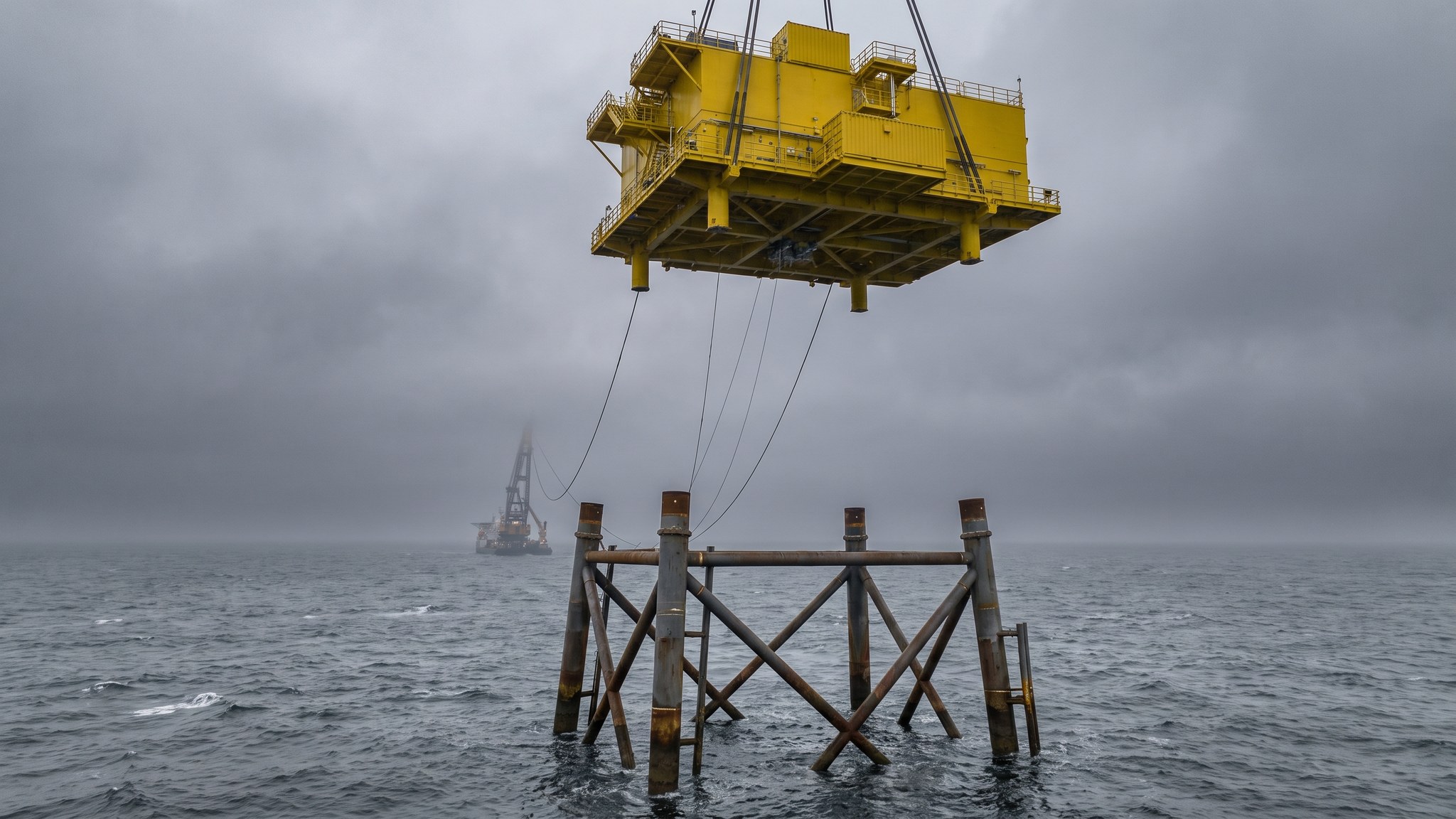
What is Compact unmanned platform?
A compact unmanned platform does the same electrical job as a full collector platform but strips out everything that exists to keep people living on it. There is no permanent accommodation, no galley, no cabins, no permanent lifeboat arrangement and a much reduced set of the systems that support human occupation. What remains is the electrical plant, its auxiliaries, the safety systems needed to protect visiting crews and enough shelter and welfare for a working day. The result is a markedly smaller and lighter structure, and because weight drives so much of the cost of an offshore platform, the saving runs through the fabrication, the vessel, the lift and the foundation.
The trade is that the platform depends entirely on visiting crews. Maintenance is done by teams who arrive by vessel or helicopter, work the day and leave, so the platform has to be designed for that pattern: remote monitoring and control so that most conditions can be seen and managed from shore, high reliability and redundancy in the equipment so that failures do not need an immediate visit, and an interior arranged so that a small team arriving with limited time can get to what they need without a large amount of preparation. Some designs go further and provide temporary refuge and short-term shelter so that a crew caught out by weather is safe until they can be recovered.
The approach suits smaller wind farms, projects closer to shore where crews can reach the platform easily and reliably, and developers who would rather spend money on redundancy in the equipment than on steel and accommodation. It is less suitable where the platform is far offshore, where sea states routinely prevent access, or where the project genuinely needs offshore accommodation to run its construction and commissioning. The decision is made early, because the difference between a manned and an unmanned platform is not a change to the fit-out, it is a different structure of a different size on a different foundation.
How does Compact unmanned platform work, step by step?
- 1
Step 1: Decide the manning philosophy first
The choice between a manned and an unmanned platform is taken at the earliest stage, because everything downstream depends on it. The project weighs the size of the array, the distance from a suitable port, the accessibility of the site through the year, the availability of vessels and helicopters, the operating strategy and the cost of the accommodation against the cost of higher redundancy in the plant. That decision is documented and its consequences flow into the equipment specification, the safety case, the structure and the installation method. Changing it later is a redesign.
- 2
Step 2: Design for remote operation and infrequent visits
An unmanned platform is designed on the assumption that nobody is there. Monitoring, control and protection are arranged so that the platform can be operated from shore, condition data is brought back continuously so that developing problems are seen early, and redundancy is provided where a failure would otherwise force an urgent visit. Auxiliary systems are simplified and made self-sufficient for long periods. The designer also thinks about what a visiting crew will need to do and lays the platform out so that routine work can be done quickly by a small team.
- 3
Step 3: Strip the topside to what is genuinely needed
Accommodation, catering, permanent lifeboats and the systems that support living offshore come out, and with them a great deal of steel, weight and cost. What stays is the electrical plant and the systems that protect it, the safety systems that protect visiting crews, welfare adequate for a working day and in many designs a temporary refuge. The layout is compacted around the equipment. Weight control is aggressive throughout, because the point of the exercise is to bring the topside within the capacity of smaller and more available installation vessels.
- 4
Step 4: Match the foundation to the reduced weight
A lighter topside opens up foundation options that a full collector platform cannot use, including monopile founding in suitable ground rather than a jacket. That in turn means the foundation can sometimes be installed by the same spread that is installing the turbine foundations, using the same equipment and the same crew, which is a real saving in mobilisation. The designer decides on the ground, the water depth and the loads, and confirms the foundation can carry the topside and its own environmental loading for the life of the project.
- 5
Step 5: Build and test the topside complete in the yard
As with any offshore platform, the work is front-loaded into the yard. Equipment is set, cabling is installed and terminated, auxiliary and safety systems are installed and tested, and the platform is commissioned as far as it can be on land. On an unmanned platform this matters even more than usual, because the offshore working environment has no accommodation to support extended campaigns. The objective is a topside that arrives finished, with a short and defined offshore scope.
- 6
Step 6: Install in a single lift
The reduced weight is the point of the whole design and it shows here. The topside can commonly be installed by a vessel that is smaller, cheaper and easier to book than the heavy-lift vessels a full platform needs, and in some cases by a vessel already on the project. The lift is planned, reviewed and executed like any other heavy lift, with the weather window and the rigging established beforehand. A shorter offshore campaign with fewer vessel dependencies is one of the strongest arguments for the compact approach.
- 7
Step 7: Hook up, pull in the cables and terminate
The offshore hook-up completes the structural connections, removes the sea fastening, brings the safety and access systems into service and makes the platform ready for people to work on. Array and export cables are pulled in and terminated by specialist crews, each cable tested before it goes any further. Because there is no accommodation, this work is done by crews transferring daily or living on a vessel alongside, which makes the sequence more sensitive to sea state than it would be on a manned platform.
- 8
Step 8: Prove remote operation before handover
Before the platform is handed over, the project proves that it can actually be run from shore, because that is the assumption the whole design rests on. Monitoring and control links are tested end to end, alarms are proved through to the people who will act on them, and the safety systems that protect visiting crews are demonstrated. Access arrangements and the emergency response plan for a platform with nobody on it are confirmed with everyone who has a part in them. Energisation itself is a controlled step carried out with the network operator under a formal authorisation regime.
What are the benefits of Compact unmanned platform?
- Markedly lighter and smaller than a manned platform, with savings running through steel, foundation, vessel and lift
- Can commonly be installed by a smaller and more readily available vessel, easing the programme
- Opens up foundation options such as monopile founding, sometimes using the spread already on the project
- Removes the cost and complexity of permanent accommodation and the systems that support it
- Shorter offshore campaign with fewer heavy-lift dependencies
- Suits an operating model built on remote monitoring and planned campaign maintenance
What are the limitations of Compact unmanned platform?
- Depends entirely on crews being able to reach the platform, so poor accessibility undermines the whole case
- Needs higher redundancy and better remote monitoring to avoid urgent visits, which offsets part of the saving
- No accommodation to support the construction and commissioning campaign, making the work more weather sensitive
- A compact layout leaves less room for maintenance access and for replacing major equipment later
- Crews caught out by weather rely on temporary refuge rather than proper accommodation
- Not suitable for the largest arrays, where the electrical plant simply will not compact into the envelope
What is Compact unmanned platform best suited for?
What plant does Compact unmanned platform need?
- Fabrication yard capable of a complete topside build and load-out
- Transport barge and tugs, or a vessel able to carry and install the topside directly
- Installation vessel with the capacity for the reduced topside lift
- Foundation installation spread suited to the chosen foundation type
- Cable pull-in and termination equipment, with crews supported from a vessel alongside
- Remote monitoring and control infrastructure, with the communications links to shore
How is Compact unmanned platform quality-checked?
- Manning philosophy documented and its consequences traced through the equipment and structural specifications
- Weight control reporting maintained through the build and confirmed by weighing before load-out
- System testing and handover completed in the yard, with a short and defined offshore scope agreed
- Foundation capacity verified against the final topside weight and centre of gravity before installation
- Remote monitoring and control proved end to end, with alarms demonstrated through to the responding team
- Safety systems, access arrangements and emergency response for an unmanned platform demonstrated before handover