Array cables
The smaller cables that string turbines into circuits, laid and buried in campaigns, with the pull-in at each foundation as the fiddly bit.
Last updated 2026-09-07
What is Array cables?
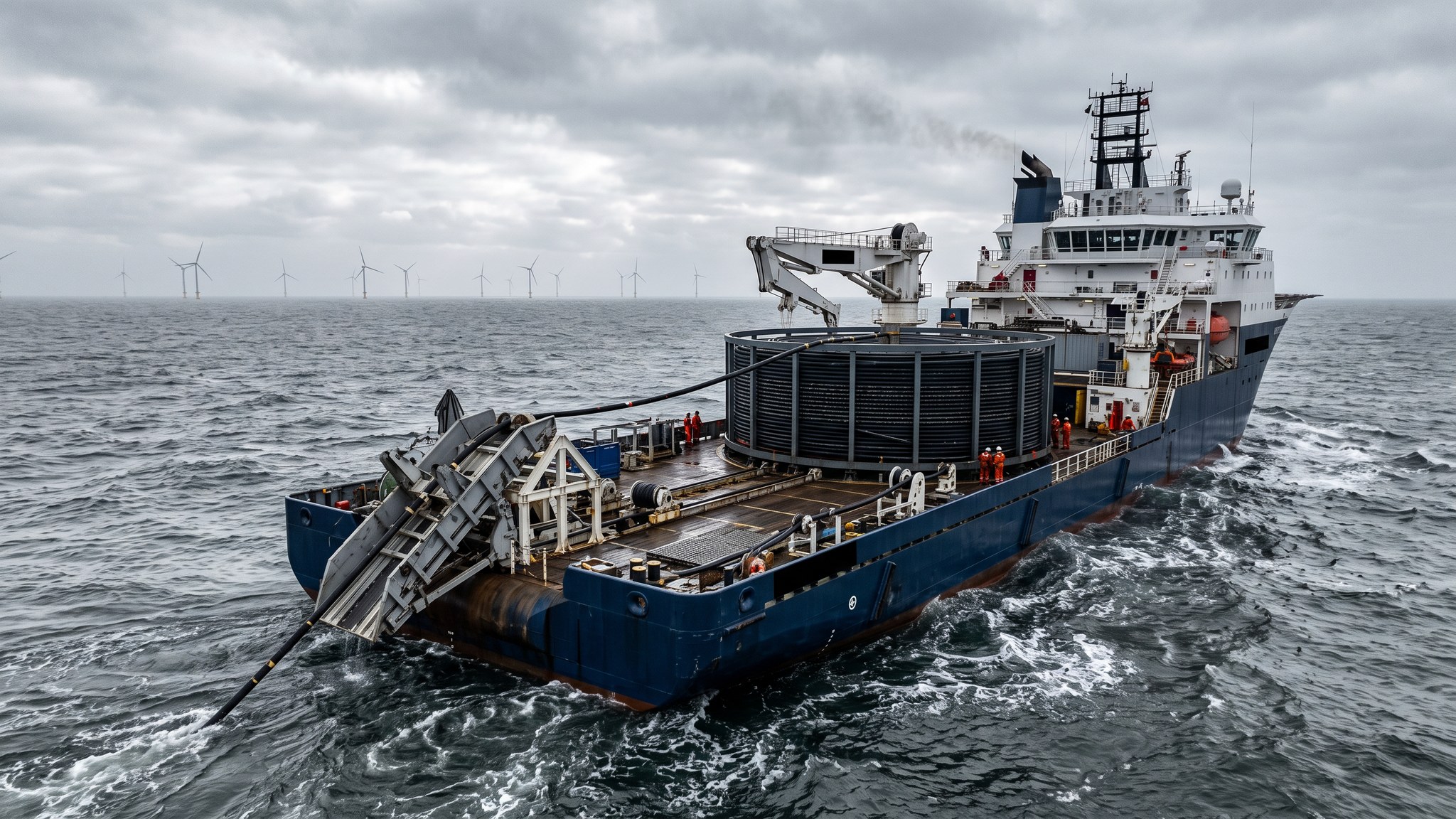
Array cables are the internal wiring of an offshore wind farm. Each cable runs along the seabed from one turbine to the next, gathering machines into strings, and each string runs back to the offshore substation where the whole output is collected. A large array contains many tens of separate cable sections and a total length that runs into hundreds of kilometres. The cables themselves are smaller and lighter than the export cables, which means more of them can be carried on a single vessel and more of them can be laid in a single trip, so the work becomes a production campaign rather than a set of one-off operations.
The construction problem is repetition under weather. Every section has the same shape of work: lay the cable along a surveyed route, bury it into the seabed for protection, and pull each end up into the foundation it serves. Doing that once is straightforward. Doing it eighty times in a North Sea season, with a spread of vessels that each cost a great deal per day and each have their own weather limits, is where projects gain or lose months. The installation contractor plans the campaign as a sequence of loops, loading a batch of cables at a marshalling port, working through them offshore, and returning to reload, and the sequence is arranged so that turbines can be energised in strings as they are completed rather than all at the end.
The fiddly part is not the laying, it is the pull-in. At each foundation the cable has to be brought up off the seabed, guided through a tube or an entry in the structure, pulled up inside to the working platform and secured, then terminated. That is close-quarters work at the base of a large structure in moving water, usually involving a remotely operated vehicle, divers or both, a messenger wire run through the entry beforehand, and a winch on the platform above. It is slow, it is sensitive to sea state, and it happens twice for every cable section. Most array cable programmes are dominated by pull-in and termination time rather than by the kilometres of lay, and the designer decides the entry arrangement early precisely because it governs how quickly that work can be done.
How does Array cables work, step by step?
- 1
Step 1: Survey and fix the routes between positions
Before anything is manufactured the seabed between every pair of positions is surveyed. Geophysical survey maps the surface and the shallow layers, sampling and cone testing establish what the ground will do when a burial tool is dragged through it, and the results are combined into a route for each section. Boulders, sand waves, wrecks, archaeology, existing cables and pipelines and any unexploded ordnance are all identified and either avoided or cleared. Routes are kept as short and as straight as the constraints allow, because every extra metre is cost and every bend is a place where the cable will want to move.
- 2
Step 2: Set the cable schedule and order manufacture
Each section has its own length, taken from the route and then increased to allow for the slack the installation needs, the rise up each foundation, the terminations and a margin for the unexpected. Those lengths go into a cable schedule that tells the manufacturer exactly what to make, and getting it wrong in either direction is expensive: too short and a section has to be remade, too long and the surplus is wasted and the handling becomes harder. Cable is then made in continuous runs, tested at the factory and wound onto carousels or drums ready for shipment. Manufacturing slots for offshore cable are booked long in advance and are commonly the earliest thing on the project programme.
- 3
Step 3: Load out at the marshalling port
Cable is transferred from the factory onto the installation vessel, either directly from a barge or through a marshalling quay where sections are staged. Loading is a controlled operation because the cable is being coiled into a carousel or a tank in a way that must not damage it, and the loading rate governs how long the vessel sits alongside instead of working. The vessel is loaded with a planned batch of sections in the order they will be installed, along with the accessories each one needs. Quay space, crane capacity and the reliability of the supply chain feeding the port all shape how many sections go out per trip.
- 4
Step 4: Prepare the foundation entries and run the messenger wires
Ahead of the lay vessel arriving, a support spread prepares each foundation. The entry tube is inspected and cleared, any temporary caps are removed, and a messenger wire is run down through the entry and out onto the seabed so that the cable end can later be attached and pulled up. A winch and the pull-in equipment are set on the platform inside the foundation. This preparation work is deliberately decoupled from the lay vessel because the lay vessel is the most expensive part of the spread and the campaign is planned so that it never waits for something that could have been done earlier.
- 5
Step 5: Pull in the first end and start the lay
The vessel comes onto position at the first foundation and the cable end is prepared and connected to the messenger. It is then pulled up through the entry and into the structure while the vessel pays out cable and holds position, with a remotely operated vehicle watching the cable at the seabed and reporting how it is lying. Once enough cable is inside, it is clamped off and made secure. The end is capped and left ready for the termination crew who will follow later, and the vessel then moves off along the route paying cable onto the seabed behind it.
- 6
Step 6: Lay the section and pull in the second end
The vessel tracks the surveyed route while the cable is laid, with the position of the cable on the seabed monitored throughout rather than assumed from the position of the vessel. Currents, water depth and lay speed all move the cable away from the ship track, and the crew adjust for it as they go. At the far foundation the process reverses: the vessel approaches, the second end is cut to the planned length, prepared, connected to the messenger and pulled up into the structure. The surplus, if any, is recovered and the section is complete as a laid but unburied cable.
- 7
Step 7: Bury the cable in a separate pass
Burial is usually a separate operation from laying, done by a trenching machine that follows the laid cable and works it down into the seabed. Different tools suit different ground, and the choice belongs to the installation contractor working to what the ground model says: jetting tools that fluidise sand, mechanical cutters for stiffer material, and ploughs that displace it. Progress is recorded continuously so that the project knows what was achieved along every metre. Where the target cannot be reached, the position is logged and dealt with under the protection and remedial regime rather than left as an open question.
- 8
Step 8: Terminate, test and record
A separate termination crew works inside each foundation, preparing the cable end and making it off into the equipment it serves. This is skilled, slow, clean work carried out in a controlled environment inside the structure, and it is one of the few offshore activities that is genuinely weather independent once the crew are aboard. After termination each section is tested before it is ever taken live, and the results are compared against the factory records for the same cable. The as-laid position, the burial record, the termination records and the test results are assembled into a file for that section, which is what the operator will use for the rest of the life of the asset.
What are the benefits of Array cables?
- Smaller and lighter than export cable, so many sections can be carried and installed in a single vessel trip
- Highly repetitive work that suits a planned campaign and improves markedly as the crew settle into a rhythm
- Strings can be completed and taken forward for energisation progressively rather than waiting for the whole array
- A failure on one section affects one string rather than the whole project output
- Route lengths are short, so a damaged section can be replaced without an exceptional manufacturing programme
- Burial can be carried out by a separate lower-cost spread, keeping the lay vessel productive
What are the limitations of Array cables?
- Pull-in and termination at each foundation dominates the programme and is sensitive to sea state
- Every section needs its own surveyed route, and the cumulative survey and clearance effort across an array is large
- Cable schedule errors are expensive and slow to correct because manufacturing slots are booked far ahead
- Ground that resists trenching leaves cable exposed and pushes the project into remedial protection work
- The spread needs several different vessels working in sequence, and any one of them can hold up the others
- Damage during installation is often not obvious at the time and only appears in later testing
What is Array cables best suited for?
What plant does Array cables need?
- Cable lay vessel with a carousel or tank, tensioners, a chute or wheel and dynamic positioning
- Trenching spread, which may be a jetting tool, a mechanical cutter or a plough depending on the ground
- Remotely operated vehicles with survey and monitoring capability for touchdown and burial checking
- Pull-in winches, messenger wires, cable grips and bend restrictors at each foundation
- Support and crew transfer vessels for the preparation and termination teams
- Survey spread for route survey, as-laid position fixing and burial depth recording
How is Array cables quality-checked?
- Factory test records for every manufactured length, held as the baseline for later comparison
- Route clearance and pre-lay survey signed off before any cable is laid on that section
- Continuous monitoring of the cable at touchdown during lay, with a stop and assess route if it departs from the route corridor
- Burial records logged along the full length of every section, with exceptions identified for remedial action
- Termination carried out by qualified crews to a controlled procedure with hold points and photographic records
- Post-installation testing of each section before it is taken forward, compared against the factory baseline
More array & export cables methods
Next method
Export cables