Cable protection and remedial burial
Rock, mattresses and protection systems where burial cannot be achieved, plus the survey and fix campaigns when cable is found exposed.
Last updated 2026-09-07
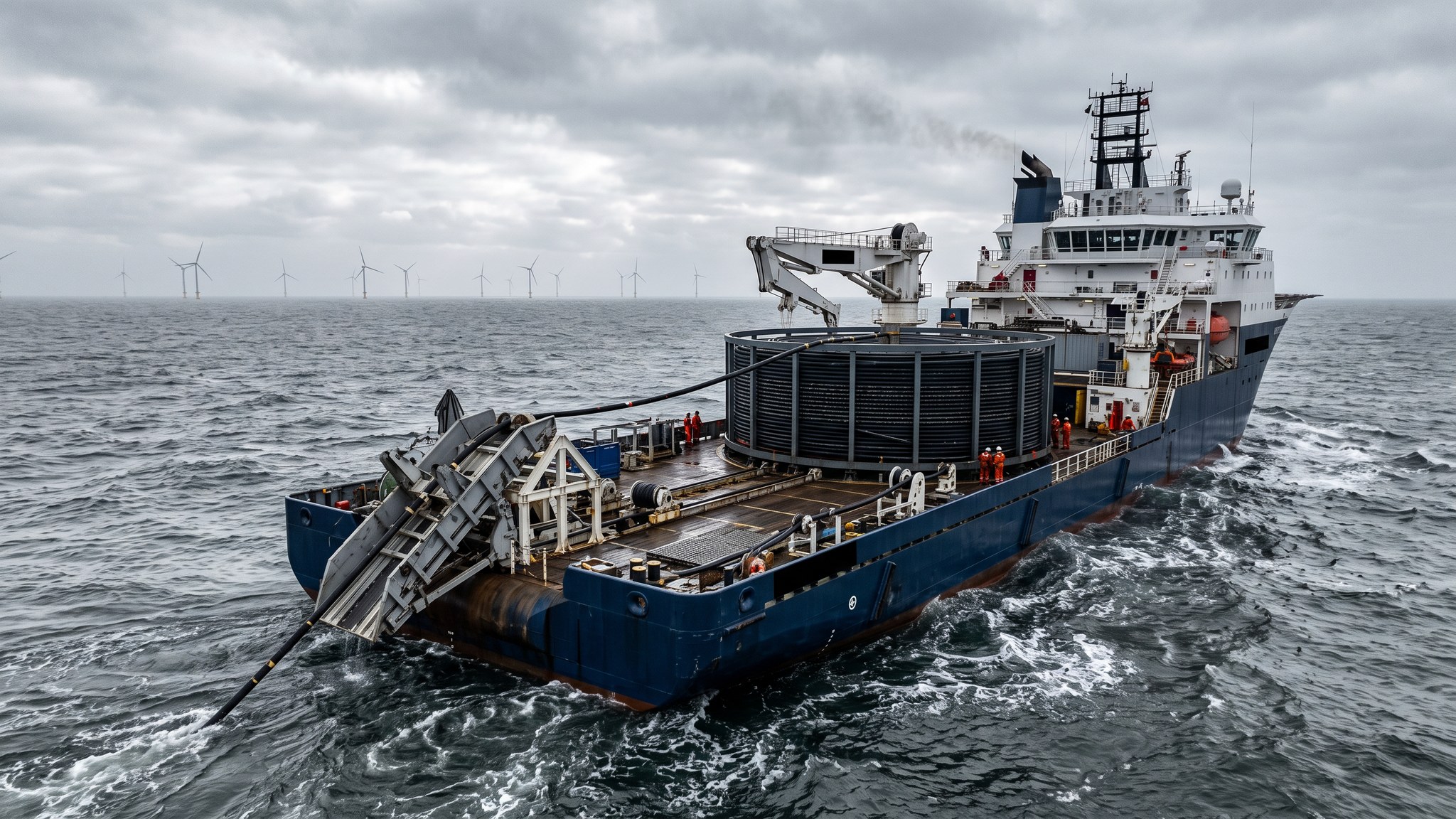
What is Cable protection and remedial burial?
Burial is the preferred way of protecting a subsea cable because it is passive, permanent and cheap once done. It is not always achievable. Rock, very stiff ground, existing infrastructure, crossings, the approaches to foundations and the immediate area around a platform all leave lengths where a trenching tool either cannot work or is not allowed to. On those lengths the cable is protected instead, by placing material or a manufactured system over it so that an anchor, a fishing gear or a dropped object meets the protection rather than the cable. Every project ends up with a mixture of buried and protected lengths, and the register of which is which is one of the more important documents the operator inherits.
The common methods are rock placement, concrete mattresses and manufactured protection systems. Rock is placed from a dedicated vessel through a fall pipe, building a berm over the cable, and it suits long lengths and crossings. Mattresses are articulated concrete units lowered and laid over the cable, and they suit shorter, more precise applications and places where a berm would be in the way. Manufactured systems are shells or half-pipes fitted around the cable, and they are used mainly at foundations and platforms where the cable rises off the seabed and is most exposed. The designer chooses between them on the exposure, the ground, the water depth and what the seabed is allowed to carry under the consent.
The second half of this work is remedial, and it never stops. Seabeds move. Sand waves migrate, scour develops around structures, and ground that held a cable at installation can expose it years later. Every offshore wind farm therefore runs periodic survey campaigns over its cables and compares what it finds against the as-installed record, and where a length is found exposed or shallower than intended a remedial campaign is mobilised to reburse or protect it. That work is unglamorous, it is expensive, it competes with everything else for vessels, and it is a permanent operating cost of the asset. Doing the original burial well is the cheapest thing a project can do about it.
How does Cable protection and remedial burial work, step by step?
- 1
Step 1: Establish the burial intent and the protection strategy
The designer sets out, for the whole route, how the cable is to be protected along each length and why. That assessment weighs the hazards present in each area, which vary with water depth, seabed type, fishing activity, anchoring practice and shipping density, against what the ground will allow. The output is a strategy that identifies where burial is expected to work, where it is not, and what will be used instead. It is agreed with the regulator and with the owners of any assets nearby, because placing material on the seabed is itself a consented activity with its own limits.
- 2
Step 2: Record what the burial campaign actually achieved
During trenching, progress is recorded continuously along the route rather than sampled. That record is what identifies the lengths where the tool did not achieve what was intended, and it is produced as the campaign runs so that remedial planning can start immediately rather than after everything is finished. The record is verified independently by survey after the trenching spread has moved on, because a trenching tool reports what it did and a survey reports what is there. Discrepancies between the two are investigated rather than averaged.
- 3
Step 3: Plan the protection scope from the survey
The verified survey produces a list of lengths needing protection, with position, extent and the reason. Each is assigned a method: rock, mattress or a manufactured system, depending on the exposure, the water depth, the proximity to structures and what else is on the seabed nearby. Quantities are calculated and materials ordered, and for rock placement that means arranging supply from a licensed source and a vessel to carry it. Because the scope is not known until the burial campaign is done, projects carry a provisional allowance and a standby arrangement rather than waiting to procure from scratch.
- 4
Step 4: Place rock where a berm is the answer
Rock placement is carried out from a purpose-built vessel that lowers graded rock through a pipe to the seabed, building a berm along the cable to a designed profile. The vessel holds position and tracks along the cable while the placement is monitored, because the objective is a berm centred on the cable with the designed cover and slope, not simply rock in the area. Rock is used for long lengths, for crossings, for scour repair around structures and for anywhere a durable, high-volume solution is wanted. It is effective and permanent, but it consumes a great deal of material and it is a significant cost line.
- 5
Step 5: Lay mattresses where precision matters
Concrete mattresses are articulated units lowered on a frame and placed over the cable, typically by a construction support vessel with a crane and a remotely operated vehicle to guide and confirm the placement. They suit shorter lengths, tight positions, crossings where a low profile is wanted and places where a rock berm would obstruct something else. Placement is a repetitive lifting operation with each unit positioned, released and checked before the next. They are quicker to mobilise than a rock vessel for a small scope, but they do not suit long runs.
- 6
Step 6: Fit protection systems at the structures
Where the cable leaves the seabed and rises into a foundation or platform it is at its most exposed, and manufactured protection is fitted around it: shells, half-pipes or bend-restricting arrangements that clamp around the cable and are secured to the structure or the seabed. Fitting is done by divers or by a remotely operated vehicle with purpose-made tooling. This is close-quarters work at the base of a structure and it is planned like any other subsea operation, with its own procedure and its own weather limits.
- 7
Step 7: Survey the protection and register the result
Everything placed is surveyed afterwards to confirm the position, extent and profile, and the result is entered into the cable protection register alongside the burial record. That register is the definitive statement of how every metre of the cable is protected, and it is what the operator, the regulator, the insurer and any future works will refer to. It also becomes the baseline against which later surveys are compared. Without it, every subsequent inspection is guesswork.
- 8
Step 8: Run periodic surveys and mobilise remedial campaigns
Through the operating life the cables are surveyed on a cycle set by the exposure and by how mobile the seabed is, with the areas known to be active surveyed more often. Results are compared against the baseline to find lengths that have become exposed, berms that have moved and scour that has developed. Where action is needed a remedial campaign is mobilised, using the same methods as the original work, and the register is updated. Projects usually bundle several remedial scopes into one mobilisation, because the cost is dominated by getting a vessel on site rather than by the work itself.
What are the benefits of Cable protection and remedial burial?
- Provides protection on lengths where burial is not physically achievable
- Rock placement suits long runs and crossings, and is durable with no maintenance requirement
- Mattresses can be mobilised quickly for small, precise scopes without a specialist rock vessel
- Manufactured systems protect the most exposed part of the route where the cable rises into a structure
- A verified protection register gives the operator a defensible basis for inspection and for insurance
- Remedial campaigns can be bundled, spreading the cost of mobilisation across several scopes
What are the limitations of Cable protection and remedial burial?
- Protection is markedly more expensive per metre than burial, and the scope is not known until burial is finished
- Placing material on the seabed is itself a consented activity with limits on quantity and location
- Rock and mattress placement introduces obstructions that constrain fishing and future works
- Seabed movement means the work is never finished, and remedial survey and repair is a permanent operating cost
- Vessels for rock placement are specialised and their availability drives when remedial work can happen
- Protection at structures is close-quarters subsea work with tight weather limits and slow progress
What is Cable protection and remedial burial best suited for?
What plant does Cable protection and remedial burial need?
- Rock placement vessel with a fall pipe, positioning system and placement monitoring
- Construction support vessel with a crane, mattress handling frames and dynamic positioning
- Remotely operated vehicles for guiding placement and confirming the result
- Dive spread where the work is at a structure and remote tooling is not practical
- Manufactured cable protection systems and the purpose-made tooling to fit them
- Survey spread for pre-works survey, as-placed verification and periodic monitoring
How is Cable protection and remedial burial quality-checked?
- Burial record verified independently by survey rather than accepted from the trenching tool alone
- Protection scope derived from the verified survey and signed off by the designer before materials are ordered
- Rock source and grading confirmed against the specification and the consent before loading
- Placement monitored during the operation, with position and profile checked against the design
- As-placed survey of every protected length, entered into the protection register
- Periodic survey cycle defined, carried out and compared against the baseline, with exceptions tracked to closure