Bunny ears with a single blade
Two blades fitted onshore and the third offshore - the compromise that keeps being the practical answer.
Last updated 2026-09-07
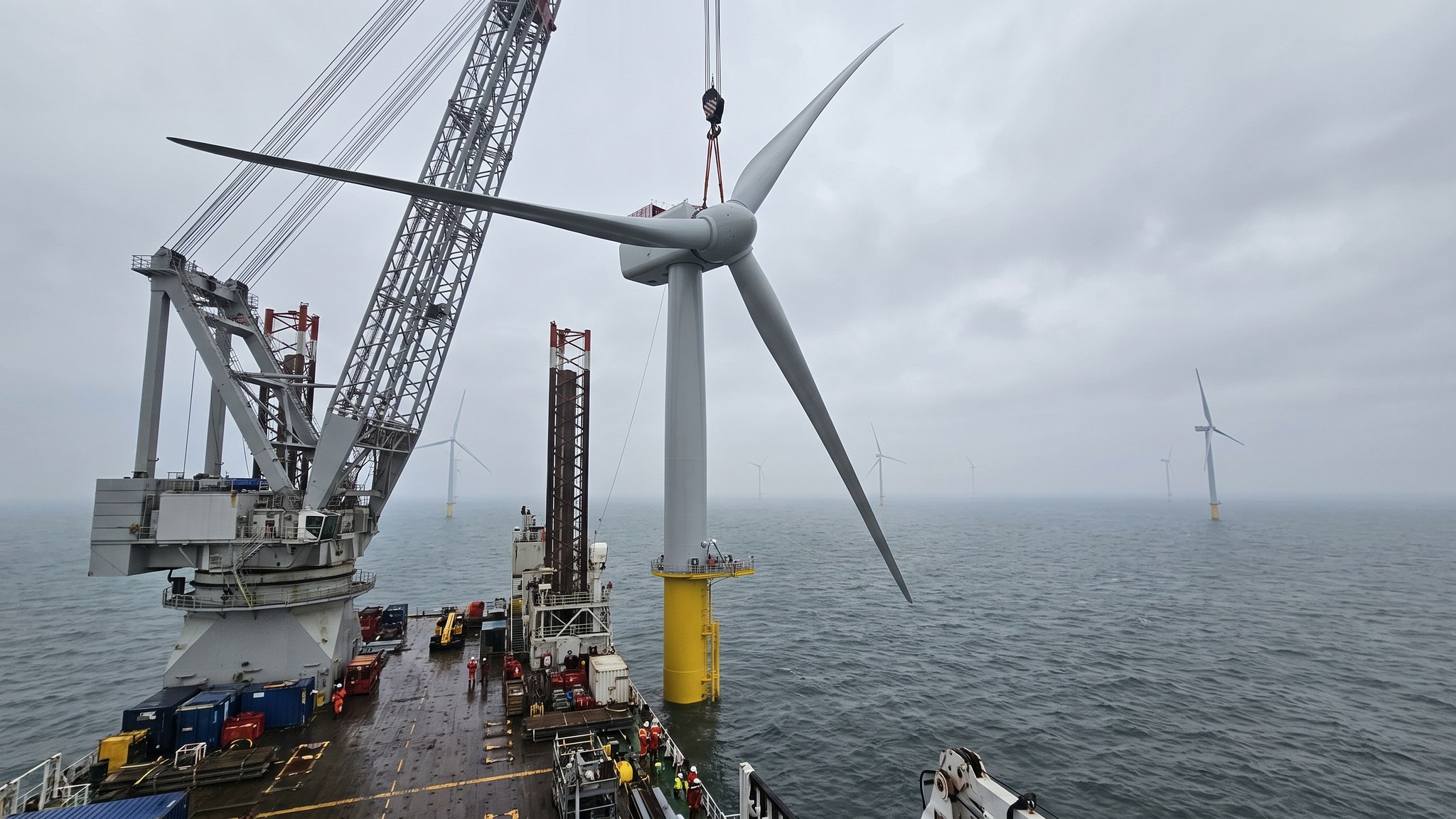
What is Bunny ears with a single blade?
The bunny ears method splits the difference. Two blades are bolted to the hub at the marshalling port, forming an assembly that looks - from the front, with a bit of imagination - like a pair of ears, and the third blade is left off. The assembly is lifted onto the nacelle offshore as one piece, and the third blade is then lifted individually and bolted on. Two of the three root connections are therefore made ashore in good conditions, and only one lift offshore involves a single blade being aligned at height.
It survives because it is genuinely balanced. Against a full pre-assembled rotor, the two-blade assembly presents less area to the wind, so the main lift can proceed in stronger conditions, and it packs onto a deck more compactly. Against single-blade installation, it removes two of the three difficult offshore blade alignments and the rotor turning between them. It also has a useful practical property: the assembly can be transported and stored lying with the two blades supported, which is easier to handle than a complete rotor. For a long time this was simply how offshore turbines were installed, and it remains widely used.
The compromises are real too. The main lift is still large and still weather-sensitive, more so than a single blade and less so than a full rotor. The assembly is asymmetric, so lifting and transporting it needs an arrangement designed for an off-centre load, and the nacelle has to be presented at the right attitude to receive it. And the crew still has to do one blade offshore, which means the vessel still carries the blade tooling and the crew still needs that skill. As turbines have grown, the size of even a two-blade assembly has pushed some projects towards pure single-blade working, but the method remains a sound answer for a great many machines and sites.
How does Bunny ears with a single blade work, step by step?
- 1
Step 1: Build the two-blade assemblies ashore
At the marshalling port, two blades are bolted to the hub at ground level using land-based cranes and supports. Both root connections are made up and tensioned in controlled conditions and inspected properly. The assemblies are then set on stands with the blades supported, ready for load-out. Getting two of the three connections done ashore is the quality argument for the method as much as the schedule argument.
- 2
Step 2: Load out and sea-fasten the asymmetric assembly
The assembly, the third blades, the towers and the nacelles are loaded and sea-fastened. The two-blade assembly is an off-centre load and needs a support and fastening arrangement designed for it, and the third blades travel in ordinary racks. Deck planning balances the footprint of the assemblies against the number of turbine sets that can travel, and that number sets how often the vessel returns to the marshalling port.
- 3
Step 3: Erect the tower
At the position, tower sections are lifted and bolted in sequence with the tightening pattern and values the specification gives, verticality checked at each landing and internal connections made up as the tower rises. The foundation interface is checked against the as-built handover record before the first section is set. The top flange is prepared for the nacelle.
- 4
Step 4: Land the nacelle and set the interface
The nacelle is lifted and landed on the yaw interface, bolted and torqued, and the electrical and control connections between tower and nacelle are made up. The main shaft flange is prepared, the rotor lock and turning gear proved, and the nacelle yawed and the shaft rotated so that the interface presents at the attitude the bunny ears assembly needs to be brought in at.
- 5
Step 5: Lift and connect the two-blade assembly
The assembly is rigged with the arrangement designed for its off-centre weight, lifted clear and brought up to the nacelle, with taglines or an active system controlling its rotation. The hub flange is mated to the main shaft flange at the correct orientation and the bolts made up in the specified pattern from inside the hub. The lift runs against the weather limits set for it, and the decision to start is taken on a forecast covering the whole operation.
- 6
Step 6: Rotate to present the third blade flange
With the two-blade assembly connected, the rotor is turned so that the vacant flange presents at the angle the procedure requires, and locked in that position. This is an unbalanced rotor, and the procedure defines the states in which it may be left and for how long. The crew confirm the lock, establish hub access and prepare the third blade on the deck while monitoring the weather for the next lift.
- 7
Step 7: Fit the third blade
The remaining blade is picked from its rack in the gripper or yoke tool, lifted and brought to the hub, and its root flange aligned to the vacant hub flange. The bolts are engaged and tensioned to the specified values and pattern. This single lift is more weather-tolerant than the assembly lift that preceded it, so it is often the operation that can be completed when the window is closing rather than the one that holds the sequence up.
- 8
Step 8: Verify, commission and hand over
All bolted connections are verified and recorded, the rotor lock released and the machine turned through its functional checks. Cable pull-in, termination and commissioning follow in this or a later campaign. The turbine file combines the onshore assembly records for two blades, the offshore records for the third, the tower and nacelle bolting records and the lift logs, and is handed to the operator for the position.
What are the benefits of Bunny ears with a single blade?
- Two of three blade root connections are made ashore in controlled conditions
- The main lift presents less area to the wind than a complete rotor, so it can proceed in stronger conditions
- Fewer offshore blade alignments than single-blade working, and only one rotor rotation
- The assembly packs more compactly on deck than a full rotor, so more sets travel per trip
- A well-proven method with a deep pool of experienced crews and established tooling
- The final single-blade lift is weather-tolerant and can often be completed as a window closes
What are the limitations of Bunny ears with a single blade?
- The main lift is still large and weather-sensitive, more so than a single blade
- The two-blade assembly is asymmetric and needs a lifting and sea fastening arrangement designed for an off-centre load
- The vessel still carries blade gripper tooling and the crew still needs the single-blade skill
- The rotor is left unbalanced between the assembly lift and the third blade, constraining what state it can be left in
- Still needs a marshalling port pre-assembly area, though a smaller one than full rotor assembly
- The assembly grows with turbine size and eventually becomes impractical to lift and carry
What is Bunny ears with a single blade best suited for?
What plant does Bunny ears with a single blade need?
- Marshalling port pre-assembly area with land-based cranes and assembly stands
- Installation vessel with crane capacity for the nacelle and the two-blade assembly
- Lifting and orientation arrangement designed for the asymmetric assembly
- Blade gripper or yoke tool for the third blade
- Blade racks, assembly support frames and sea fastening
- Bolt tensioning equipment, rotor lock, turning gear and hub access arrangements
How is Bunny ears with a single blade quality-checked?
- Onshore blade root bolt tensioning records for the two pre-fitted blades, with tool calibration on file
- Assembly support and sea fastening inspection before sailing, sized for the off-centre load
- Tower flange bolt records and verticality checks at each section
- Hub to main shaft bolting records made up in the specified pattern and orientation
- Offshore blade root tensioning records for the third blade
- Rotor lock and unbalanced-state controls recorded, with weather logs for both lifts