Quayside assembly and wet tow
The complete turbine erected in port and floated out - the move that makes floating wind credible.
Last updated 2026-09-07
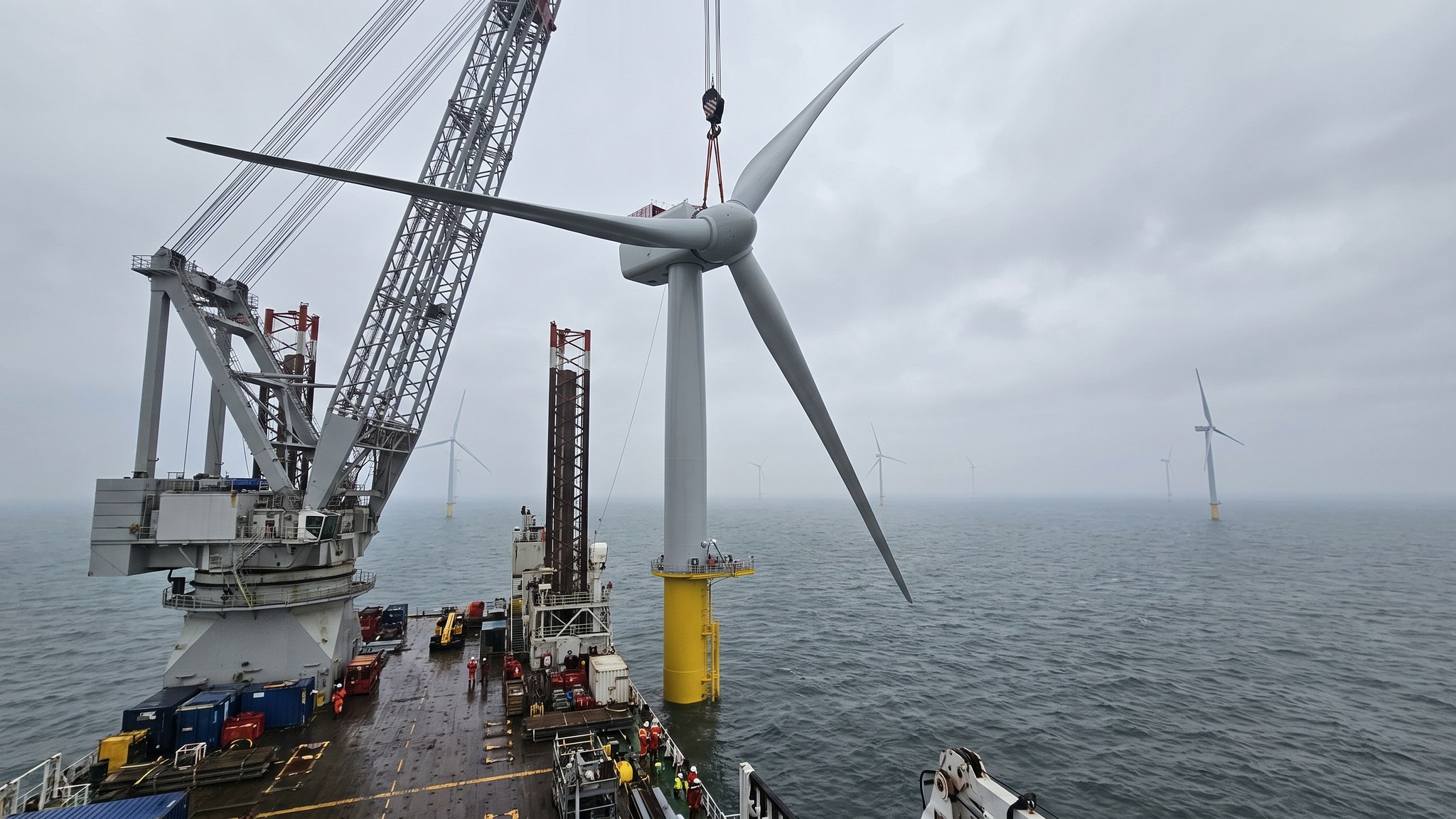
What is Quayside assembly and wet tow?
Quayside assembly and wet tow inverts the whole installation problem. Instead of taking components to sea and building the turbine there, the substructure is brought alongside a quay, the complete turbine is erected on it using land-based cranes, and the finished machine is towed out to its position and connected. Every heavy lift happens in sheltered water with the crew standing on solid ground, with mains power, with a workshop and a store a short walk away, and with as much time as the work needs. There is no offshore lift at all.
This is what makes floating wind economically credible. Floating substructures sit in water too deep for a jack-up to stand in, so the alternative would be lifting very large components from a floating vessel onto a floating platform, with both moving - a genuinely difficult operation. Quayside assembly removes it entirely. It also removes the dependence on the small global fleet of very large offshore installation vessels, which are scarce, expensive and booked years ahead, and replaces it with land-based cranes and tugs, which are neither. That substitution is a large part of the cost case for floating.
What it needs is a port, and not any port. The quay has to take the bearing pressure of very large crawler or ring cranes, there has to be sufficient water depth alongside for a substructure with a deep draught, and there has to be laydown for components and space to work on more than one unit at a time. Air draught, channel depth and any bridges on the departure route all matter. Because each complete unit must then be towed to position, the campaign rate is set by tug availability and by tow windows rather than by crane hours, and towing a fully erected turbine is a slow operation planned against a forecast with limits agreed beforehand and independently reviewed. Get the port right and the method is transformative; get it wrong and there is no way to recover, because there is no offshore fallback.
How does Quayside assembly and wet tow work, step by step?
- 1
Step 1: Establish the assembly port
The port assessment comes first and it decides the project. Quay bearing capacity for the cranes, water depth alongside, air draught and channel depth on the departure route, laydown area for components, and the number of berths available for parallel working are all checked against what the design needs. Where an existing port cannot meet it, the project either upgrades one or finds another, and that is a long-lead item measured in years rather than months. Component delivery routes into the port matter as much as the quay itself.
- 2
Step 2: Bring the substructure alongside
The floating substructure is delivered from its fabrication yard, or built at the same port, and moored alongside in its assembly ballast condition. It is ballasted and trimmed so that the deck presents at a stable, known attitude and freeboard, and mooring arrangements hold it firmly against the quay so that it moves as little as possible during the lifts. Tidal range at the berth is accounted for, because the relationship between the crane and the deck changes with the tide.
- 3
Step 3: Erect the tower
Tower sections are lifted from the quay and set on the substructure interface, bolted and tightened in the specified pattern and to the specified values. Verticality is monitored as each section lands, with allowance made for the fact that the base is floating rather than fixed, and the ballast is trimmed as the load comes on to keep the unit upright. Internal fit-out connections are made as the tower rises, with the advantage that anything missing can be fetched from the store rather than waited for on a supply boat.
- 4
Step 4: Land the nacelle
The nacelle is lifted from the quay and landed on the yaw interface, bolted and torqued. The lift is heavy and high but it is made from a stable land-based crane onto a moored, ballast-trimmed platform, which is a far more controlled operation than the equivalent offshore. Ballast is managed through the lift to keep the unit trimmed as the centre of gravity rises. The electrical and control connections between tower and nacelle are made up with full access to the quay.
- 5
Step 5: Fit the rotor
The rotor is completed using whichever method suits the crane and the layout - blades fitted individually to the mounted hub, or an assembly built on the quay and lifted as one. Because the work is ashore in sheltered conditions, the weather constraint that drives the choice offshore largely falls away, and the decision is made on crane capability and laydown instead. Every root connection is made and inspected at a berth with proper access.
- 6
Step 6: Commission as far as possible before departure
The machine is commissioned to the greatest extent it can be while alongside: control system checks, electrical testing, hydraulic and lubrication systems, safety systems, lift and access equipment. Anything found here is fixed with a workshop nearby. Anything left undone becomes an offshore visit later, at many times the cost, so the pressure is always to complete as much as possible at the quay. The unit is then stored, moored, or handed over for tow depending on the campaign sequence.
- 7
Step 7: Ballast, prepare and tow out
The unit is ballasted to its tow condition and prepared: rotor locked, systems secured, tow gear connected, and monitoring rigged. The tow plan defines the route, the speed, the weather limits, the shelter options and the go and no-go points, and it is independently reviewed. Tugs take the unit out at slow speed, and towing a fully erected turbine is done inside a defined window rather than opportunistically. The unit is escorted and monitored throughout.
- 8
Step 8: Hook up on station and energise
At the position, the pre-laid mooring lines are recovered and connected leg by leg and the system is tensioned to bring the unit into its design position and orientation, confirmed by survey. The dynamic cable is pulled in and hung off with its buoyancy and bend restrictor arrangement set as designed. Final commissioning and energisation follow, and the unit enters service. The complete file - onshore assembly and commissioning records, the tow log, the hook-up and tension records and the cable configuration survey - is handed to the operator.
What are the benefits of Quayside assembly and wet tow?
- No offshore turbine lifts at all, removing the hardest operation in floating wind
- All heavy lifting is done from land-based cranes onto a moored platform in sheltered water
- Removes dependence on the scarce and expensive fleet of very large offshore installation vessels
- Commissioning is largely completed at the quay with a workshop, store and mains power to hand
- Far better working conditions and lower exposure for the crew than any offshore method
- Quality of bolted connections and inspection benefits from unhurried access at ground level
What are the limitations of Quayside assembly and wet tow?
- Depends entirely on a port with the quay strength, water depth, air draught and laydown to suit, and few qualify
- Port upgrade or construction is a multi-year lead item with no offshore fallback if it is not ready
- Campaign rate is governed by tug availability and tow windows rather than by crane hours
- Towing a fully erected turbine is slow and weather-sensitive, and needs a reviewed tow plan every time
- Berth occupancy limits how many units can be in build at once, which caps throughput
- Only applicable to floating substructures, not to fixed foundations
What is Quayside assembly and wet tow best suited for?
What plant does Quayside assembly and wet tow need?
- Deep-water quay with the bearing capacity for large crawler or ring cranes and adequate laydown
- Land-based heavy-lift cranes sized for the nacelle and rotor at full tower height
- Ballast control system, pumps and monitoring on the substructure for trim during lifting
- Ocean-going and harbour tugs, with a tow monitoring and escort spread
- Anchor handling vessel for mooring recovery, hook-up and tensioning on station
- Cable lay spread for dynamic cable pull-in, with buoyancy modules and bend restrictors
How is Quayside assembly and wet tow quality-checked?
- Ballast and trim records through each lift, confirming the platform stayed within its assembly attitude
- Tower, nacelle and blade root bolting records taken at the quay with calibrated tooling
- Pre-departure commissioning checklist closed out and signed before the unit leaves the berth
- Stability and tow condition verification, with the tow plan and its independent review documented
- Mooring hook-up tensions and platform position survey checked against the design watch circle
- Dynamic cable configuration survey and the complete unit file handed to the operator