Pre-assembled rotor
The whole rotor built onshore and lifted in one - the fewest offshore lifts, and the most weather-sensitive one.
Last updated 2026-09-07
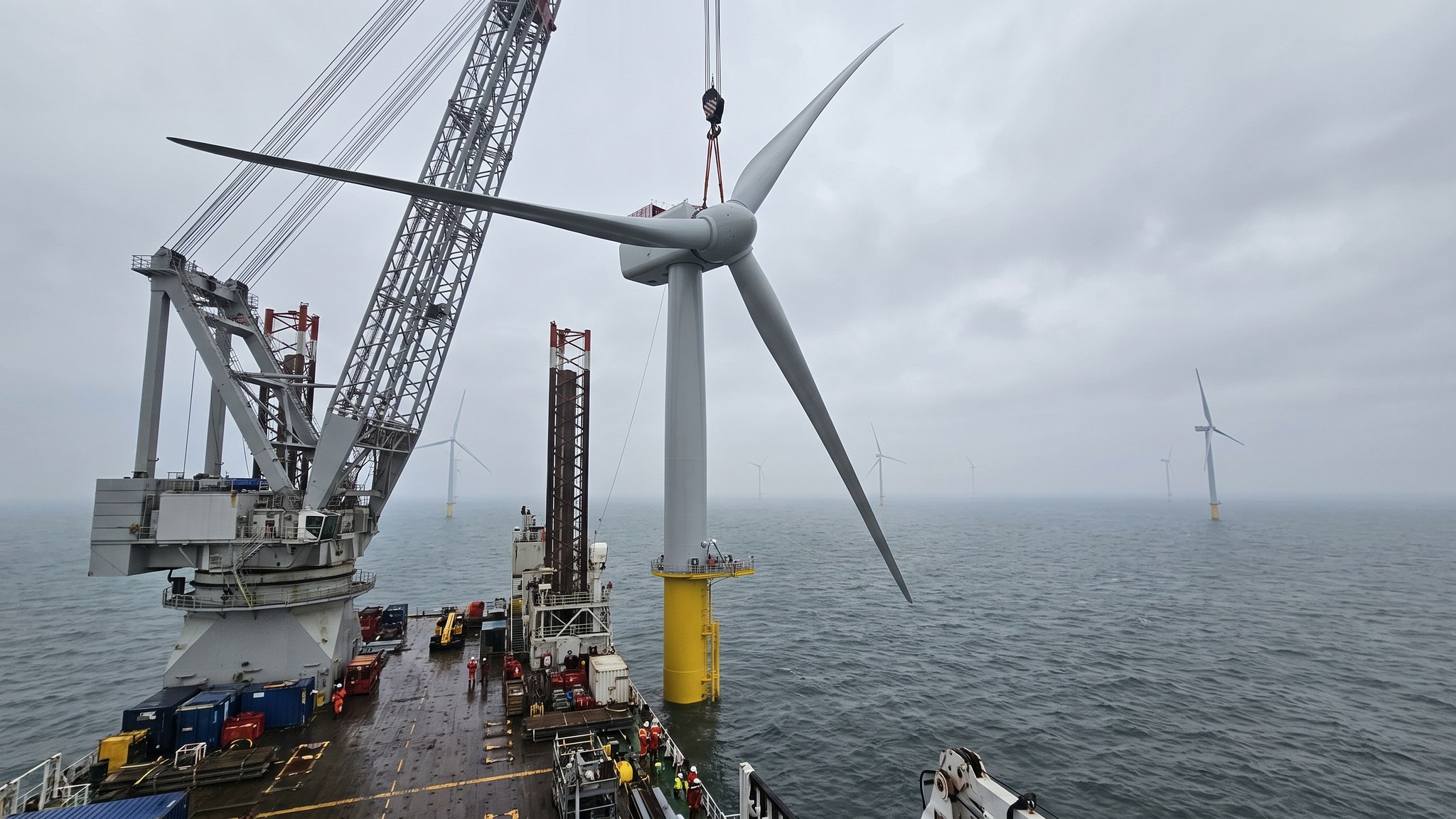
What is Pre-assembled rotor?
Pre-assembled rotor installation moves the blade work onshore. The three blades are bolted to the hub at the marshalling port, where the work is done at ground level with land-based cranes, controlled access and unlimited time. The complete rotor is then transported to the site and lifted onto the nacelle as a single item. Offshore, the turbine goes up in the fewest possible operations: tower sections, nacelle, rotor, done. Where the weather cooperates that is the quickest way to install a turbine, and on a settled campaign it produces the highest rate per vessel day.
The catch is the same thing that makes it attractive. A complete rotor is one enormous object, and it presents an enormous area to the wind while it hangs from the crane. The wind speed at which the lift has to stop is therefore markedly lower than for a single blade, and on an exposed site the number of hours in which the operation can start at all falls sharply. Worse, the lift is long, so the forecast has to hold for the whole of it rather than for a short window. Projects that adopt this method are betting on a benign wind climate, or on a shorter campaign where the odds of finding enough windows are good.
It also imposes demands ashore and on the vessel. The marshalling port needs a pre-assembly area with the space, the cranes and the laydown to build complete rotors and store them, and rotors take up far more deck space than blades in racks, so fewer turbine sets travel per trip and the vessel returns to port more often. The lifting arrangement for a rotor is specialised, and the rotor has to be presented to the nacelle at the correct attitude and rotational orientation, which is a control problem in itself. As with every heavy offshore lift, the operation is planned by the installation contractor and independently reviewed, and it runs against a forecast with defined limits agreed in advance.
How does Pre-assembled rotor work, step by step?
- 1
Step 1: Assemble rotors at the marshalling port
Blades are brought to the pre-assembly area and bolted to the hub on the ground using land-based cranes and support stands. Every root connection is made up and tensioned in controlled conditions, with the technicians standing on solid ground and the work inspected properly. Completed rotors are stored on stands until they are called forward. The quality of this work is generally better than the same connections made at height offshore, which is one of the real advantages of the method and not just a scheduling one.
- 2
Step 2: Load out rotors and turbine components
Rotors, tower sections and nacelles are loaded onto the installation vessel and sea-fastened. A rotor occupies a large footprint and needs support at the hub and along the blades, so deck planning is the constraint on how many sets travel per trip. Fewer sets per trip means more port calls across the campaign, and that transit time is factored into the programme from the start. Quay crane capacity and the vessel's own crane both have to handle the rotor at load-out.
- 3
Step 3: Erect the tower offshore
At the position, the vessel jacks up or holds station and the tower sections are lifted and bolted in sequence, with the connections tightened in the pattern and to the values the specification gives. Verticality is checked at each section, and the internal fit-out connections are made up as the tower rises. The flange at the top is prepared and protected ready for the nacelle, and the as-built foundation interface record is checked before anything is landed.
- 4
Step 4: Land the nacelle and prepare the hub interface
The nacelle is lifted and landed on the yaw interface, bolted down and torqued. The main shaft flange that will receive the rotor is prepared, the rotor lock and turning gear are proved, and access is established for the technicians who will make up the connection. The nacelle is yawed and, where required, the shaft is rotated so that the interface presents at the angle the procedure needs for the rotor to be brought in.
- 5
Step 5: Rig and check the rotor lifting arrangement
The rotor is rigged using the arrangement designed for it, which holds the assembly at the attitude required for the lift and controls its rotation while it is airborne. Taglines or a dedicated control system manage the orientation. The rigging is checked and the lift is briefed in full before the rotor is picked, because once the assembly leaves the deck the operation is committed for its whole duration and there are few opportunities to pause it.
- 6
Step 6: Lift and connect the rotor
The rotor is lifted clear, brought up to the nacelle and manoeuvred until the hub flange meets the main shaft flange at the correct rotational orientation. The bolts are engaged and made up in the pattern and to the values the specification requires, working from inside the hub. Weather is monitored continuously through the operation against the limits set for it, and the go decision to start the lift is taken on a forecast that covers the whole sequence rather than the moment of picking up.
- 7
Step 7: Release, verify and complete
The lifting arrangement is released only once the connection is complete and verified. Bolt tensioning records are taken, the rotor lock is released and the machine is turned through its initial checks. Any transit or handling damage to the blades found during the operation is recorded and assessed, and because the rotor was assembled ashore, most such issues will already have been caught before the assembly ever left the quay.
- 8
Step 8: Commission and hand over the position
Cable pull-in, termination, control commissioning and energisation follow, in the same visit or a later campaign depending on the project. The turbine file for the position is assembled from the onshore assembly records, the offshore lift and bolting records, the weather logs and the functional test results, and handed to the operator. The vessel then moves to the next position or returns to port to reload, and the balance between those two is what the whole method is optimising.
What are the benefits of Pre-assembled rotor?
- The fewest offshore operations of any method, so the fastest turbine installation when weather allows
- Blade root connections are made ashore at ground level, in better conditions and with better access for inspection
- Less work at height offshore, which reduces exposure for the crew
- No specialist blade gripper tooling needed offshore
- Simplest offshore sequence to plan and brief, with fewer hold points per position
- Highest achievable rate per vessel day on a site with a benign wind climate
What are the limitations of Pre-assembled rotor?
- The single most weather-sensitive lift in offshore wind, because the assembled rotor presents a very large area to the wind
- The forecast has to hold for the whole of a long lift, not just for its start
- Rotors consume far more deck space than racked blades, so fewer sets travel per trip and port calls increase
- Needs a marshalling port with a dedicated pre-assembly and rotor storage area
- Becomes impractical as rotor diameters grow beyond what a vessel can carry and lift as one piece
- A damaged blade means dealing with a complete assembled rotor rather than a single component
What is Pre-assembled rotor best suited for?
What plant does Pre-assembled rotor need?
- Marshalling port pre-assembly area with land-based crawler cranes, rotor stands and laydown
- Installation vessel with crane capacity and hook height for a complete rotor lift
- Dedicated rotor lifting and orientation arrangement with tagline or active control
- Rotor transport and support frames with sea fastening
- Bolt tensioning and torquing equipment for tower, nacelle and hub connections
- Rotor lock, turning gear and hub access arrangements
How is Pre-assembled rotor quality-checked?
- Blade root bolt tensioning records taken during onshore assembly, with tool calibration on file
- Rotor dimensional and balance checks completed before the assembly leaves the quay
- Sea fastening and support frame inspection before sailing
- Tower flange bolt tightening records and verticality checks at each section
- Hub to main shaft connection bolting records, made up in the specified pattern
- Weather log and lift plan retained for the rotor lift as evidence the agreed limits were respected