Off-site printed components
Print discrete elements in a controlled factory, then transport and install them like any other precast unit.
Last updated 2026-09-05
What is Off-site printed components?
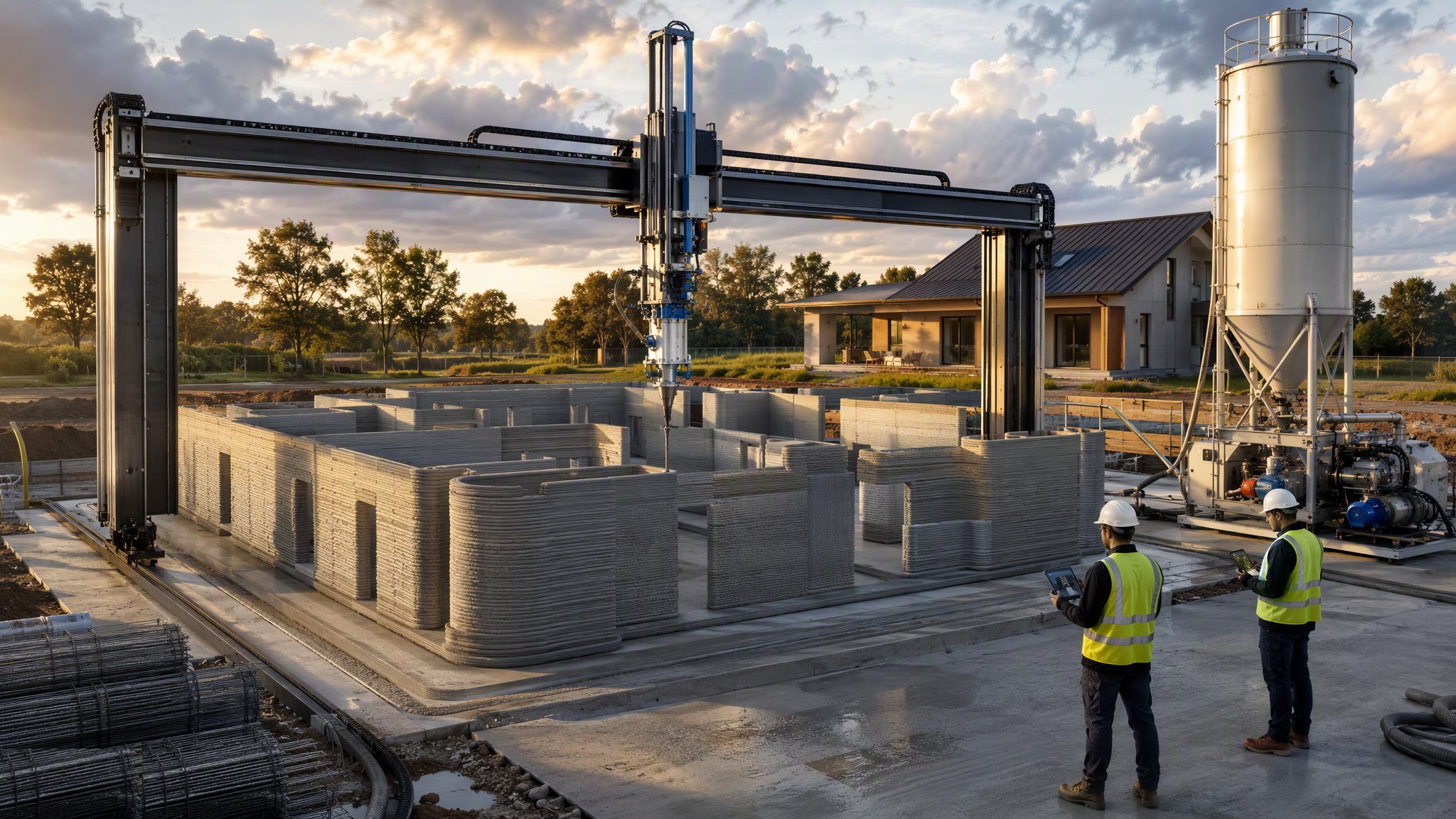
Off-site printed components move the printing indoors. Instead of printing a building in place, discrete elements - wall panels, columns, permanent formwork units, facade features, street furniture, drainage and utility components - are printed in a factory and then transported to site and installed. The printing plant, whether a gantry or a robotic arm, is set up once at a fixed station rather than being erected, calibrated and dismantled on every project, and the whole operation runs in the conditions the material actually wants.
The advantages follow directly from the setting. Temperature and humidity are controlled, so the material behaves consistently and print parameters that worked yesterday still work today. There is no wind, no rain and no need for a weather enclosure. Curing is controlled rather than left to the weather. The plant is fixed, calibrated and maintained, and the operators are a stable crew who print every day rather than a team assembled for one project. Quality control becomes ordinary factory practice - the component is printed, cured, inspected, tested and only then released, and a component that fails is rejected in the factory rather than discovered in a building. Site work reduces to lifting and connecting, which is fast, weather-independent and needs no specialist printing capability at the project at all.
What limits the method is the same thing that limits any precast approach: the component has to be transportable, liftable and connectable. Size and mass are capped by the route and the crane, joints appear where the printing would otherwise have been continuous, and those joints have to be designed, made and sealed. The economics also change - factory printing suits repetition and volume, whereas printing in place suits a one-off building on a site where transport is difficult. As with all additive construction the method is still emerging, and the approvals route, the durability record and the structural design basis continue to develop: the engineer designs the component and its connections, and the approving authority accepts the proposal case by case, generally supported by testing on the actual material and printed geometry. In practice most factory-printed structural components follow the same logic as printed work on site, with the printed element acting as permanent formwork or as a non-structural face and reinforced concrete doing the structural work.
How does Off-site printed components work, step by step?
- 1
Step 1: Establish the component design and its approvals route
The engineer designs the component, its connections and its behaviour in the finished structure, and determines what the printed material is assumed to contribute and where reinforcement and concrete are required. The approving authority is engaged early and accepts the proposal case by case. Because the component will be manufactured repeatedly, the testing regime supporting the design is established at this stage and continues through production.
- 2
Step 2: Design for transport, lifting and connection
Component size and mass are set within what the route and the site crane can take, and the joints between components are located and detailed by the designer. Lifting points, transport restraint and any temporary stiffening required for handling are designed with the component rather than added afterwards, and the connection detail on site is designed to be made with normal access and normal tolerances. A component that is elegant in the factory and impossible to connect at height is a design failure.
- 3
Step 3: Set up and calibrate the factory print station
The printer - gantry or arm - is installed, founded, calibrated and maintained as fixed plant, with its print bed or casting area levelled and registered. Mixing plant, pump and delivery line are set up for continuous consistent output. Because the station is permanent, calibration and maintenance become routine scheduled activities rather than a project-by-project set-up, which is a large part of why factory printing is more consistent than printing in place.
- 4
Step 4: Prove the component in a prototype
A prototype component is printed and tested before production. It proves the print path, the parameters, the demoulding or handling of the fresh component, the lifting points and the connection detail, and it produces specimens for testing against the design assumptions. Production parameters are then fixed and recorded, and any change to them afterwards is a controlled change rather than an operator preference.
- 5
Step 5: Print components in controlled conditions
Components are printed to the fixed parameters in a controlled temperature and humidity, with the material batched and checked for consistency. Reinforcement, inserts, fixings and lifting points are built in as printing proceeds or placed in the cavity where the component is a twin-shell type, and where structural concrete is required it is placed and compacted in the factory. Every component is identified with a unique mark number tied to its position in the building.
- 6
Step 6: Cure, inspect and release
Components are cured under controlled conditions and then inspected - dimensions, squareness, layer bonding, cracking, the condition and position of inserts and lifting points, and the finish. Specimens are tested against the design assumptions. Only components that pass are released for delivery, and rejects stay in the factory. This is the central quality advantage of the method and the reason it is used.
- 7
Step 7: Store, load and transport
Released components are stored on designed bearing points and protected, loaded in the sequence in which they will be installed, and restrained for transport. Where a component exceeds ordinary vehicle dimensions or mass the haulier and the relevant highway and police authorities determine what permissions and conditions apply to the movement. Components are inspected again on arrival for transit damage before restraints are released.
- 8
Step 8: Install and connect on site
Components are lifted into position under the lift plan prepared for them, set to the survey, temporarily propped or restrained as the temporary works design requires, and connected as the engineer has detailed. Joints are made, sealed and finished, and the connections are inspected before they are concealed. Site work is short and largely weather-independent, and no printing capability is needed at the project.
What are the benefits of Off-site printed components?
- Controlled temperature and humidity give consistent material behaviour and repeatable print quality
- No weather exposure during printing or curing, and no weather enclosure to erect
- Fixed, calibrated and maintained plant with a stable, experienced operating crew
- Components are inspected, tested and released before they ever reach the project - rejects never leave the factory
- Site work reduces to lifting and connecting, which is fast and needs no printing capability on site
- Suits repetition, so unit cost falls with volume in a way that printing in place does not
- Complex geometry still costs little more than simple geometry, since there is no mould to make
What are the limitations of Off-site printed components?
- Component size and mass are capped by the transport route and the site crane
- Introduces joints where printing in place would have been continuous, and every joint must be designed and made
- Transport, handling and lifting add cost, and expose components to damage that in-situ printing avoids
- Economics depend on repetition - a genuine one-off may be cheaper printed in place
- Still an emerging method, with the approvals route, durability record and design basis developing
- Requires a factory, fixed plant and storage - a capital commitment rather than a project cost
- Large components may become abnormal loads, with the permissions and cost that follow
What is Off-site printed components best suited for?
What plant does Off-site printed components need?
- Fixed gantry or robotic arm print station with print head and control system
- Factory batching or mixing plant with continuous consistent output, and pump and delivery line
- Controlled curing area, with temperature and humidity control
- Overhead crane, gantry or forklift for handling components within the factory
- Storage racking or stillages with designed bearing points and protection
- Trailers appropriate to the component, with restraint gear and specialist transport where the load is abnormal
- Site crane sized for the heaviest component at its furthest radius, with component-specific lifting gear
- Temporary propping and restraint for components landed but not yet permanently connected
How is Off-site printed components quality-checked?
- Component and connection design, and the approvals route, agreed with the engineer and the approving authority
- Transport and lifting envelope confirmed with the haulier and the site before component size is fixed
- Print station calibration and maintenance on a scheduled routine, with records
- Prototype component printed and tested, with production parameters fixed and recorded before manufacture
- Material batch consistency checks and specimen testing against the design assumptions throughout production
- Dimensional, squareness, layer bonding and insert position inspection on every component before release
- Unique mark numbers carried through drawings, components, storage records and delivery paperwork
- Arrival inspection for transit damage before restraints are released, and connection inspection before joints are concealed