Hybrid volumetric over a conventional core
The modules carry themselves, the core stops the building falling over - and the gap between them is where the job is won.
Last updated 2026-08-30
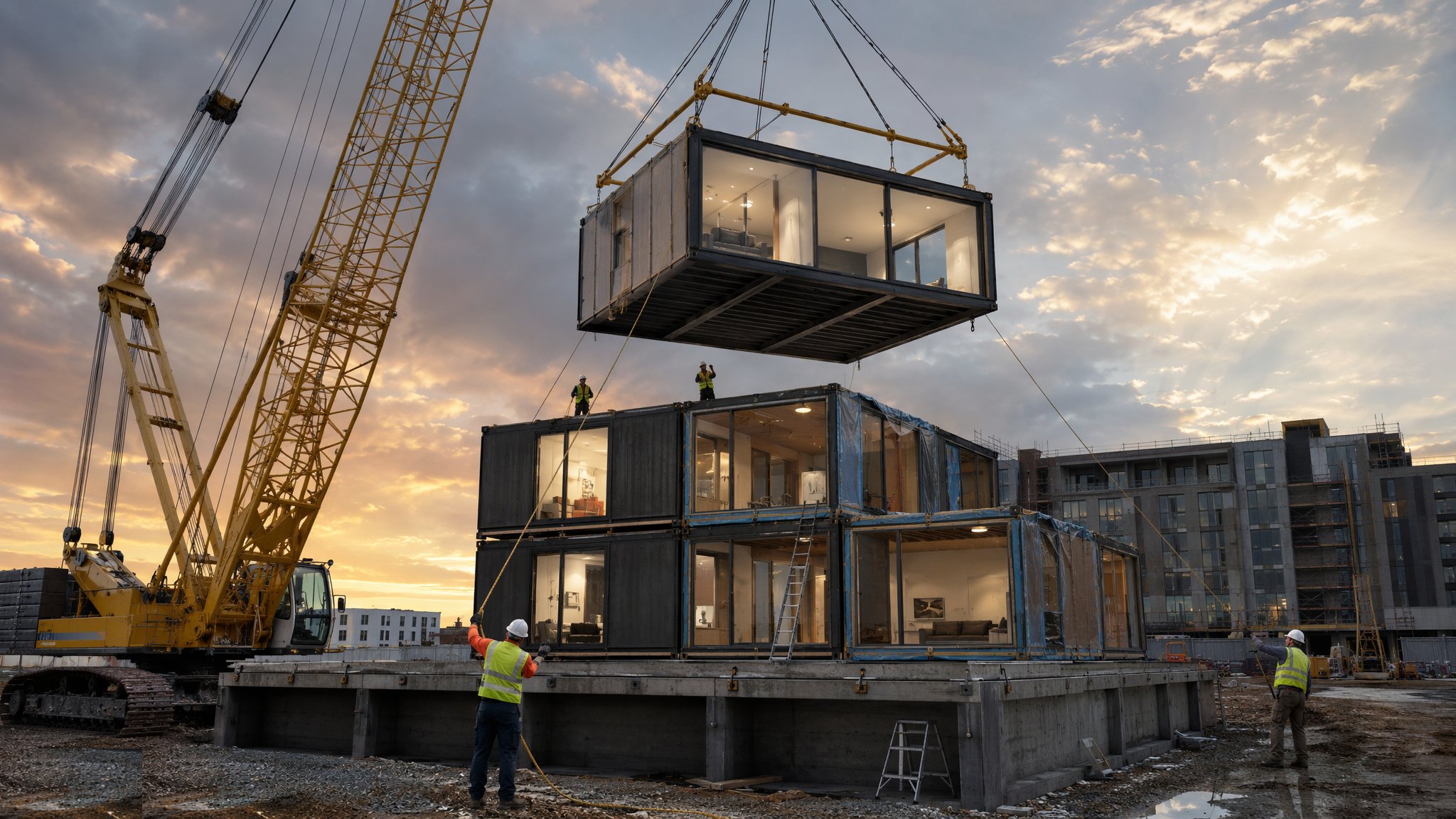
What is Hybrid volumetric over a conventional core?
Hybrid volumetric splits the structural job in two. A cast in situ concrete or steel core takes the lateral stability and carries the lifts, the stairs and the main risers. The modules stack around or beside it and carry only their own gravity load. That division is what lets volumetric go taller than a self-stabilising stack of boxes would manage on its own, and it is the arrangement behind most tall modular buildings. It also means you are running two completely different construction methods, two supply chains and two tolerance regimes on the same footprint at the same time.
The tolerance clash is the defining problem. A concrete core is built to construction tolerances measured in tens of millimetres over its height. A module leaves the factory with tolerances measured in a few millimetres. Those two numbers meet at the connection between the module and the core, and the difference has to be absorbed somewhere. The answer is always an adjustable interface designed in from the start - a connection with slotted or shimmed adjustment, and a corridor or interface zone wide enough to swallow the difference without the finishes telling the story. The structural engineer designs that connection and sets how much movement it can take. What you must not do is discover the problem on the day the first module is offered up to the core.
The second defining problem is sequence. The core has to run ahead of the module stack, usually by a comfortable margin of storeys, so the crane can work and the connections can be made from a completed structure. That makes the core the pacing item for the whole job. If it slips, modules that were built to a fixed factory programme sit on trailers or in a yard, and the storage cost sits with somebody. Two programmes have to be locked to one another and both have to be honest, because in this arrangement the cheapest module in the world is worthless if the core is not there to bolt it to.
How does Hybrid volumetric over a conventional core work, step by step?
- 1
Step 1: Split the structure and agree who takes what
The engineer decides the division early: core takes lateral, modules take gravity, and there is a clearly drawn boundary between them. That decision drives the module grid, the position of every riser, whether the corridor sits between the modules or against the core, and how loads from the modules find their way into the base. Get this on paper before the architecture is fixed, because moving the core later moves everything.
- 2
Step 2: Design the interface as a system, not a detail
This is the piece of the job that repays effort out of all proportion to its size. The module-to-core connection has to accept the difference between construction tolerance and factory tolerance, allow for long-term movement between a concrete core and a stack of modules, and still transfer the load the engineer says it must. Draw it, model it, and where the risk is high, build a mock-up of one bay including the corridor make-good, the service crossovers and the junction sealing before the first module is built.
- 3
Step 3: Build the core ahead and survey it as built
The core is built conventionally and runs ahead of the module stack by the margin the method statement sets. What matters more than usual is the as-built survey: every level of the core face that a module will connect to gets surveyed and recorded, and the results feed back to the module manufacturer and the interface designer before deliveries are called forward. Finding out the core face has wandered while a lorry is waiting at the gate is the expensive way to learn this.
- 4
Step 4: Set the base and the transfer structure to module tolerance
Below the modules there is usually a podium, transfer deck or foundation grid, and it has to be finished to the module manufacturer's tolerance band, not the tolerance the concrete frame was built to. That normally means a survey, then a levelling operation - shims, grout pads or a levelling course - and a full sign-off of the setting-out grid as a single exercise. The engineer confirms how load from the module corners is taken into the structure below.
- 5
Step 5: Run one crane, two workfronts and one sequence
Craneage is usually shared between the core operation and the module lifts, and that shared resource is the daily fight. The install sequence works out from the core, each module landed, levelled, tied back to the core and connected to its neighbours before the next one lands. Because two teams are working in the same airspace, the lift plan and the exclusion zones need managing properly rather than negotiated at the tea hut. Deliveries are called forward against the actual lift rate, with a plan for what happens when the crane is off.
- 6
Step 6: Close the gaps - corridors, risers and the envelope
The stitching work is heavier than on a pure module stack because there is a whole new junction: modules to core. Corridor floors and ceilings are made good across the interface, riser services connect from the module stubs into the core risers, junctions are sealed to the fire strategy the fire engineer has set, and the façade has to run past the core-to-module joint without the movement joint showing up as a crack. Sequence this properly and it disappears. Leave it to the end and it becomes the snagging list.
What are the benefits of Hybrid volumetric over a conventional core?
- Takes volumetric considerably higher than a self-stabilising stack of boxes can go
- Modules only carry gravity, so the box structure can be lighter than a fully self-stable module
- Lifts, stairs and main risers are conventional, which suits maintenance and long-term alteration
- The core gives an early, stable structure to work from and to tie temporary works into
- Fire escape and vertical circulation follow familiar, well-understood construction
- Allows a mix of module types and conventional floor areas in the same building
What are the limitations of Hybrid volumetric over a conventional core?
- Two tolerance regimes meet at every module-to-core connection, and the interface must absorb the difference
- The core is the pacing item - a slip leaves finished modules standing in a yard at somebody's cost
- Craneage is shared between two operations working in the same airspace
- Long-term differential movement between the core and the module stack has to be designed for
- Two supply chains, two sets of temporary works and two commercial teams to keep aligned
- Interface design effort is far larger than the physical size of the joint suggests
What is Hybrid volumetric over a conventional core best suited for?
What plant does Hybrid volumetric over a conventional core need?
- Tower crane, usually shared between the core operation and the module lifts
- Climbing or jump formwork, or a steel core erection package, running ahead of the stack
- Spreader frames and module guidance equipment for landing against a completed face
- Total station and as-built survey equipment for recording every core face level
- Shims, grout and levelling materials for the podium or transfer structure
- Mast climbers or hoists for interface, riser and façade work behind the module lifts
How is Hybrid volumetric over a conventional core quality-checked?
- As-built survey of every core face recorded and issued to the module manufacturer before deliveries
- Interface connection mock-up built and signed off before the first production module
- Podium or transfer deck surveyed and levelled to the module tolerance band, signed off as a whole grid
- Module-to-core connections inspected and recorded level by level, before the next lift lands
- Riser and service crossover connections tested at each level rather than at the end
- Movement joints and junction sealing at the core interface inspected and photographed before closing up