Concrete block paving (CBP)
Interlocking blocks on a prepared base - the traditional container yard surface, liftable and relayable.
Last updated 2026-09-06
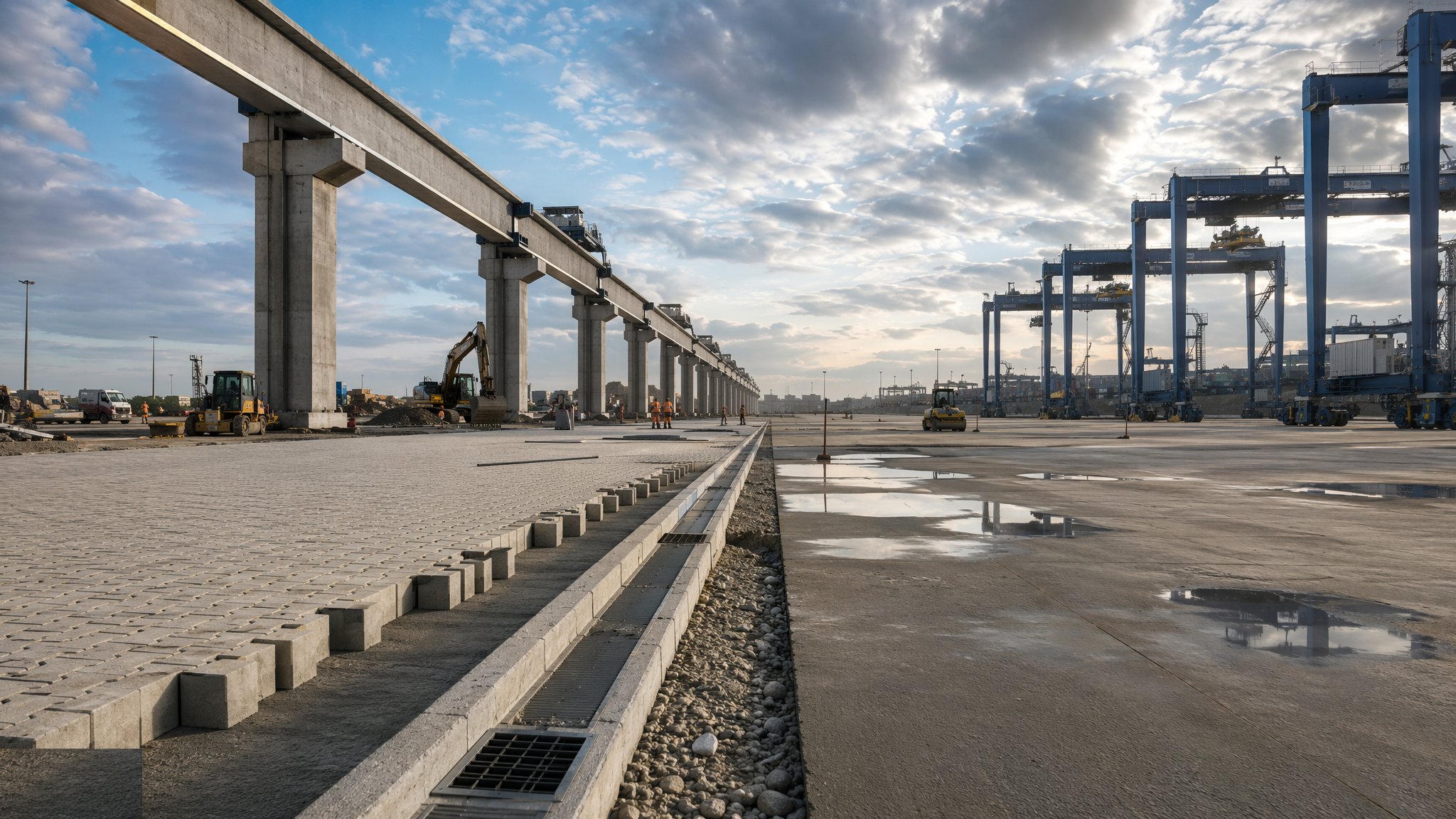
What is Concrete block paving (CBP)?
Concrete block paving is the traditional container terminal surface, and it survives in a world of concrete and asphalt for one reason: it can be taken up and put back. Blocks are laid on a thin laying course over a bound or unbound base, with jointing sand swept into the narrow gaps between them. The blocks do not act as one slab. They interlock, so that a load applied to one block is shared with its neighbours through the jointing sand, and the pavement behaves as a flexible surface made of many small stiff pieces. That is a genuinely useful property under container loads, because a block pavement can accommodate small movements without cracking.
The relaying property drives the whole business case. A container terminal is a working machine that is constantly changing - reefer points added, ducts diverted, drainage altered, a stacking row reconfigured. In a block yard the operator lifts the blocks, does the work, and puts the same blocks back, with a joint that is as good as the original. In a concrete yard the same intervention means breaking out and recasting bays. Over the life of a terminal that difference is worth a great deal, and it is why block paving persists in areas where services and layout are expected to change.
The cost is laid down in labour and in joint discipline. Laying blocks is a slower, more manual operation than paving concrete or asphalt, even with mechanical laying equipment, and it needs a base and a laying course prepared to tight tolerance because every irregularity beneath shows through. More importantly, block paving depends entirely on its jointing sand: joints that are not properly filled, or that lose sand to sweeping, washing or traffic, stop transferring load between blocks and the pavement begins to rock, spall and rut. Joint sand maintenance is a permanent obligation the operator takes on, and it is the single thing that determines whether a block yard performs well or badly.
How does Concrete block paving (CBP) work, step by step?
- 1
Step 1: Prepare and prove the base
Block paving reflects what is under it, so the base does the structural work and the blocks provide the surface. The formation, subbase and base - bound or unbound according to the designer's choice - are placed, compacted and surveyed to a tolerance tighter than for most other pavement types, because the thin laying course cannot regulate out irregularity. Drainage falls are set in the base rather than corrected in the laying course. Edge restraints, kerbs and channels are built before laying, because a block pavement without restraint at its edges will spread and fail there first.
- 2
Step 2: Complete the services and record them
Reefer ducts, lighting and crane supplies, drainage connections, chambers and draw pits are installed and surveyed before laying begins. Block paving is more forgiving here than concrete because access can be regained later, but the as-built record still matters - the operator lifting blocks in five years wants to know exactly where to lift. Chamber and gully surrounds are detailed carefully, because the junction between a rigid frame and a flexible block surface is where most block yards first show distress.
- 3
Step 3: Lay and screed the laying course
The laying course of sand or grit is spread and screeded to a consistent thickness, and it is protected from rain and from being walked or trafficked before the blocks go on. Consistency matters more than absolute thickness, because the blocks will settle by a predictable amount when they are compacted and any variation in the laying course becomes a variation in the finished surface. Screeded material is laid only as far ahead of the block layers as can be covered the same day.
- 4
Step 4: Lay the blocks to the specified pattern
Blocks are laid to the pattern the designer has specified, laid tight with narrow joints, working forward off the laid surface so that the screeded laying course is never walked on. Herringbone patterns are usual under heavy trafficking because they resist creep under braking and turning far better than stack or stretcher patterns. Laying lines are checked frequently against stringlines or a laser, because a block pavement that starts to run out of line will not correct itself. Blocks are drawn from several packs at once so that any colour or shade variation is distributed rather than banded.
- 5
Step 5: Cut the edges and complete the details
Perimeter blocks, and those around gullies, chambers, bollards and crane rails, are cut to fit with a block splitter or saw. Cut pieces below the size the specification allows are not used, because small slivers work loose under traffic almost immediately. Detailing around fixed items is where a block yard is judged, and it is worth the time it takes - a ragged edge around a chamber becomes a maintenance liability within a season.
- 6
Step 6: Fill the joints and compact the pavement
Jointing sand is swept into the joints and the pavement is vibrated with a plate compactor fitted with a protective mat, which forces sand down into the joints and beds the blocks into the laying course. Sand is swept in and the compaction repeated until the joints are full to the top. This is not a finishing operation - it is what creates the interlock that makes the pavement work, and an under-filled joint is a structural defect rather than a cosmetic one.
- 7
Step 7: Check level, regularity and joint width
The finished surface is surveyed for level and regularity against the specification, and joint widths are checked against the tolerance. Areas that are out of tolerance are lifted and relaid, which is quick and cheap compared with the equivalent operation in any other pavement type. Falls are re-checked to confirm the yard drains as designed, with particular attention around gullies and channels where ponding will otherwise appear.
- 8
Step 8: Top up the joints and hand over the maintenance regime
Joints are topped up again shortly after the area is first trafficked, because early traffic settles the sand further. The operator is handed a maintenance regime that makes the joint sand obligation explicit: periodic inspection, topping up, care with mechanical sweeping and washing, and prompt attention to any area where blocks begin to rock. Spare blocks from the same production are left with the operator so that later repairs and relaying match the original.
What are the benefits of Concrete block paving (CBP)?
- Blocks can be lifted and relaid, so services and layout changes cost far less over the terminal's life
- Flexible surface accommodates small movements and settlement without cracking
- Repairs are local, quick and reuse the original blocks
- Trafficable immediately after laying and compaction, with no curing period
- Individual damaged blocks can be replaced without touching the surrounding pavement
- Good skid resistance and clear delineation, and the pattern itself helps organise the yard
What are the limitations of Concrete block paving (CBP)?
- Labour-intensive to lay, with slower production than concrete or asphalt paving
- Depends entirely on jointing sand - lost sand means lost interlock and rapid deterioration
- Needs a base and laying course to tight tolerance, because irregularity shows straight through
- Blocks can creep under braking and turning if the pattern and edge restraint are not right
- Edge restraints and the junctions with chambers and rails are the usual first points of failure
- Not the right surface where fuel and oil spillage or very high point loads dominate
What is Concrete block paving (CBP) best suited for?
What plant does Concrete block paving (CBP) need?
- Grading and compaction plant for the base, with survey control for tight tolerance
- Screeding equipment and rails for the laying course
- Mechanical block laying equipment and clamps, or hand laying gangs for detail areas
- Block splitters and cutting saws with dust suppression
- Plate compactors with protective mats, and sweeping equipment for jointing sand
- Survey equipment for level, regularity and falls
How is Concrete block paving (CBP) quality-checked?
- Base level and tolerance survey signed off before the laying course is screeded
- As-built survey of ducts, drainage and chambers recorded before laying
- Laying course thickness and consistency checked, and screeded areas protected until covered
- Laying pattern, joint widths and minimum cut sizes inspected as work proceeds
- Joint filling and compaction verified, with joints confirmed full to the top before handover
- Final level, regularity and falls survey, with joints topped up after first trafficking