RMG crane beams and rails
A gantry runs on two rails that must stay in line for decades - alignment is the whole engineering problem.
Last updated 2026-09-06
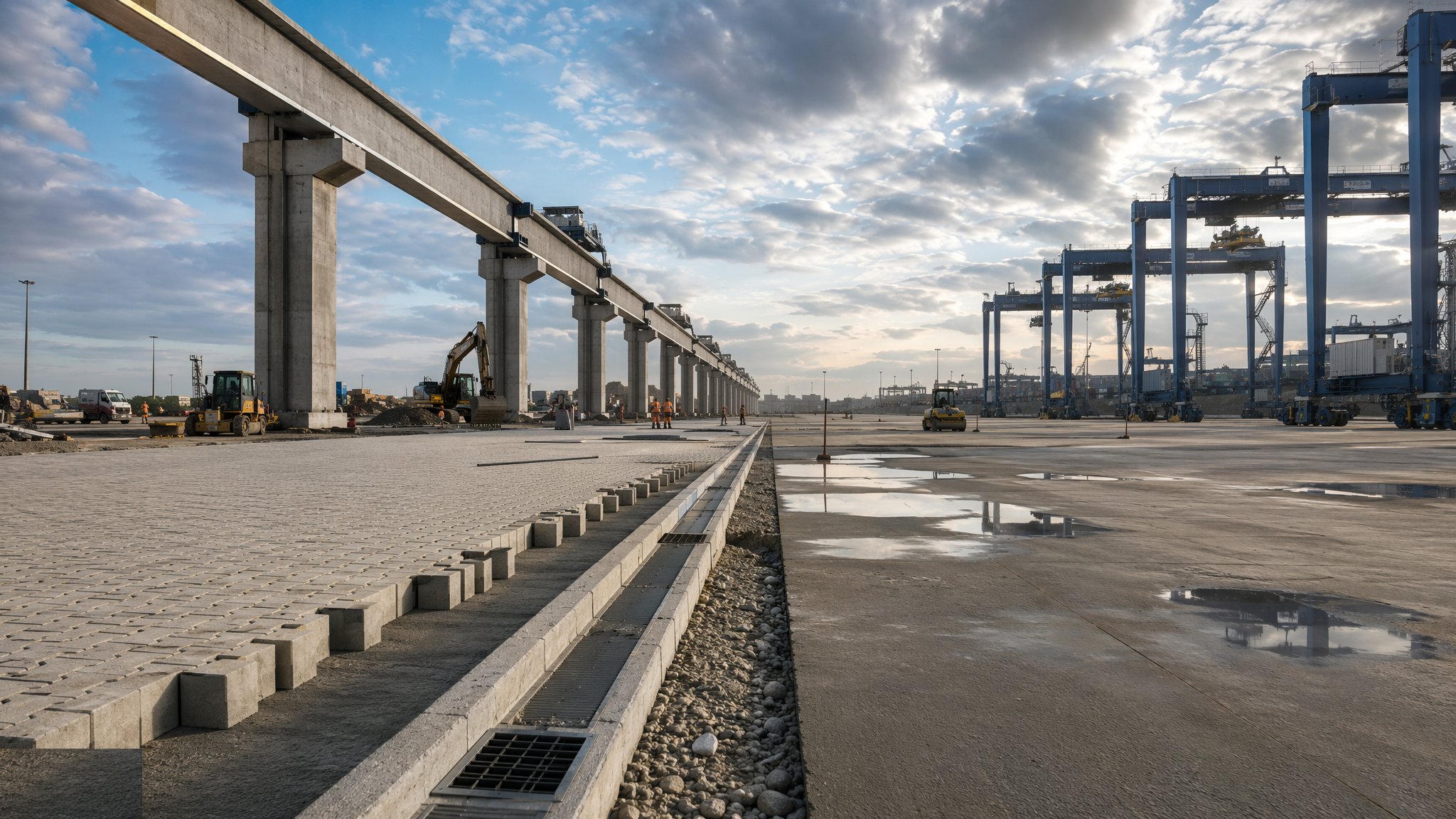
What is RMG crane beams and rails?
A rail-mounted gantry crane runs on two parallel rails carried on continuous beams, and everything about the way those beams and rails are built is driven by one requirement: the two rails must stay accurately parallel, at the same level, and straight, for the life of the terminal. A gantry is a rigid steel portal spanning between its two sets of wheels. If the rails converge, diverge, twist or settle differentially, the crane is forced into the geometry of its runway, and it responds with wheel flange wear, skewing, drive problems and structural fatigue. On an automated terminal, where the crane is positioning itself without a driver to compensate, the tolerances are tighter again.
That is why the crane beam is a structural element rather than a piece of paving. On most projects it is a continuous reinforced concrete beam, founded on piles where the ground will not guarantee uniform support and on a prepared ground-bearing formation where it will. The choice is usually made on settlement rather than on bearing capacity: a beam can be strong enough and still be useless if it settles differentially along its length. Reclaimed and filled terminal ground is exactly the condition that pushes designers towards piling the crane beams even when the surrounding pavement is ground-bearing.
On top of the beam sits the rail, and the rail fixing system is a designed assembly in its own right - the rail itself, a resilient pad beneath it, clips or a continuous fastening, and either a grout bed or a soleplate arrangement that allows the rail to be set precisely to line and level and then locked. The crane supplier, not the civil designer, sets the tolerances for gauge, straightness, level and the difference in level between the two rails, together with the rail section and the electrification and communication arrangements that run alongside. The civil works exist to deliver those tolerances. Survey is therefore continuous, and the runway is surveyed again after the crane is loaded onto it, because the structure moves under the crane it was built for.
How does RMG crane beams and rails work, step by step?
- 1
Step 1: Take the crane supplier's requirements as the governing input
The runway is designed to the crane, so the crane supplier's data comes first: wheel loads and spacing, the gauge, the operating and stowed load cases, the rail section, the fixing arrangement, the electrification and communication systems and, above all, the alignment tolerances the machine requires. Automated cranes are more demanding than manned ones. The civil designer builds the beam and foundation to deliver those figures. All the loads and tolerances are the crane supplier's and the terminal designer's, and they are confirmed in writing before the beam is designed.
- 2
Step 2: Choose the foundation on settlement, not just capacity
The geotechnical designer assesses the ground along the whole runway, with particular attention to variation from one end to the other and to the settlement history of any fill or reclamation. Piled foundations are usual where uniform support cannot be guaranteed; ground-bearing beams are used where the formation is proven and consistent. The decision is made on differential settlement over the life of the terminal, because that is what breaks a runway, and it is made for the runway as a whole rather than section by section.
- 3
Step 3: Install the foundations and set the survey control
Piles are installed and tested, or the ground-bearing formation is prepared and proven. At the same time a permanent survey control network is established for the runway - baseline monuments outside the working area that will still be there in ten years, so that the runway can be re-surveyed against the same references throughout construction, at crane commissioning and during operation. Without that permanent control there is no way to demonstrate later whether a runway has moved.
- 4
Step 4: Construct the beam
The beam is formed and cast as a continuous element, with reinforcement, movement joints and the cast-in items - holding-down bolts, soleplates, pockets, earthing and any cable fixings - set to the tolerance the rail fixing system requires. Cast-in item tolerances are machine tolerances rather than civil ones, so they are set with survey control and checked immediately before the pour. Concrete supply, placing and curing are controlled as for any structural element, and the beam is surveyed after casting so that any correction is made in the rail setting rather than argued about later.
- 5
Step 5: Coordinate the trench, services and drainage alongside
A crane runway is accompanied by a cable trench or festoon arrangement, the power supply, communication and data cables, drainage and often a walkway. These are built alongside the beam and their positions are fixed by the crane supplier's requirements. Drainage matters more than it looks: water standing in a rail trench or against the beam is a long-term durability problem, and on a port terminal it will contain salt. The trench, its covers and its drainage are detailed as part of the runway rather than added afterwards.
- 6
Step 6: Set the rail to line and level
The rail is laid on its pads and set to line and level using the fixing system's adjustment, working from the permanent survey control and checking gauge, straightness, level and cross-level continuously along the runway. This is slow, painstaking work and it is the operation the whole project has been building towards. Rail joints are made as the crane supplier specifies, usually welded and dressed to give a continuous running surface, and the rail is checked again after any welding because heat moves steel.
- 7
Step 7: Grout, clamp and lock the rail
Once the rail is set, the grout bed or soleplate arrangement is completed and the clips or continuous fastenings are installed and tightened to the specified arrangement, locking the rail in position while allowing the movement the design intends. Grouting is done to the manufacturer's method with full contact under the rail, because a void beneath a loaded rail is a fatigue problem that will appear as a broken fixing years later. The rail is surveyed again after grouting and clamping.
- 8
Step 8: Survey under load, commission and set the monitoring baseline
The runway is surveyed again after the crane has been erected and loaded onto it, because the beam and its foundations deflect under a load that did not exist during construction. Crane commissioning then proves travel, positioning, stops, buffers and, on automated systems, the positioning and safety systems along the full runway length. The final alignment survey becomes the baseline for the operator's periodic re-survey regime, which is how a runway is kept within tolerance over decades.
What are the benefits of RMG crane beams and rails?
- Rail-mounted gantries are precise, repeatable and suited to automated operation
- Loads are carried by a designed structural beam rather than by the yard pavement
- Piled beams can be founded below settling fill, so the runway stays true while the yard around it moves
- Electric supply along a fixed runway removes the fuel handling of rubber-tyred machines
- Rail can be re-surveyed, adjusted and renewed without rebuilding the yard around it
- Long service life for the civil works, with the crane replaceable on the same runway
What are the limitations of RMG crane beams and rails?
- Alignment tolerance dominates everything - the civil work is slow, surveyed and unforgiving
- Differential settlement along the runway is the classic failure mode and is hard to correct later
- The crane fixes the yard layout - stacking arrangements cannot easily be changed afterwards
- High capital cost in foundations, beams, rail and electrification before any box is moved
- Rail trenches and fixings sit in a salt-laden environment with a real corrosion and drainage problem
- Construction usually has to be phased around live operations, which slows a tolerance-critical job
What is RMG crane beams and rails best suited for?
What plant does RMG crane beams and rails need?
- Piling rig and testing equipment where the beams are piled
- Formwork, reinforcement and concrete supply for continuous beam pours
- Precision survey equipment and a permanent control network along the runway
- Rail handling, cutting, welding and dressing equipment
- Grouting equipment and torque-controlled tools for the fixing system
- Lifting equipment for rail, soleplates and trench covers
How is RMG crane beams and rails quality-checked?
- Crane supplier's loads, gauge and alignment tolerances confirmed in writing before beam design
- Pile testing or formation proving records for the whole runway length
- Cast-in item positions surveyed to the fixing system tolerance immediately before each pour
- Rail gauge, straightness, level and cross-level surveyed from permanent control after setting
- Grout contact under the rail verified and fixings installed to the specified arrangement
- Post-erection survey under crane load recorded as the baseline for the operator's re-survey regime