Container Terminals & Port Pavements
The hardest-working pavement in construction - heavy-duty concrete and block paving under container corner-casting loads and rubber-tyred gantries, RTG and RMG rails and beams, reefer gantries and their substations, terminal buildings and gate complexes, all phased around a terminal that wants to keep earning.
Last updated 2026-09-06
Typical duration
A full greenfield terminal landside is a 2–5-year phased programme; a single berth's yard block - formation to commissioning - runs 12–24 months, and live-terminal phasing adds the time that operations quite rightly refuses to give back.
What is Container Terminals & Port Pavements?
A container terminal pavement is not a road and it is not a factory floor - it is both at once and worse. Stacked boxes stand on their corner castings, putting the weight of five-high stacks through four small steel footprints; rubber-tyred gantry cranes run the same wheel paths ten thousand times a year; reach stackers and terminal tractors hammer the manoeuvring areas; and none of it forgives a soft formation, a rocking slab or a ponded corner. Heavy-duty pavements answer in one of three dialects: pavement-quality concrete in dowelled bays for the stacking rows and crane rails, concrete block paving for the straddle-carrier and RTG running surfaces where flexibility and re-laying matter, and heavy-duty asphalt where the traffic mix and maintenance regime suit. All three stand on a formation and drainage system engineered for loads no highway ever sees.
The pavement is only the stage - the terminal's machines define the structure. Rail-mounted gantries (RMGs) run on crane beams cast continuous on piled or ground-bearing foundations, with the rail aligned and grouted to tolerances the automation demands; rubber-tyred gantries (RTGs) steer between painted lines but want a surface that will not rut or dish under their wheel loads; ship-to-shore cranes sit on the quay crane rails. Reefer racks and gantries carry the plug points for refrigerated containers, fed from substations and HV ducting threaded under the yard - an electrical distribution network with a pavement poured on top, which is why the duct routes, draw pits and earthing are fixed before the first bay is cast.
Around the yard sit the buildings that make a terminal a business: the gate complex with its lanes, canopies, kiosks and inspection areas where every box is weighed, scanned and checked; the control tower and terminal operating building; workshops, wash pads and the customs and border inspection facilities. The whole estate is phased - terminals are built and rebuilt beside live operations, so the works run in blocks handed over to the operating company one yard section at a time, with temporary fencing, wayfinding and gate arrangements rebuilt at every phase boundary. The finish line is not a ribbon but a systems handover: markings and signage down, reefer points energised and certified, gate systems live, and the terminal operating system seeing the new ground.
Compare the methods at a glance
When and why is Container Terminals & Port Pavements used?
Terminal works run on every new container port and on the endless upgrade cycle of existing ones - yard expansions, RTG-to-RMG conversions, reefer capacity additions and gate reconfigurations. The pavement choice is made on traffic and maintainability: concrete where the loads and the automation are heaviest, block paving where re-laying around services and settlement is expected, asphalt where the owner's maintenance fleet can live with it. It matters because a terminal pavement failure is paid for in moves per hour: a dished stacking row slows the RTGs, a rocking slab trips the automation, a ponded gate lane backs trucks onto the public road. The terminal lives or dies on dwell time, and dwell time starts at the ground - which is why the best terminal contractors talk about pavement flatness with the same passion the operations director talks about crane rates.
Walkthrough storyboard
The process in pictures, step by step - Step 1 of 7 - slide through the snapshots.
STEP 1
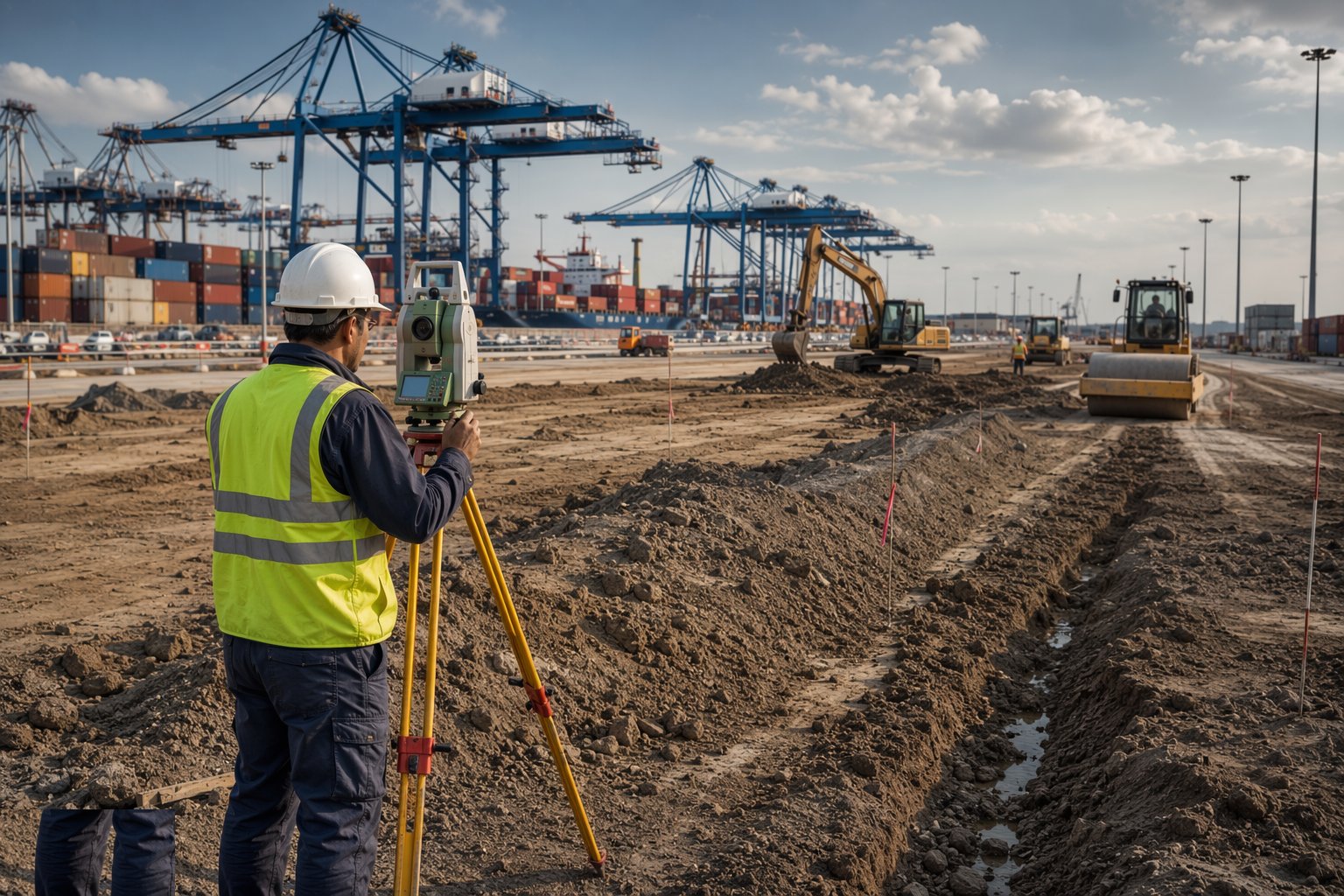
Engineer the formation and the drainage
Terminal pavements inherit the ground, and reclaimed or filled ground inherits the settlement statement from the reclamation stage.
Types of Container Terminals & Port Pavements
Explore each method in depth - benefits, limitations, plant and quality control on its own page.
Pavement-quality concrete (PQC) yards
Dowelled concrete bays 250–350 mm thick, slipformed or formed, for stacking rows, crane beams and the heaviest trafficking. The long-life answer: decades under corner-casting loads, at the price of a quality-hungry paving operation.
Explore this methodConcrete block paving (CBP)
80 mm blocks on laying-course sand over a bound or unbound base, to BS 7533 principles. The flexible terminal pavement: tolerant of settlement, re-layable around services, and the traditional straddle-carrier surface - with a joint-sand discipline it never escapes.
Explore this methodHeavy-duty asphalt
Thick-lift dense asphalt base and surface courses for tractor routes, gate lanes and car parking. Fast to lay and easy to patch - the right answer where trafficking is wheeled and continuous rather than point-loaded.
Explore this methodRMG crane beams and rails
Continuous reinforced concrete beams on piled or ground-bearing foundations carrying rail on soleplates, aligned for automated operation. Structure disguised as pavement: the rail gauge and level tolerances are those of a machine tool, not a road.
Explore this methodRTG runways and beamless systems
Reinforced runways or thickened pavement strips on the RTG wheel paths, with painted or sensor guidance between. The compromise that keeps rubber-tyred fleets productive without the cost of full rail.
Explore this methodBest suited for
- New container yards and terminal expansions on reclaimed or brownfield port land
- RTG-to-RMG and automation conversions on operating terminals
- Reefer capacity additions and substation upgrades
- Gate complex rebuilds and traffic-system reconfigurations
- Heavy-duty pavements for ro-ro, break-bulk and logistics port estates
Container Terminals & Port Pavements: step by step
- 1
Step 1: Engineer the formation and the drainage
Terminal pavements inherit the ground, and reclaimed or filled ground inherits the settlement statement from the reclamation stage. The formation is proven by testing to the design CBR or modulus, subbase and capping placed in controlled layers, and the drainage built as a system that survives point loads: channels, gullies and oil-water separation sized for a yard where a leaking reefer is an environmental event. Falls are checked by survey before a tonne of pavement goes down - a terminal yard that ponds is a defect the operations team will photograph forever.
- 2
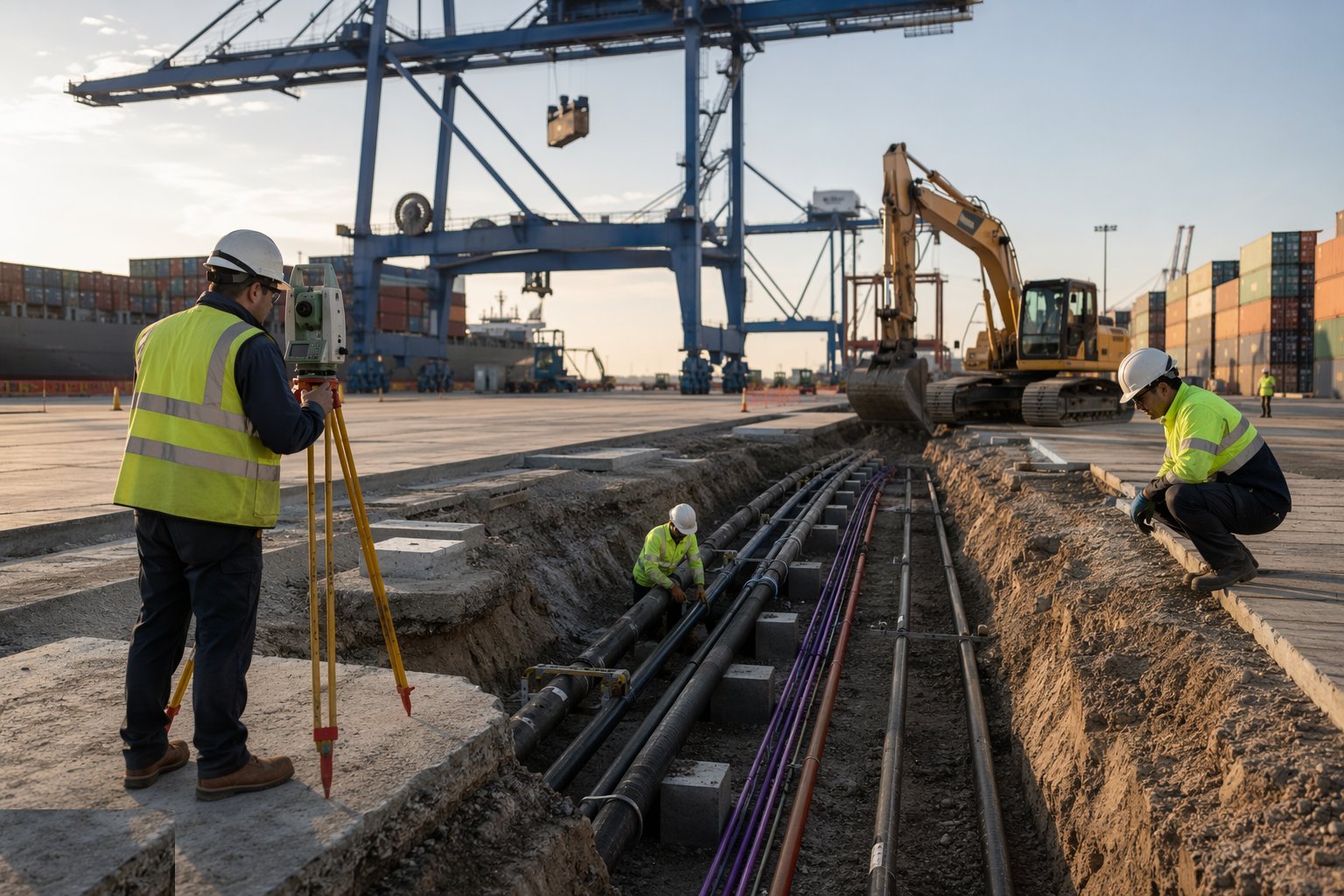
Step 2: Fix the buried services before the pavement
Everything under the yard goes in first and is recorded precisely: HV and LV duct routes from the substations to the reefer racks and crane beams, draw pits, earthing, comms and fibre for the terminal operating system, fire mains and washdown. Routes are surveyed as-built at trench stage with coordinates the operations engineers will trust for fifty years, because the day the pavement closes over a duct run is the last cheap day anyone will ever dig for it.
- 3
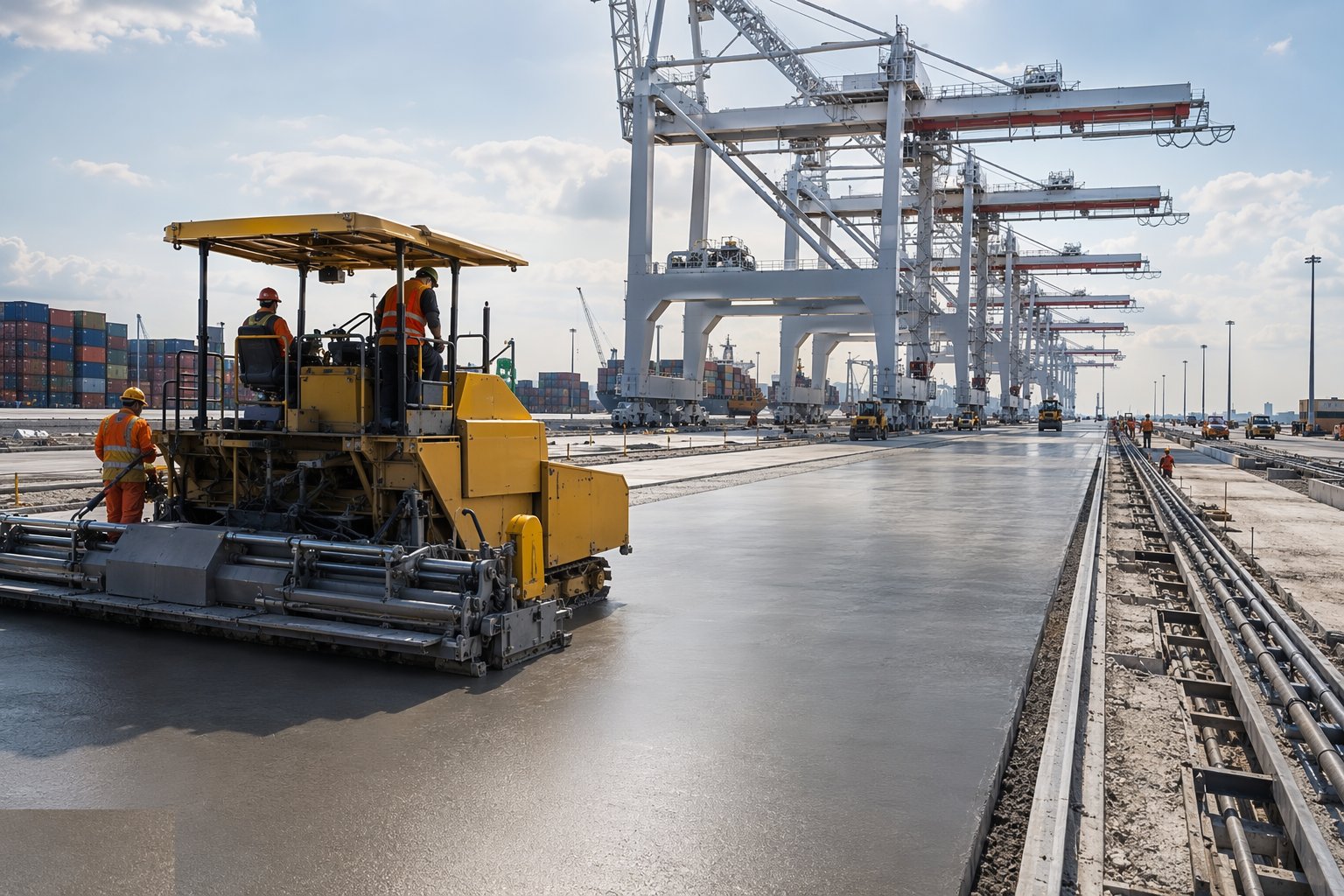
Step 3: Lay the heavy-duty pavement
PQC runs as a disciplined paving train - slipform or fixed-form bays, dowels and tie bars set and checked, texture and cure applied - with bay layouts matched to the stacking rows so joints fall where the loads do not. Block paving follows its own liturgy: screeded laying course, blocks laid to pattern, cut edges restrained, compaction passes and kiln-dried joint sand worked in and topped up, edge courses haunched. Asphalt runs in echelon with density proved by cores. Each surface is level-checked against the flatness the cranes and the drainage both demand.
- 4
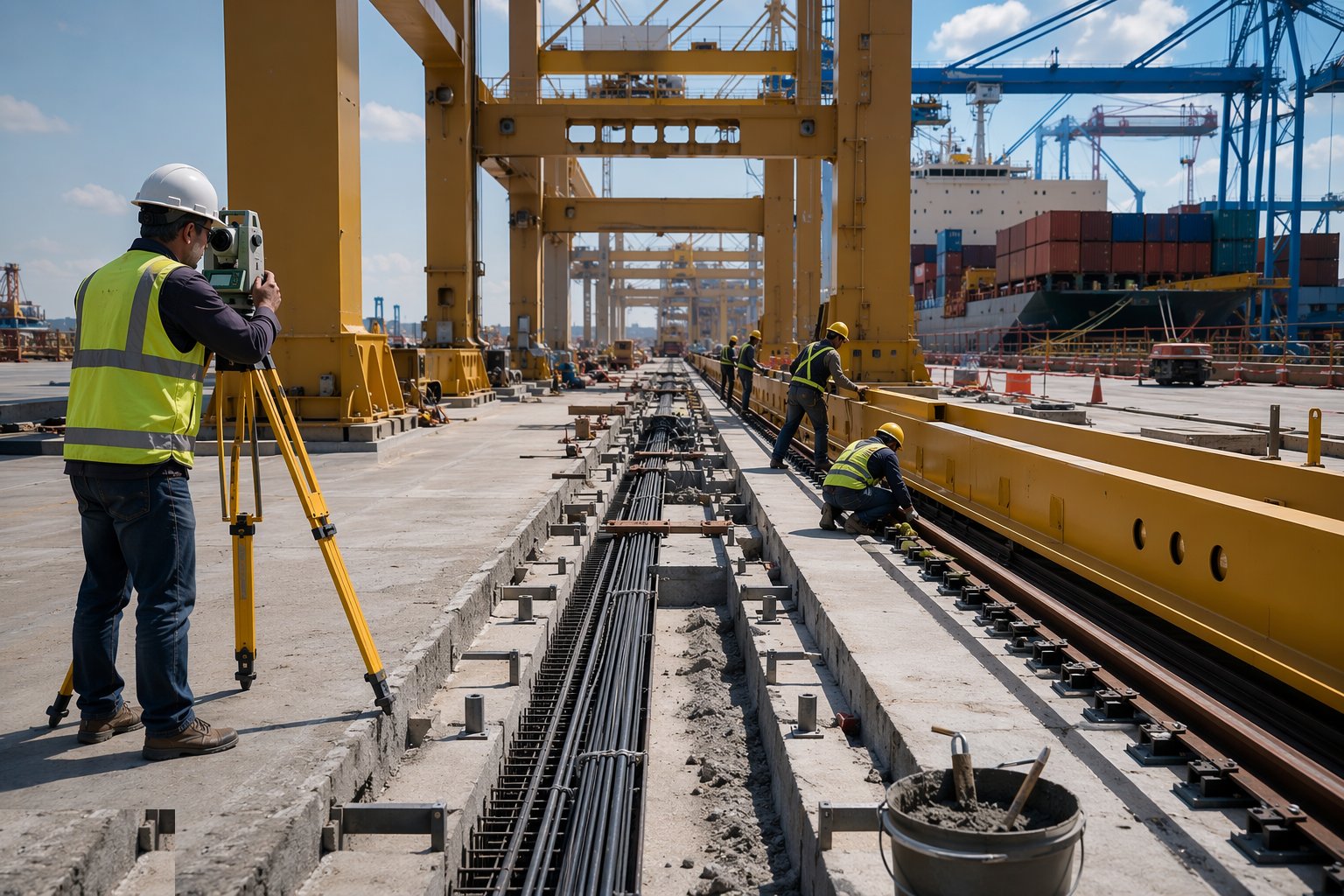
Step 4: Build the crane beams and set the rails
RMG beams are cast continuous with their holding-down assemblies templated in, rails aligned for gauge, level and straightness on their soleplates and grouted, with the alignment survey repeated after grouting and again after the grout has cured. The tolerances belong to the crane builder's automation, not to habit: a rail out of gauge chews wheels, trips drives and blames everyone. Crossing details where the rail meets the yard pavement are built to take the impact of every machine that crosses it.
- 5
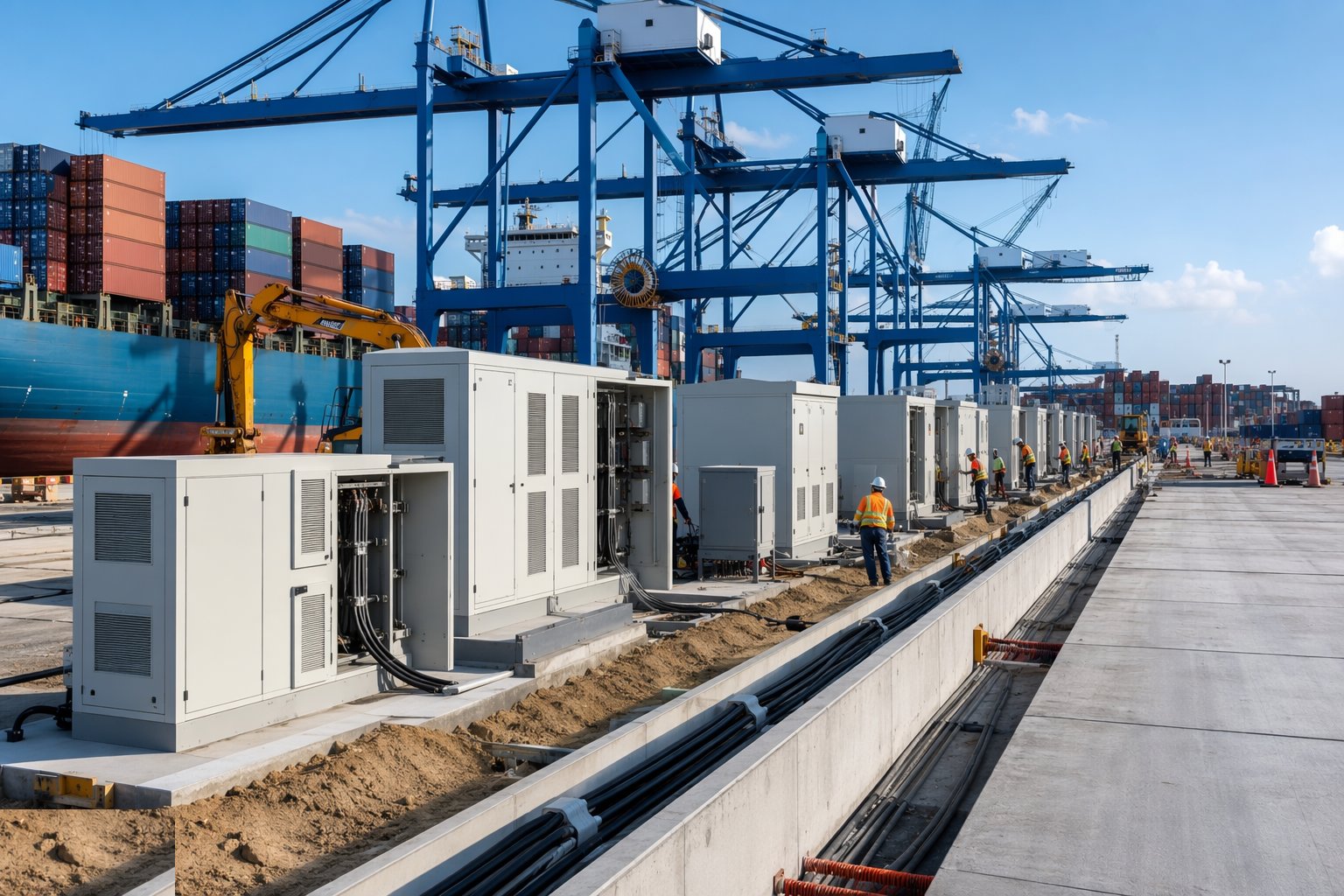
Step 5: Install reefer infrastructure and substations
Reefer racks and gantries are erected on their foundations, plug points and distribution boards fitted, and the HV/LV network from the substations terminated, tested and certified section by section. Earthing and lightning protection are proved, SCADA and monitoring connected, and the whole electrical estate energised under a permit regime - a terminal yard is a substation with containers on it, and the commissioning paperwork is what lets the first reefer plug in legally.
- 6
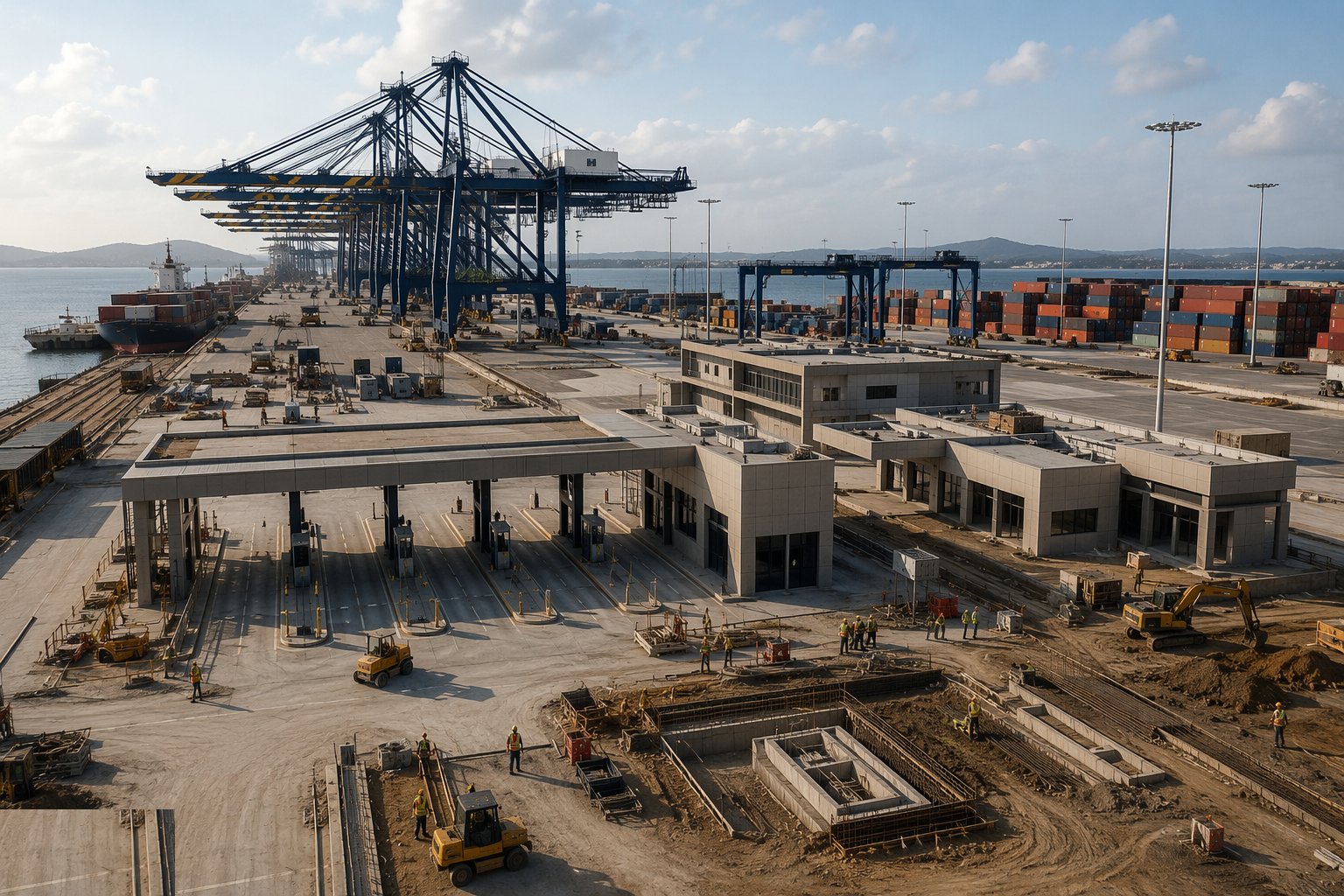
Step 6: Construct the gate complex and terminal buildings
The gate is built as a traffic system: lanes and canopies, weighbridges set in their pits, OCR portals and kiosks on their foundations, inspection and customs facilities, and the segregated pedestrian and vehicle flows barriered and marked. Terminal buildings - control, operations, workshops - follow ordinary building construction with extraordinary interfaces: every one sits beside or within a working yard, so deliveries, cranes and welfare are planned against terminal operations from the first footing.
- 7
Step 7: Mark, commission and hand over block by block
Each block is finished as a working asset: bay and row markings to the terminal's numbering scheme, signage, lighting commissioned, reefer points live, drainage running, and the block surveyed and handed to operations with its records - test results, as-builts, rail alignment, electrical certificates. The terminal operating system is updated, the fencing moves to the next phase, and the new ground takes its first boxes. Phased handover is the terminal way: the port never stops, so the works learn to finish a hundred small times instead of one big one.

Plant & equipment
- Slipform and fixed-form concrete paving trains with dowel and tie-bar equipment
- Block paving laying and compaction spreads with plate compactors and sand kit
- Asphalt pavers in echelon with rollers and density testing
- Crane rail alignment gear: precision survey, soleplate levelling and grouting equipment
- Piling or foundation rigs for crane beams on poor ground
- Cable pulling, jointing and test equipment for the HV/LV and reefer networks
- Weighbridge, OCR and gate-system installation and commissioning specialists
- Phasing kit: temporary fencing, wayfinding, wheel washes and the logistics of a live terminal
Quality control & testing
- Formation and subbase testing - CBR, plate tests, density - against the pavement design
- PQC cubes and flexural beams, dowel alignment checks and bay level surveys
- Block paving compaction, joint sand and straightedge checks; asphalt cores for density and thickness
- Crane rail alignment surveys at set, after grouting and at handover - gauge, level, straightness
- Electrical certification of reefer and substation networks before energisation; earthing test records
- Buried services as-builts surveyed at trench stage and lodged with the terminal's records
Safety watchpoints
- Live-terminal working: segregated haul routes, gate discipline and absolute respect for operating crane exclusion zones
- Paving train hazards: reversing deliveries, hot materials and men on foot beside heavy plant - positive communication everywhere
- Electrical works under permit: HV switching, test-before-touch and energisation controlled section by section
- Night and weekend possession working against vessel schedules: fatigue management and hard handback times
- Lifting operations around stacks and gantries with wind limits and dropped-object zones enforced
- Dust, slurry and jointing sand exposure at the paving face; welfare maintained at the far end of a big yard
Common defects to hunt
- Slab rocking and corner breaks under corner-casting loads where the formation was passed on a prayer
- Joint spalling and faulting in PQC where dowels misaligned or saw-cuts ran late
- Block paving rutting and shoving on the RTG wheel paths - joint sand lost and never replaced
- Ponding at drainage low spots and trench settlements - the yard that floods in the first storm
- Crane rail misalignment after grout cure - wheels and drives wearing against a survey nobody repeated
- Reefer plug and pit corrosion, and duct routes lost to memory - as-builts that were never quite finished
How long does Container Terminals & Port Pavements take?
Typical duration: A full greenfield terminal landside is a 2–5-year phased programme; a single berth's yard block - formation to commissioning - runs 12–24 months, and live-terminal phasing adds the time that operations quite rightly refuses to give back..
Related processes
- Quay Walls & Berth Construction
- Dredging & Land Reclamation
- Marine Piling & Jetty Construction
- Pavement-quality concrete (PQC) yards - method
- Concrete block paving (CBP) - method
- Heavy-duty asphalt - method
- RMG crane beams and rails - method
- RTG runways and beamless systems - method
- Ports, Harbours & Marine Works sector guide
- Transport Infrastructure - group of sectors
Previous in sequence
03 - Marine Piling & Jetty Construction