Granular capping over weak formation
A graded granular layer built over soft ground so the load reaching the subgrade is one the subgrade can carry.
Last updated 2026-09-05
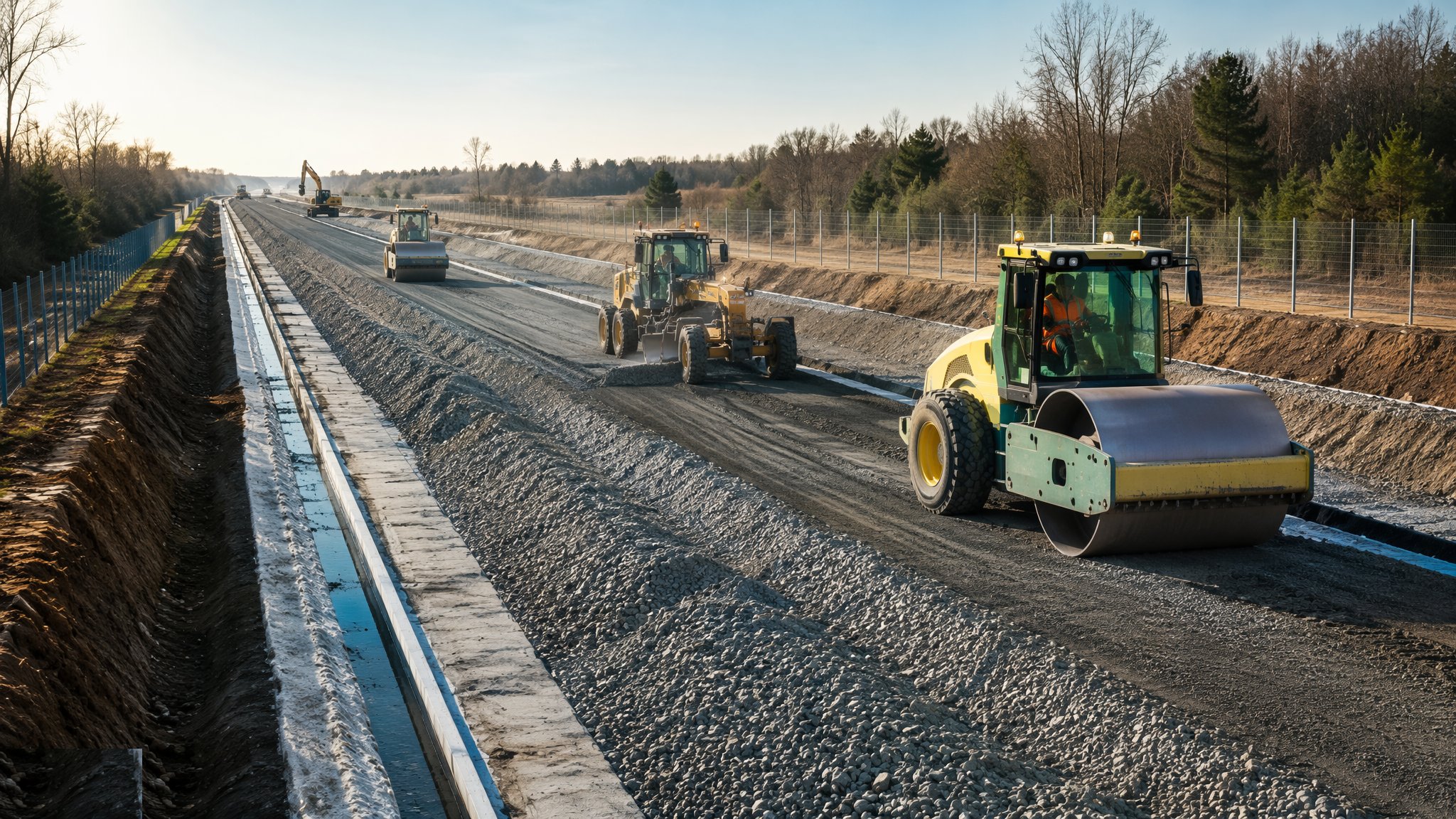
What is Granular capping over weak formation?
Capping is the classic remedy for a weak railway formation. The ground beneath an old line is rarely what a modern axle load wants to sit on. Much of the network was built on materials that would not be accepted today, laid without compaction, drained by ditches that silted up decades ago and loaded ever since by traffic heavier than anything the original builders imagined. Where the subgrade is too soft to carry the stress arriving from the sleepers, the answer on most projects is to interpose a thick, well-graded granular layer between the two. The capping spreads each wheel load over a wider area of the subgrade, so the pressure reaching the soft material falls to something it can take without deforming.
The behaviour is simple to picture and harder to design. Load leaves the sleeper as a concentrated patch, spreads through the ballast, spreads again through the sub-ballast, and spreads once more through the capping. Every additional millimetre of well-compacted granular material widens the cone and lowers the stress at the bottom of it. Thickness is therefore the main design lever, and the designer sets it from the measured strength and stiffness of the subgrade, the traffic the route carries, the line speed and the tolerance for future settlement. The capping material itself matters as much as its depth. It has to be well graded so that it locks together, clean enough that fines do not choke it, hard enough to survive compaction and the years of traffic that follow, and frost resistant where the formation sits close to the surface.
Capping is chosen because it is understood, buildable and forgiving. It uses ordinary earthworks plant, ordinary quarried material and skills every civils contractor already has. Its weakness is that it needs room. Adding a granular layer beneath the track means either digging the formation down to make space or raising the rail level, and on a live railway both of those are expensive. Digging down means excavating in a possession, handling wet arisings and putting the track back in the same shift. Raising the level means checking the clearance under every bridge, at every platform and against every structure for miles. Where neither is available, the designer usually looks at a reinforced or stabilised solution instead. Where the room exists, capping remains the default, and on most projects it is the cheapest way of turning ground that will not take the traffic into ground that will.
How does Granular capping over weak formation work, step by step?
- 1
Step 1: Investigate the formation and set the design
The design starts with what is actually under the track. Trial pits, boreholes, probing and geophysical survey between them establish the depth and condition of the existing ballast, whether the old formation has been fouled by fines pumped up from below, how strong and how stiff the subgrade is, where water sits and how it moves. The designer reads that record and decides the treatment: how deep to dig, how thick the capping needs to be, what material it is built from and what drainage goes with it. The thickness for any particular site belongs to that calculation. It follows the measured strength of the ground and the traffic the route carries, and the designer sets it.
- 2
Step 2: Plan the possession and the access
Formation work is never a matter of turning up. Everything happens inside a possession granted by the infrastructure manager, under a safe system of work that the infrastructure manager controls, and the length of that possession dictates how much can be attempted. The team works backwards from the handback time: how much track can be lifted, how much material can be excavated and removed, how much capping can be imported, placed and compacted, and how long it takes to put the track back and make it fit to run over. Access for road plant is usually the constraint that decides the method, because a site reachable only along the track is a very different project from one with a compound beside it.
- 3
Step 3: Excavate to formation level
The track is lifted or slewed clear, the old ballast is removed and the excavation is taken down to the level the design calls for. This is the moment the ground is finally visible, and it commonly disagrees with the investigation. The engineer inspects the exposed formation, compares it with what was expected and confirms or changes the design before anything is built on it. Excavation is kept moving so the formation is not left open in the rain, because an exposed subgrade that softens has to be dug out again. Arisings are separated as they come out, since old fouled ballast and wet cohesive material go to different places.
- 4
Step 4: Prepare and prove the formation
The exposed subgrade is trimmed to a level surface with a fall across it so water runs off rather than ponds. Soft spots are dug out and replaced. The surface is then tested to show that it is what the design assumed, using plate or stiffness testing at a frequency set by the specification. Where the formation is too weak to support the plant that has to build on it, a first sacrificial layer goes down to give a working surface. The formation is signed off before the capping starts, because everything above it is only as good as the layer it sits on.
- 5
Step 5: Place and compact the capping in layers
Capping is built in successive layers rather than in one lift, because a roller can only compact so much material at a time. Each layer is spread to an even thickness, brought to a moisture content at which it will compact, then rolled until the specified density is achieved. Compaction is verified layer by layer, and a layer that fails is reworked before the next one covers it. Levels and cross-falls are surveyed as the build rises so the finished surface arrives where the design wants it rather than being trimmed into place at the end.
- 6
Step 6: Build the drainage with the layers, not after them
Drainage decides how long a trackbed lasts. Water trapped in or beneath the capping softens the subgrade, and softened subgrade pumps fines upwards into the ballast until the track will not hold its geometry. Cess drains, filter drains, carrier pipes and outfalls are therefore built as part of the same operation, connected to a discharge that has been proved to work, and given the falls the design calls for. On most projects the drainage is the single item most likely to be squeezed by a short possession, and it is the item that repays being done properly more than any other.
- 7
Step 7: Cap with sub-ballast and hand back
A sub-ballast layer is placed over the capping to filter between the fine and coarse materials and to shed water off the formation. The ballast, sleepers and rail then go back, and the track is brought to a condition fit for traffic before the handback time. The engineer records what was built, where the layer boundaries sit and what the test results were, because the next generation of maintainers will want to know what is under the track. Survey control runs throughout, from the first setting out to the final as-built.
- 8
Step 8: Monitor the finished formation
A new trackbed is not finished when the possession ends. The line is watched over the following months for settlement, for geometry that deteriorates faster than its neighbours and for water appearing where it should not. Where the design allowed for consolidation, the movement is measured against what was predicted. Persistent problems are traced back to their cause, which in the great majority of cases turns out to be water that is not getting away, rather than a capping layer that was too thin.
What are the benefits of Granular capping over weak formation?
- Uses ordinary earthworks plant, ordinary quarried material and skills every civils contractor already has
- A well understood and forgiving solution, easy to design, easy to price and easy to check
- Spreads load over a wide area of subgrade, so weak ground can carry modern traffic without being replaced wholesale
- Layer by layer compaction testing gives direct evidence that what was built matches what was designed
- Robust against the variability found in old formations, since thickness can be adjusted as the ground is exposed
- Combines naturally with new drainage, which is usually the other half of the problem
What are the limitations of Granular capping over weak formation?
- Needs vertical room, either by digging the formation down or by raising the rail level
- Raising the level forces a clearance check against every bridge, platform and structure on the section
- Large volumes of imported stone and exported arisings, with the haulage and carbon that go with them
- Excavated formation is vulnerable to rain, and a softened subgrade has to be dug out again
- Possession length often decides how much can be built in one go, which fragments long schemes
- Wet cohesive arisings can be difficult and expensive to handle and dispose of
What is Granular capping over weak formation best suited for?
What plant does Granular capping over weak formation need?
- Excavators with grading buckets, working from the track or from a formed haul road
- Dumpers and tippers for import and export, or rail-borne wagons where road access is absent
- Dozers and graders for spreading and trimming the layers
- Vibrating rollers sized to the layer thickness, with a smaller compactor for edges and around drainage
- Pumps, sumps and settlement facilities for water taken out of the excavation
- Plate or stiffness testing equipment and survey instruments for level and cross-fall control
How is Granular capping over weak formation quality-checked?
- Formation inspected and proved before any capping is placed, with soft spots dug out and replaced
- Capping material tested on delivery for grading, cleanliness and durability against the specification
- Compaction verified layer by layer, with failing layers reworked before being covered
- Levels and cross-falls surveyed as the build rises, so falls shed water rather than trap it
- Drainage runs proved to discharge, with falls and connections recorded before backfilling
- As-built record of layer depths, materials and test results handed over for future maintenance
More rail formation & trackbed methods
Next method
Geosynthetic-reinforced trackbed