Stabilised formation
Binding the soil that is already there into a platform, instead of carting it away and importing stone.
Last updated 2026-09-05
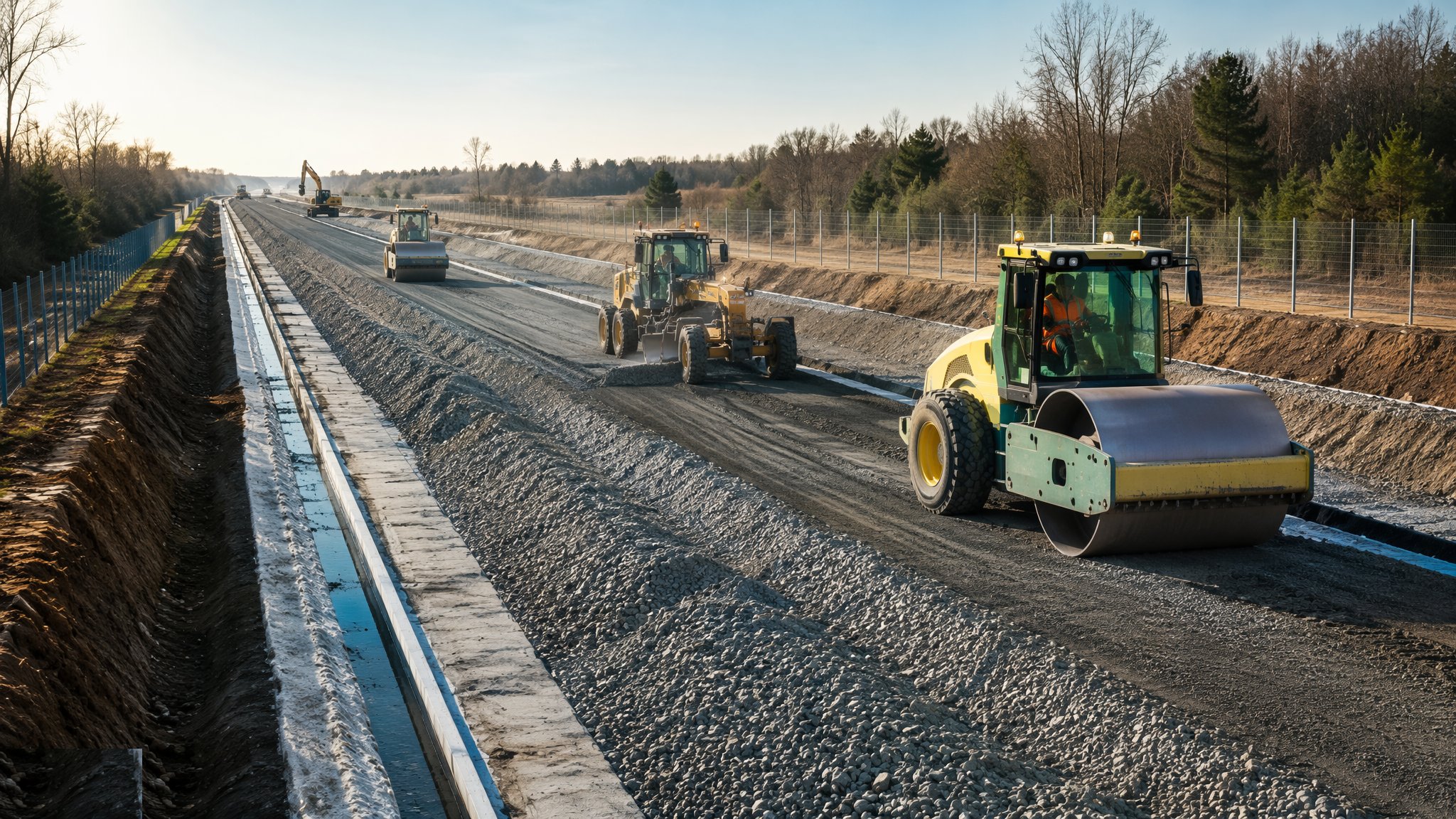
What is Stabilised formation?
Stabilisation treats the existing ground as a material rather than as a problem to be removed. A binder is mixed into the in situ soil, the mixture is compacted, and what was a soft or wet formation becomes a stiffer, stronger and more water resistant platform. Two broad families of binder are used. Lime reacts with clay minerals, dries the soil, reduces its plasticity and over time develops strength, which makes it the usual choice for wet cohesive ground. Hydraulic binders such as cement produce a more direct cementing action and suit granular and low plasticity soils. Many projects use both in sequence, lime first to dry and modify, then a hydraulic binder to build strength.
The attraction on a railway is arithmetic. A conventional dig and replace generates a large volume of wet arisings to export and an equally large volume of stone to import, and on a site with only rail access that traffic can dominate the possession. Stabilisation reduces both to near zero, since the material stays where it is. It also raises the rail level far less than an imported capping layer would, which keeps clearance problems away. Against that, it introduces a process that is sensitive to the soil it is applied to, to the moisture content on the day and to the weather that follows.
Stabilisation is a chemical process taking place in a field, and it behaves accordingly. The soil has to be suitable, which is established by laboratory trials on samples from the actual site rather than assumed from a soil description. Certain soil chemistries react badly with certain binders and can swell long after the works are finished, so the testing that rules those out is not optional. The mixed material has to be compacted within the working time of the binder, and rain falling on a freshly spread binder or on an uncompacted mixture can spoil a shift. Dust and run-off need managing, since binders are alkaline and both the powder and the water leaving the site are controlled. Where the ground suits and the weather cooperates, stabilisation is among the cheapest and lowest carbon formation solutions available. The designer decides whether those conditions are met.
How does Stabilised formation work, step by step?
- 1
Step 1: Sample the soil and test it in the laboratory
Nothing is stabilised on the strength of a borehole log alone. Representative samples are taken along the length to be treated and tested to establish the soil type, its plasticity, its moisture content and its chemistry. Laboratory mixes are then prepared at several binder contents to find what the soil actually does when the binder is added, and to confirm it does not react in a way that causes swelling later. The designer sets the binder type, the binder content and the target properties from those results. Variation along the route is normal, and the design usually zones the works accordingly.
- 2
Step 2: Plan the works around weather and possession
Stabilisation has a working window. Binder spread on the ground has to be mixed and the mixture has to be compacted within a limited time, and heavy rain during that window can undo the shift. The programme therefore plans a treatable area per shift that can be completed rather than started, with a fallback if conditions turn. All of this sits inside a possession granted by the infrastructure manager and under the safe system of work that the infrastructure manager controls, so the treatable area is bounded by access and handback as much as by the weather.
- 3
Step 3: Prepare and pulverise the formation
The track is lifted, old ballast removed and the formation exposed to the level the design calls for. Obstructions, buried services and anything that would damage a mixing rotor are located and removed. The soil is then pulverised by the mixer so that the binder can be distributed through it rather than sitting in lumps. Cohesive soils need more pulverisation passes than granular ones. The engineer checks the exposed material against the design zones, because the ground rarely changes exactly where the drawing says it will.
- 4
Step 4: Spread the binder at the specified rate
Binder is spread by a calibrated spreader at the rate the design sets, and the rate is verified on the ground rather than taken from the delivery note. Spreading is done into the wind where possible and dust suppression is used, since the binders are alkaline powders and both operatives and neighbours are protected from them. Spread widths are overlapped so that no untreated strips are left. On a windy day the operation stops, because binder blown off the formation is binder that is not in the mix and is a nuisance somewhere else.
- 5
Step 5: Mix to full depth and adjust the moisture
A rotary mixer works the binder through the soil to the full treatment depth in one or more passes, and the depth is checked by digging into the mixed material rather than by reading the machine. Water is added or the soil is aerated to bring the mixture to the moisture content at which it will compact properly, since too wet and it will not densify and too dry and the binder cannot react. Where lime is used to dry and modify a wet clay, a mellowing period is usually allowed between mixing and final compaction so the reaction can work through the soil.
- 6
Step 6: Compact and trim within the working time
The mixed material is compacted with rollers sized to the layer, working systematically so that the whole area receives the same effort, and finished to level and cross-fall. All of this happens inside the binder working time, which is why the treatable area per shift is planned rather than optimistic. The surface is then sealed or protected against drying out and against rain, because the reaction continues after the roller has left and a surface that dries too quickly or is washed by rain does not gain the strength the design expects.
- 7
Step 7: Test the finished platform
The treated formation is tested for compaction, thickness and strength or stiffness at the frequency the specification sets, and the results are compared with the target properties from the laboratory design. Cores or pits confirm that the treatment reached the full design depth across the width, since a shallow pass at the edges is a common defect. Areas that fail are re-treated rather than accepted, and re-treatment is far easier before the ballast and track go back than after.
- 8
Step 8: Build drainage and reinstate the track
Drainage is installed with the works. A stabilised platform sheds water far better than the soil it was made from, which makes it all the more important that the water has somewhere to go. Sub-ballast, ballast, sleepers and rail are then reinstated and the section brought to a condition fit for traffic before handback. The as-built record states the binder, the rates, the depths and the test results, because a stabilised layer is not obvious to anyone excavating the same ground years later.
What are the benefits of Stabilised formation?
- Uses the soil already present, so import and export are close to zero
- Removes the haulage that would otherwise dominate a possession on a site with poor access
- Raises the rail level far less than an equivalent imported capping layer
- Turns wet cohesive ground into a trafficable platform, often within the same shift
- Low embodied carbon per metre compared with dig, cart away and import
- The finished platform sheds water and resists softening better than the untreated soil
What are the limitations of Stabilised formation?
- Only suitable where laboratory testing on site samples shows the soil reacts appropriately
- Certain soil chemistries react badly with certain binders and can swell long after completion
- Weather sensitive, since rain during the working window can spoil a shift
- Binders are alkaline powders, so dust control and run-off control are constant obligations
- Needs specialist mixing plant and a crew experienced in rate control and depth control
- Difficult to excavate later, and invisible to anyone without the as-built record
What is Stabilised formation best suited for?
What plant does Stabilised formation need?
- Rotary soil mixer capable of treating to the full design depth in a controlled number of passes
- Calibrated binder spreader with rate control, plus binder tankers and dust suppression
- Water bowser for moisture adjustment, and a grader or dozer for aeration when the soil is too wet
- Vibrating and pneumatic tyred rollers for compaction, with hand compactors at edges
- Excavators for exposing the formation and for removing obstructions before mixing
- Field testing equipment for depth, compaction and stiffness, with sampling gear for laboratory checks
How is Stabilised formation quality-checked?
- Laboratory mix design on samples from the actual site, including checks that rule out damaging reactions
- Binder spread rate verified on the ground, not taken from the delivery ticket
- Mixing depth checked by digging into the treated material across the full width
- Moisture content controlled so the mixture compacts, with mellowing time allowed where specified
- Compaction, thickness and strength or stiffness tested at the specified frequency against the design targets
- As-built record of binder type, rates, depths and results, so future excavation is informed