Sub-ballast and sand blanket
The graded layer between ballast and formation that filters, sheds water and stops the ballast punching into the subgrade.
Last updated 2026-09-05
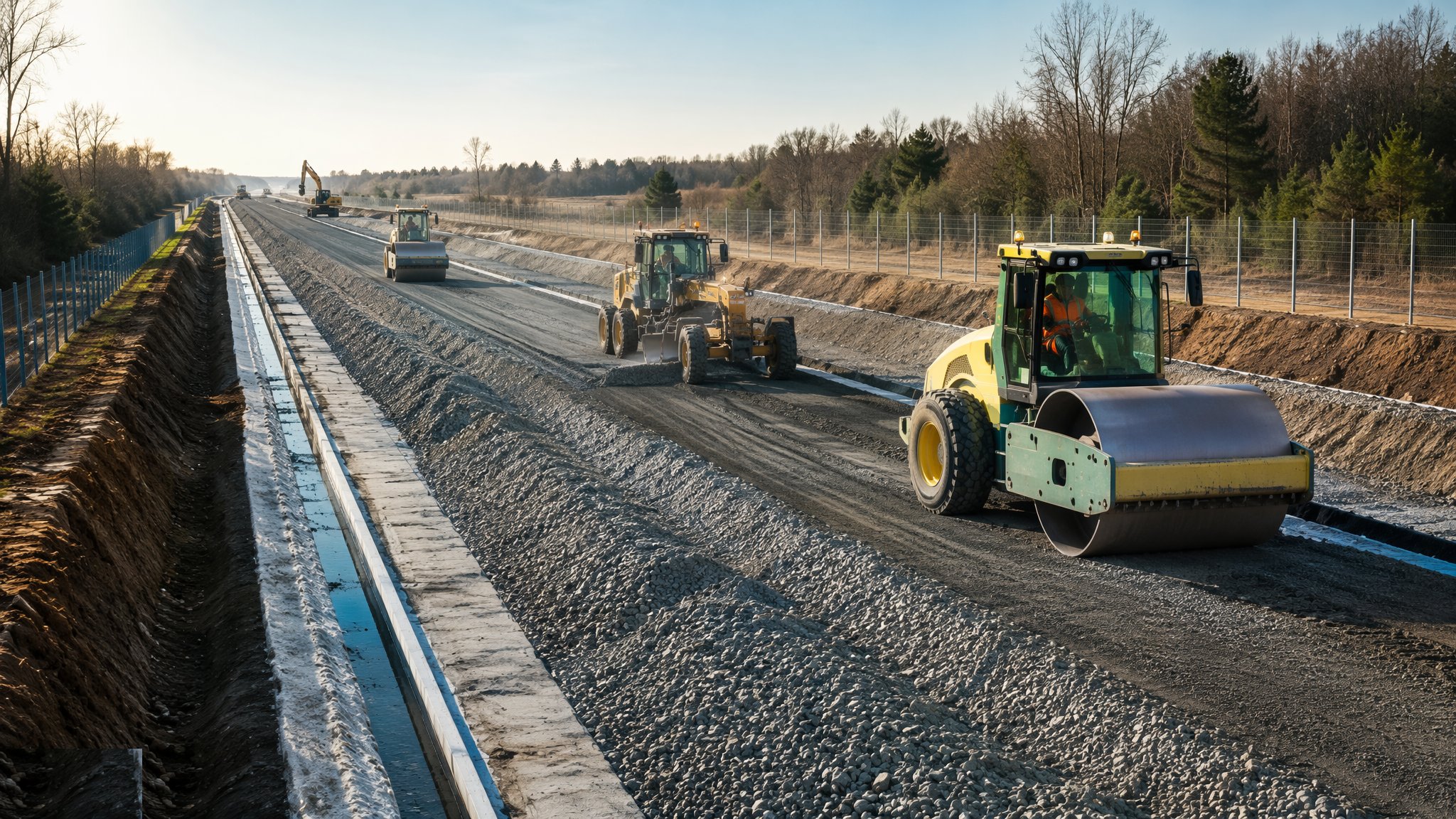
What is Sub-ballast and sand blanket?
Sub-ballast is the quiet layer that decides how long a trackbed lasts. It sits between the coarse ballast above and the fine formation below and it does several jobs at once. It filters, so that fine material from the subgrade cannot migrate up into the ballast voids and foul them. It separates, so that ballast stones do not punch down into a soft formation and disappear into it. It spreads load, further reducing the stress arriving at the subgrade. And it sheds water, being laid to a cross-fall so that rainfall passing down through the ballast is carried sideways to the drainage rather than soaking into the formation. A sand blanket is a variant of the same idea, a fine granular layer used chiefly for its filtering and separating action.
The filtering function is the one that governs the material selection, and it is a balancing act. A layer too coarse lets the subgrade fines pass straight through and does nothing. A layer too fine blocks, holds water against the formation and creates the very problem it was meant to prevent. The specification therefore describes a graded material sitting between the two, and the grading envelope is checked on delivery rather than assumed. Where the grading requirement is hard to satisfy with available materials, a geotextile is sometimes used alongside the granular layer to do the filtering, with the granular layer left to spread load and shed water.
Sub-ballast is cheap relative to what it protects, and its absence or its failure is behind a large share of trackbed problems. Where a line pumps fines into its ballast every wet season, the underlying cause is almost always that the separating and filtering layer is missing, fouled or has been contaminated during construction. That last point matters on site. Sub-ballast placed on a muddy formation, or trafficked by plant that drags clay across it, arrives fouled and stays fouled. The layer only works if it is built clean, kept clean and given a cross-fall that actually drains. The designer sets the thickness and the grading, and on most projects the site team decides whether the layer performs, simply by how carefully it is built.
How does Sub-ballast and sand blanket work, step by step?
- 1
Step 1: Select the material against the formation it protects
The grading of the sub-ballast is chosen against the fines it has to hold back and the water it has to move. The designer works from the subgrade description in the ground investigation and specifies a grading envelope, along with requirements for cleanliness, hardness and frost resistance. Where the available material cannot meet the filtering requirement, a geotextile is specified to perform the filtering and the granular layer is left to spread load and shed water. Substituting a material that merely looks similar is not a like-for-like change.
- 2
Step 2: Prepare the formation and set the cross-fall
The formation is trimmed to a smooth even surface and cut to the falls the design shows, so that water reaching the top of the subgrade runs off it. Soft spots are dug out and replaced, ruts are graded out and any standing water is removed before anything is placed. A formation left dished, or graded flat, will hold water at the interface for the life of the track no matter how good the layer above it is.
- 3
Step 3: Place the layer without contaminating it
Material is tipped and spread so that plant runs on the placed material rather than on the exposed formation, and haul routes are managed so that clay is not dragged across the clean stone. Spreading is even, since a layer of variable thickness compacts unevenly and drains unevenly. On a wet site the placing rate is matched to what can be covered and protected, because sub-ballast left open in the rain on a soft formation is sub-ballast being spoiled.
- 4
Step 4: Compact to the specified density
The layer is compacted with rollers sized to its thickness, in the number of passes established at the start of the work, until the specified density is achieved. Compaction is what gives the layer its load spreading stiffness, and an under-compacted sub-ballast settles under traffic and takes the track geometry with it. Density is verified at the frequency the specification sets, and edges and the areas around drainage are compacted with smaller plant rather than left.
- 5
Step 5: Survey the finished surface
Level and cross-fall are surveyed across the full width, since this surface controls where water goes. Low spots are corrected before the ballast covers them. The finished thickness is confirmed against the design, because a layer thinner than specified in places is the part that will fail first. The surveyed record becomes part of the as-built, and it is the reference anyone investigating a future wet bed will come back to.
- 6
Step 6: Connect the surface to the drainage
Water shed across the sub-ballast has to reach a drain and then an outfall. Cess drains, filter drains and carriers are installed to the levels the design shows, connected to a discharge that has been proved to flow, and their falls are checked rather than assumed. This is the step that turns a well built layer into a working system, and it is the step most often compromised when a possession runs short.
- 7
Step 7: Place the ballast and reinstate the track
Ballast is placed over the finished surface, and the sleepers and rail follow. Plant working on the ballast is kept from disturbing the layer beneath it. The section is brought to a condition fit for traffic before the possession ends, under the infrastructure manager's safe system of work. The as-built record states the material, the thickness, the falls and the test results.
- 8
Step 8: Watch the layer through its first seasons
The evidence that a sub-ballast layer is working shows up in the ballast above it. Clean ballast that stays clean through a wet winter means the filter is doing its job. Fines appearing at the sleeper ends, water standing in the cess or geometry that deteriorates locally all point back to the same place. Early investigation is cheap, and on most projects the cause turns out to be drainage that is not discharging rather than a grading that was wrong.
What are the benefits of Sub-ballast and sand blanket?
- Stops fine subgrade material migrating up and fouling the ballast, which is the commonest trackbed failure
- Prevents ballast punching down into a soft formation and being lost into it
- Sheds rainfall sideways to the drainage instead of letting it soak the subgrade
- Adds load spreading, further reducing the stress reaching the formation
- Cheap relative to the ballast and track it protects, with a long service life when built clean
- Built with ordinary earthworks plant as part of the same operation as the rest of the trackbed
What are the limitations of Sub-ballast and sand blanket?
- Grading has to sit within a narrow window, since too coarse does not filter and too fine blocks
- Easily contaminated during construction by plant dragging clay across the clean material
- Adds thickness, which counts against it where vertical room is short
- Depends on cross-fall and connected drainage, and does little in a dished formation
- Suitable material is not always available locally, which drives haulage cost
- Once fouled it cannot be cleaned in place and has to be replaced
What is Sub-ballast and sand blanket best suited for?
What plant does Sub-ballast and sand blanket need?
- Excavators and dumpers for placing material without tracking on the exposed formation
- Dozers and graders for even spreading and for cutting the cross-fall
- Vibrating rollers sized to the layer, with hand compactors at edges and around drainage
- Drainage excavation plant, pipe handling gear and pumps for keeping the works dry
- Survey instruments for level, thickness and cross-fall control across the full width
- Sampling and density testing equipment for grading and compaction checks
How is Sub-ballast and sand blanket quality-checked?
- Grading, cleanliness and hardness checked on delivery against the specified envelope
- Formation trimmed, dried and cut to falls before any material is placed
- Haul routes controlled so that clay is not dragged onto the clean layer
- Compaction verified at the specified frequency, including edges and around drainage
- Finished level, thickness and cross-fall surveyed across the full width and recorded
- Drainage proved to discharge before the ballast covers the surface