Asbestos survey and licensed removal
Nothing intrusive starts until this is surveyed, removed and certified - it is the first item on the programme, not a variation.
Last updated 2026-08-25
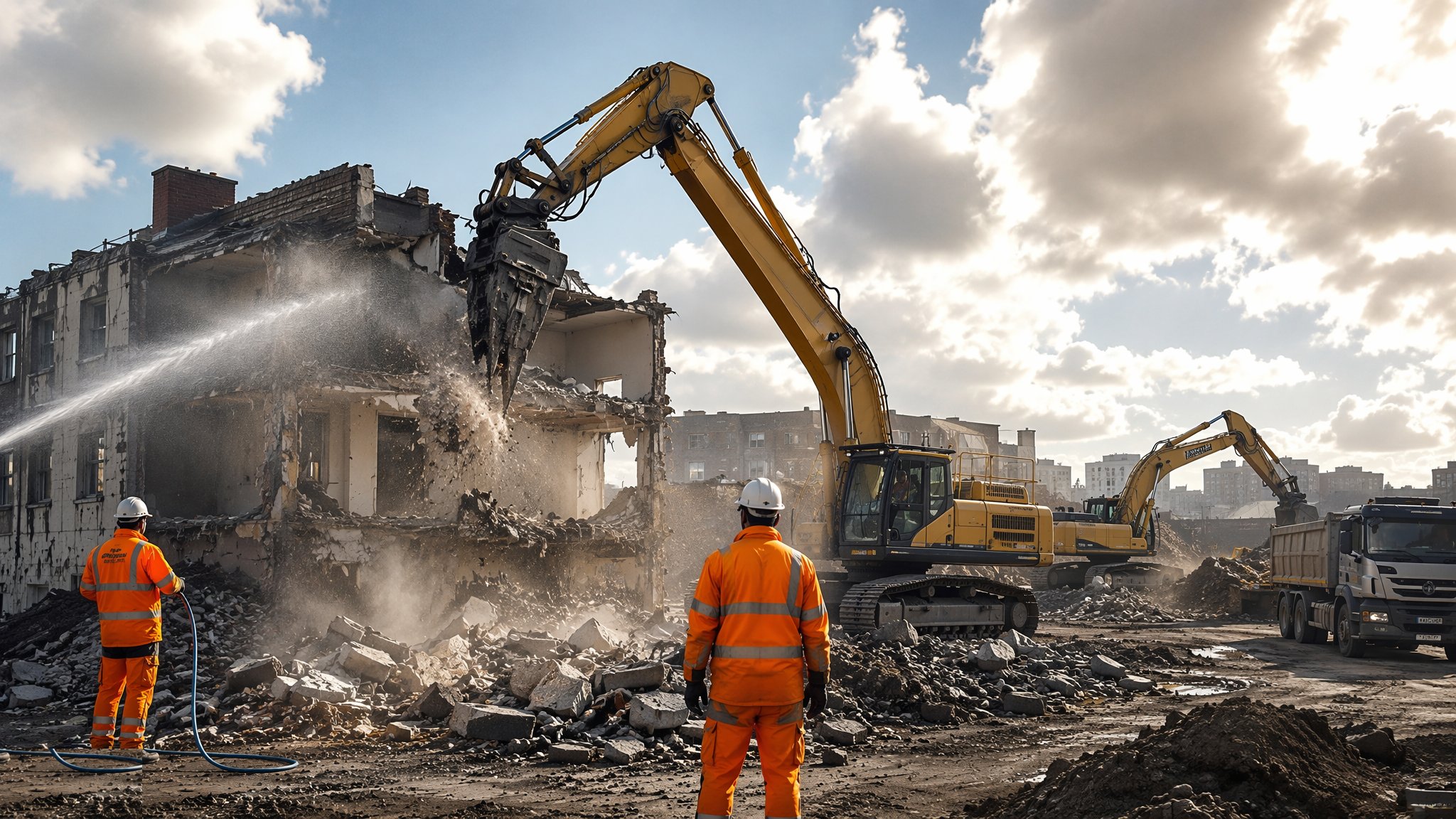
What is Asbestos survey and licensed removal?
Asbestos is the most tightly controlled activity in pre-demolition and refurbishment work in the UK, and it is the one item on the programme that no amount of commercial pressure can compress. The sequence is fixed: you find out what is in the building, you have the material removed by a contractor licensed by the regulator, you receive the paperwork that proves the area is fit to reoccupy, and only then does anyone start knocking anything down. Any building put up or refurbished before the end of the 1990s is treated as containing it until a survey says otherwise, and on a strip-out or demolition of that age the asbestos package is normally the first four to twelve weeks of the job. This page describes how a project manages that sequence. It does not describe how removal is carried out. That work is done exclusively by licensed contractors working to a plan of work under the regulator's regime, and the technique, the controls and the testing that goes with them are outside the scope of this guide.
Everything begins with the survey, and the commonest and most expensive mistake in the whole subject is commissioning the wrong one. A management survey is for a building that stays in use - it locates and assesses material so it can be managed in place, and it is deliberately not destructive; on an occupied building one usually already exists, because the duty holder is required to keep a register. A refurbishment and demolition survey is intrusive: it opens up the fabric, goes into voids and behind linings, and is written for areas that are going to be disturbed. A management survey used to price a demolition will miss what is buried in the structure, and the project will find it later with a machine, at which point everything stops. The survey has to match the scope of works, and it has to be commissioned early enough that the results can actually change the plan. A refurbishment and demolition survey of a medium-sized building is commonly a few days to a couple of weeks on site, with a further week or two for laboratory analysis and reporting, so it is a lead-time item, not a same-week decision - and it costs a small fraction of the removal package it scopes.
From the survey comes a register, and from the register comes a scope. The licensed contractor and the regulator's regime decide which items are licensed work, which are notifiable, and which are neither - that classification is not the main contractor's call and should never be assumed from a price. Licensed work is separated from everything else for a simple reason: the area is handed over in full to the specialist, sealed off, and no other trade goes anywhere near it until it is handed back with a certificate. That is why it comes first in the programme rather than running alongside other packages, and why an asbestos discovery mid-project is so damaging - it does not slow the job down, it stops it. A mid-job discovery routinely costs weeks even where the quantity is small, because the notification period and the hand-over of the area apply whatever the scale.
How does Asbestos survey and licensed removal work, step by step?
- 1
Step 1: Establish what is already known about the building
Before anyone is sent near the building, the existing record is gathered: the asbestos register the duty holder is required to keep, any previous survey reports, records of past removal work, and the construction date and history of the building and its alterations. Extensions and refits mean different eras of material in one structure. This step costs nothing and frequently changes the risk picture entirely - it can reveal that a survey already exists, that a floor was cleared years ago, or that a suspended ceiling was installed over something that was never removed.
- 2
Step 2: Commission the right survey for the works being done
The scope of the survey is written to match the scope of the works, not the other way round. If the building is coming down or the fabric is being opened up, that means a refurbishment and demolition survey covering every area to be disturbed, carried out intrusively by a competent surveying organisation, in areas that have been vacated so the surveyor can actually get into the structure - which on a part-occupied building means the survey programme follows the decant programme rather than the other way round. Areas that cannot be accessed have to be recorded as such, and either surveyed later or presumed to contain asbestos until proven otherwise. Presumption is a legitimate answer and is far cheaper than a surprise.
- 3
Step 3: Turn the report into a register, a scope and a programme
The survey report is read against the demolition or strip-out drawings so every item in the register is located, understood and tied to a work area. Licensed contractors then price against that scope and confirm what falls into which category of work under the regulator's regime. The removal is procured as a separate specialist package, usually direct, and it goes on the programme as an activity that precedes everything intrusive - with a realistic allowance for the fact that opening up will find more than the survey did, which is why the package is normally carried as a provisional sum until the areas are open.
- 4
Step 4: Appoint the licensed contractor and notify the regulator
The appointed contractor must hold a current licence from the regulator, granted for a fixed term of a year or more and renewable, so the licence is checked and recorded at appointment rather than assumed from a previous job. The contractor produces a plan of work setting out how the removal will be carried out, and where the work is licensed the regulator is formally notified before it begins. There is a statutory notice period between that notification and the start of work - commonly around a fortnight - set by the regulator, and no amount of programme pressure shortens it. Building that notice period into the programme at tender stage is the difference between a controlled start and a delay claim.
- 5
Step 5: Hand the area over and keep everyone else out
Licensed work is separated because the area stops being the main contractor's workplace. It is handed over to the licensed contractor, sealed off, signed and controlled, and no other trade enters until it is handed back - a single enclosure for a few days, a whole floor of a commercial building for weeks or months. The main contractor's job for the duration is to hold that boundary: maintain the exclusion, keep services and access arrangements as agreed, and make sure inductions and site rules tell every operative on site to stop work and report anything suspected rather than move it, cut it or sweep it up. Unidentified material found by another trade is a stop-work event, not a housekeeping problem.
- 6
Step 6: Collect the certificates and release the area to the programme
The area is only released back when the paperwork exists to release it. That means a certificate issued by an independent analyst confirming the enclosure is fit to be reoccupied, the consignment documentation showing the waste went to a licensed facility by a licensed carrier, and the completion records from the licensed contractor. Those documents are what a client, an insurer or the regulator will ask for years later, so they are filed as project records and kept for the life of the building, and the building register is updated. Demolition or strip-out does not start in that area until the certificate is in hand - and that rule is worth enforcing in writing.
What are the benefits of Asbestos survey and licensed removal?
- Removes the single largest source of stop-work risk from a demolition or strip-out programme before it can bite
- Gives the project a documented, defensible position for the client, the insurer and the regulator
- Separating the package means the follow-on trades work in a released, certified area with no residual restriction
- An accurate register turns an unknown liability into a priced, programmed scope of work
- Protects everyone on site, including trades who would otherwise disturb material without knowing it was there
- The completed evidence file supports the building record and any future works on the same structure
What are the limitations of Asbestos survey and licensed removal?
- A survey reports what was accessible on the day, so concealed material is still found once opening up starts
- The statutory notice period before licensed work can begin - commonly around a fortnight - is fixed and cannot be accelerated
- The work area is closed to every other trade for the duration, which blocks parts of the programme entirely
- Costs are difficult to fix until the fabric is opened up, so provisional sums and change are normal
- Occupied and part-occupied buildings restrict survey access, which pushes findings later into the job
- Removal technique, controls and testing are entirely the licensed contractor's domain and outside this guide
What is Asbestos survey and licensed removal best suited for?
What plant does Asbestos survey and licensed removal need?
- Survey and sampling equipment, provided and operated by the competent surveying organisation
- Enclosures, extraction, decontamination and control equipment - specified, provided and operated by the licensed contractor alone
- Sealed waste containment and licensed carrier vehicles, with consignment documentation for every load
- Site exclusion equipment - hoarding, signage and controlled access - maintained by the main contractor around the handed-over area
- Independent analytical services engaged to assess and certify the enclosure on completion
- Document control for the register, the survey report, the plan of work, the notification and the certificates
How is Asbestos survey and licensed removal quality-checked?
- Survey type confirmed to match the scope of works before it is commissioned, and non-accessed areas recorded as presumed
- Every register entry located against the demolition or strip-out drawings, with nothing left unassigned
- Contractor's licence checked and its currency recorded before appointment
- Notification made and the statutory notice period elapsed before work starts, evidenced on file
- Certificate of reoccupation from the independent analyst held before any follow-on trade enters the area
- Waste consignment notes reconciled against the removed scope, the building register updated on completion and the evidence file kept for the life of the building