Explosive demolition
Months of engineering for ten seconds of gravity - the building falls into its own footprint.
Last updated 2026-08-25
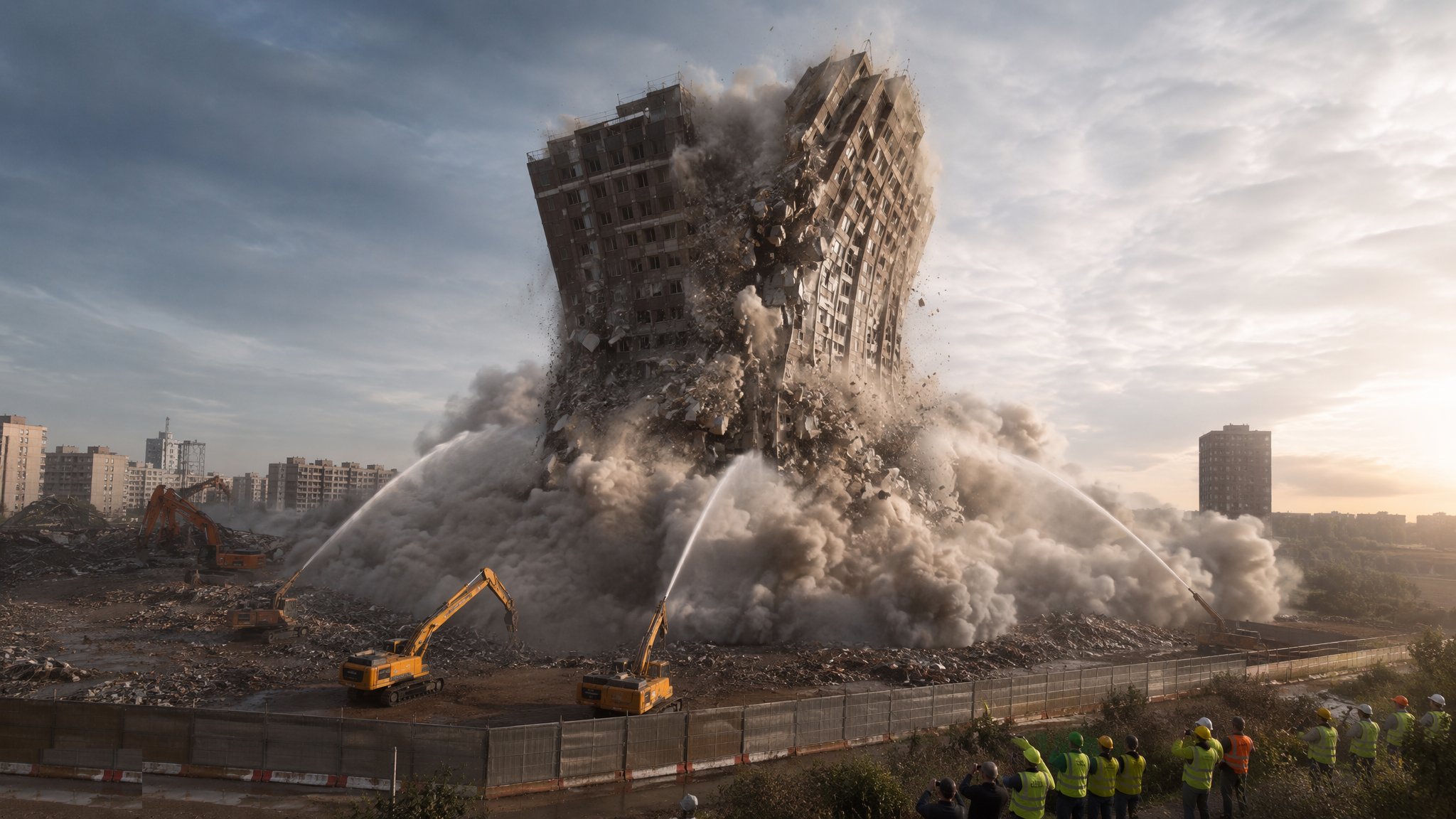
What is Explosive demolition?
Explosive demolition - blowdown - is the deliberate collapse of a structure by sequentially removing its supports with charges, timed in milliseconds, so gravity does the work and the building falls where the engineer decided it should. It is the method of last resort and first choice simultaneously: reserved for tall, redundant, or heavily reinforced structures where months of mechanical demolition would expose people and neighbours to a slowly dying building, and where a clear fall zone exists. On residential-scale work it is rare; on tower blocks, chimneys and industrial frames it can be the only sane answer.
The ten seconds are the easy part. The months before them are structural reverse-engineering: as-built records recovered or reconstructed, trial blasts on sample columns to calibrate charges, pre-weakening by removing stairwells, floors and non-structural elements, and a blast design that models the collapse mechanics so the structure folds inward rather than toppling sideways. Around that sits the regulatory machine - police, fire authority, highways, the HSE, utilities, and every neighbour inside an exclusion zone measured in hundreds of metres - all coordinated to a single morning.
What the public sees is the collapse; what the engineer sweats is the aftermath. Vibration and air overpressure are monitored at agreed points against predicted levels. The drop zone is prepared to absorb impact - often a bed of the building's own arisings. Dust management, the exclusion zone sweep, and the re-entry inspection are choreographed like the blast itself. And the contingency is real: a structure that fails to fall completely is a partially collapsed building that must now be approached, assessed and finished by machines working toward an unpredictable object.
Process storyboard
Step 1 of 6 - slide through the snapshots.
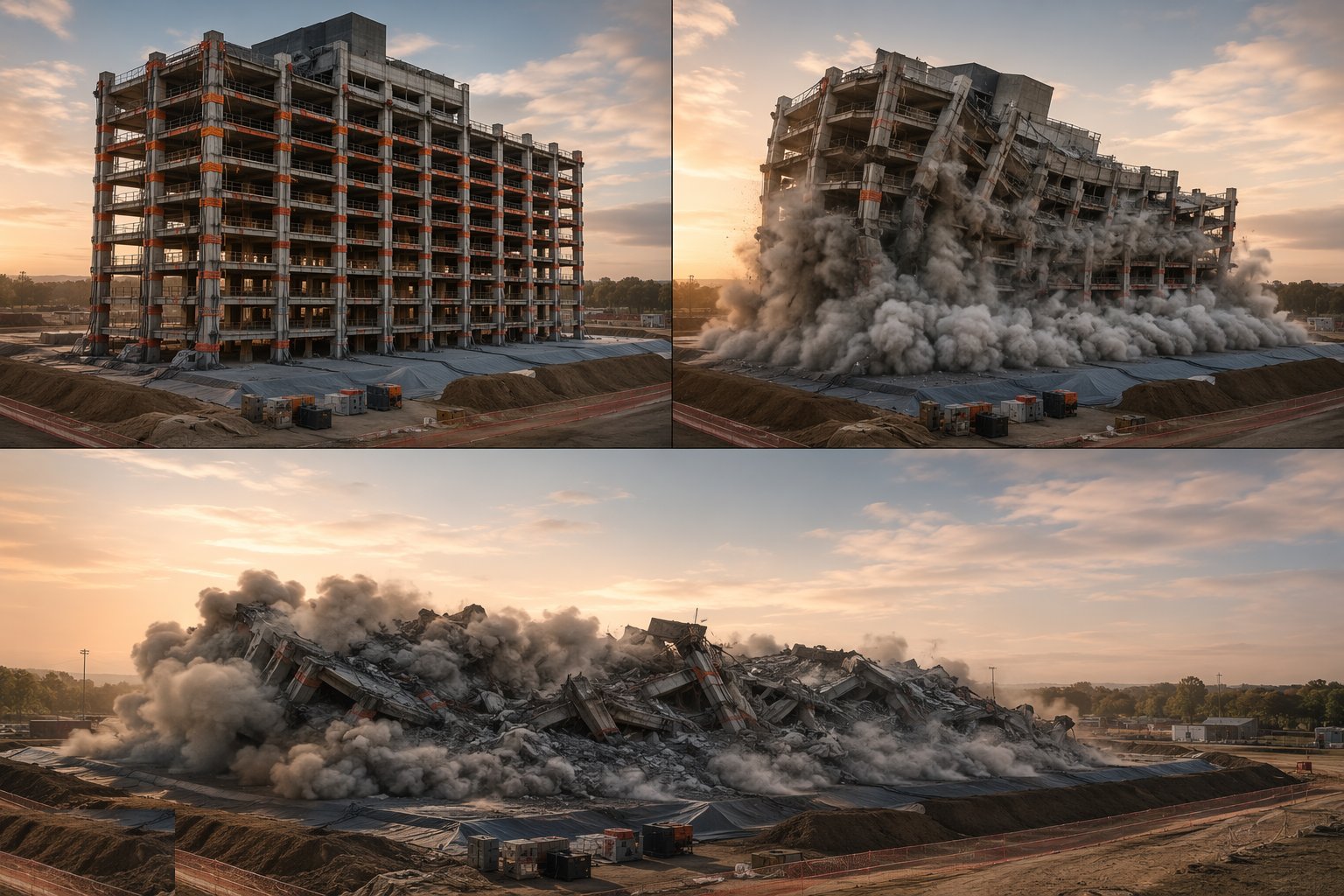
STEP 1
Reconstruct the structure and design the collapse
As-built drawings are recovered or the structure is surveyed and investigated - cores, cover-meter surveys, opening up - until the blast designer trusts the…
How does Explosive demolition work, step by step?
- 1
Step 1: Reconstruct the structure and design the collapse
As-built drawings are recovered or the structure is surveyed and investigated - cores, cover-meter surveys, opening up - until the blast designer trusts the model. The collapse mechanism is designed: which columns and shear walls are charged, in what millisecond sequence, so the building folds into the prepared drop zone. Trial blasts on representative elements calibrate charge weights against the real concrete and steel, not the drawings' assumptions.
- 2
Step 2: Strip, pre-weaken and protect
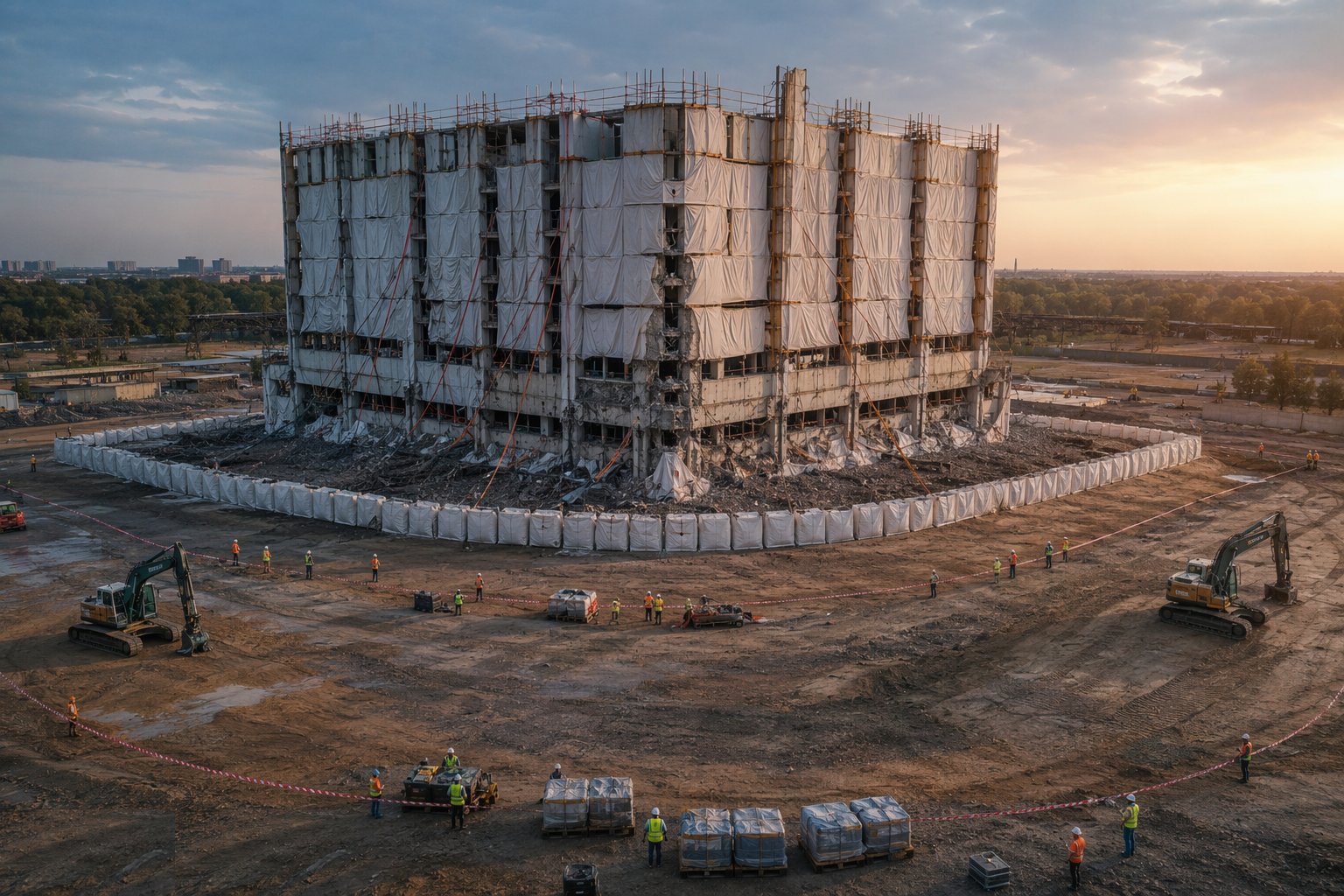
The full soft strip happens first, then pre-weakening: non-structural walls, stairs, selected floors and sections of charged elements are removed by machine and hand so the charges finish what the strip started. Adjacent structures, utilities and retained elements get physical protection - screens, mats, sometimes their own support. Every service through the site is certified dead or diverted; there is no permit-to-dig after the charges are in.
- 3
Step 3: Secure the consents and the exclusion zone
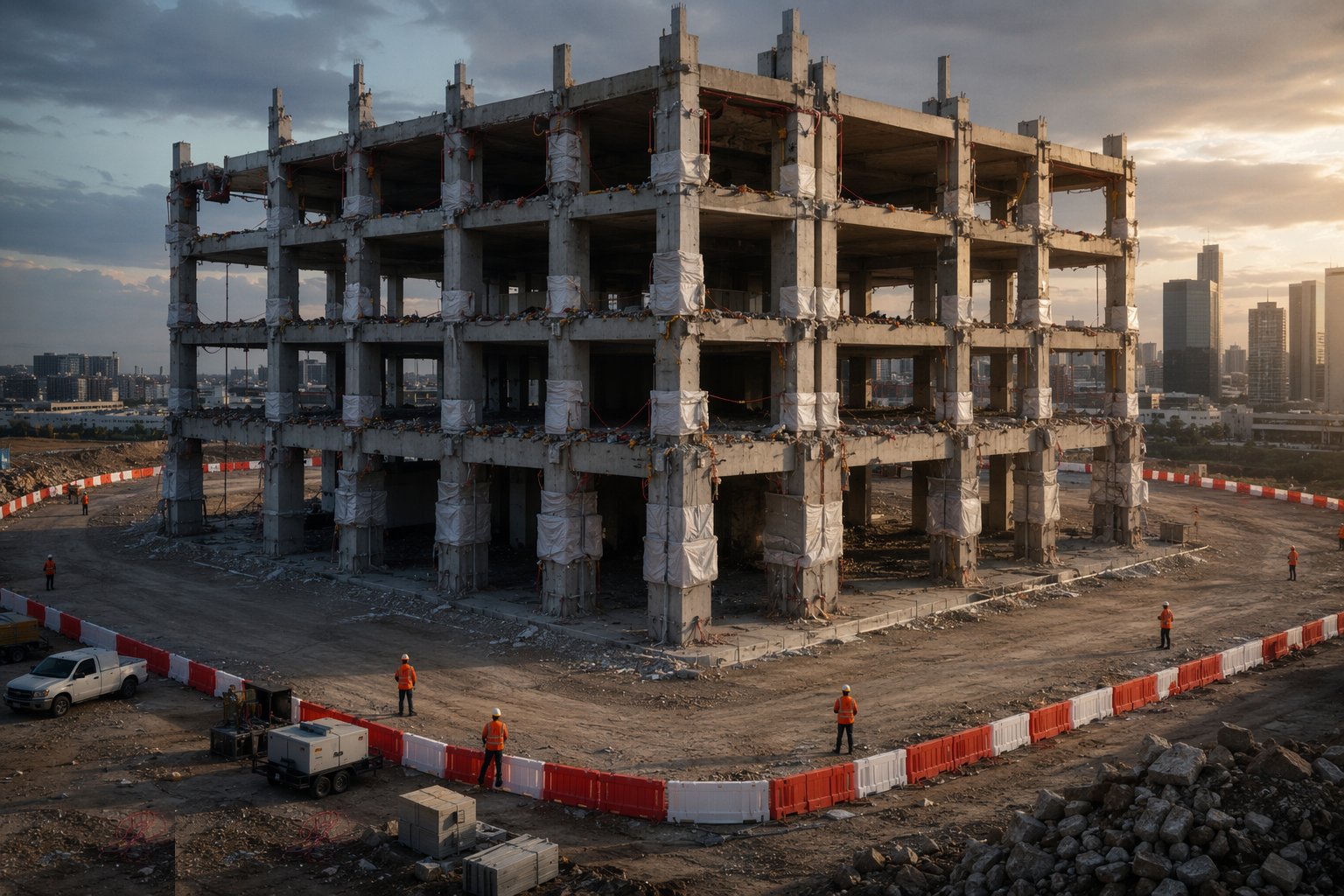
The blast plan goes to the enforcing authorities: exclusion zone boundary and sweep plan, road closures, rail possessions if needed, resident evacuation arrangements, monitoring positions and trigger levels for vibration and air overpressure, and the communication plan. The drop zone is prepared - debris beds placed, voids protected, the ground verified to take the impact load without transmitting damaging vibration to neighbours' foundations.
- 4
Step 4: Charge the structure under lockdown
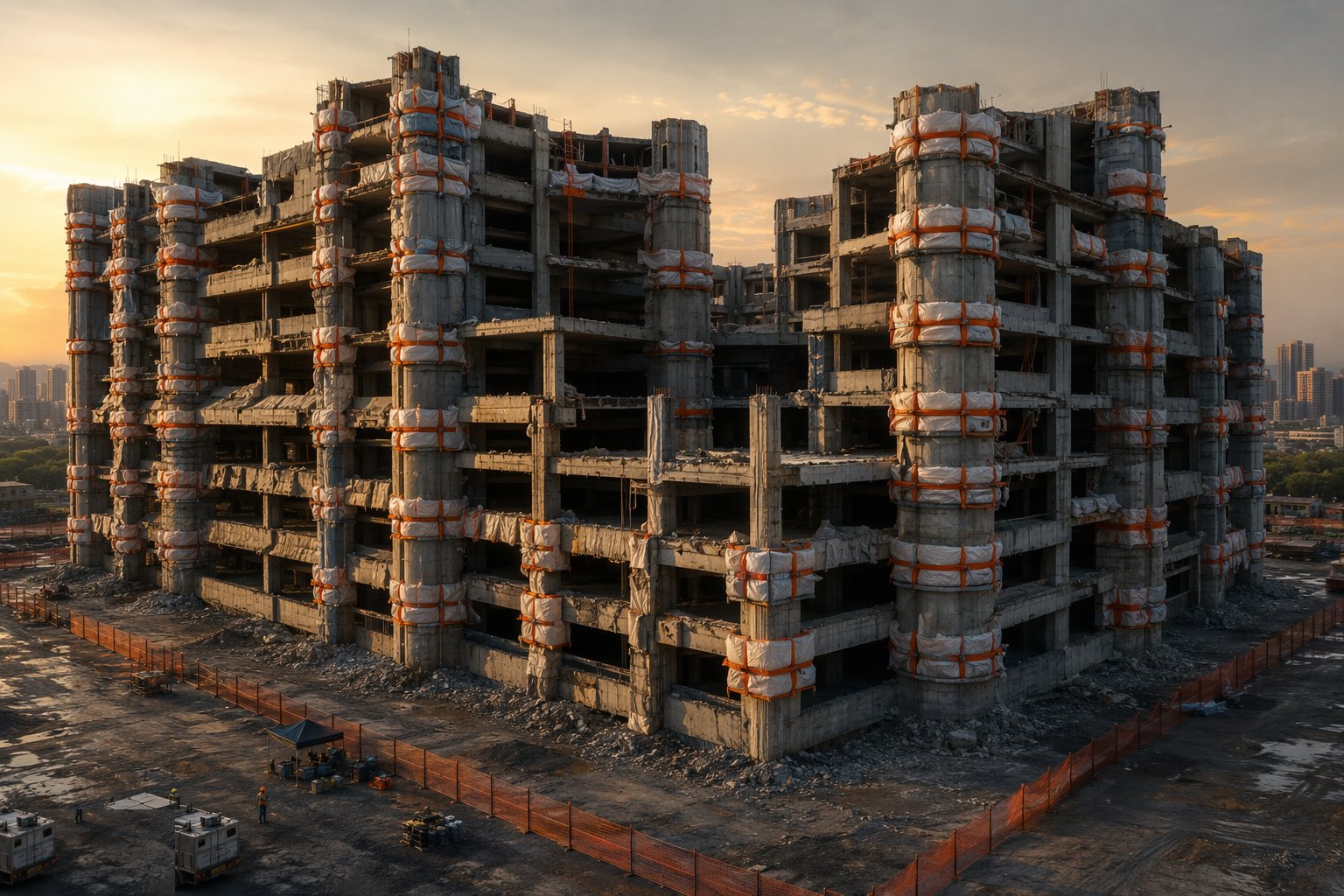
Charges are placed by the licensed shotfirer's team in the final days, with the building under 24-hour security from the moment the first charge goes in - nobody enters a charged structure except the blasting crew. Detonator circuits are tested and re-tested. Weather is watched: wind over the limit postpones, because the dust cloud and the fall dynamics both care.
- 5
Step 5: Sweep, clear and fire
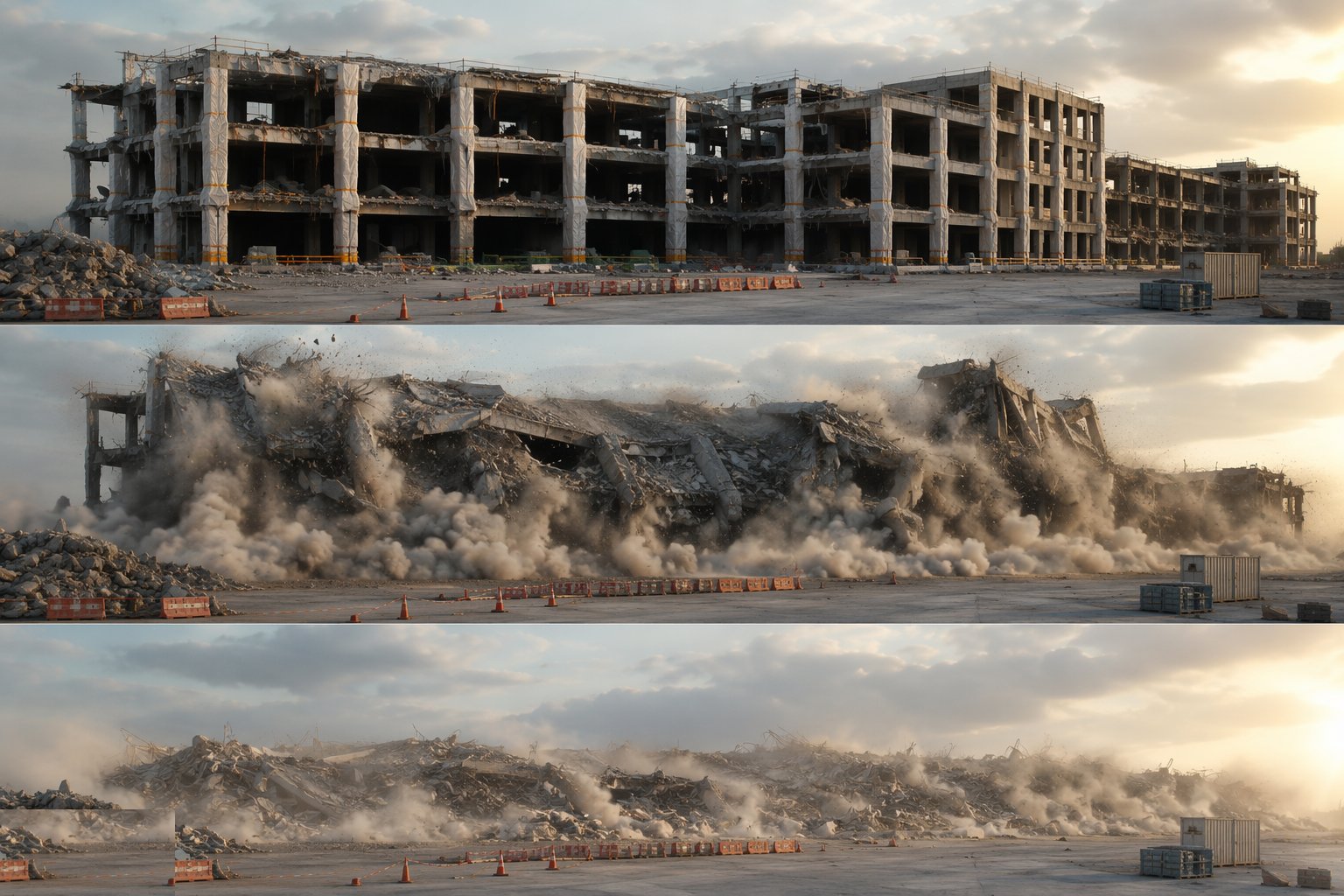
On the morning: the exclusion zone is swept and confirmed clear sector by sector, roads are closed, sentries posted, and the countdown proceeds only when every sector reports in. The shot is fired remotely. The structure falls - or does not - in seconds. Sentries hold the zone while dust settles and the blast engineer makes the first assessment from a safe position.
- 6
Step 6: Inspect, declare and process the pile
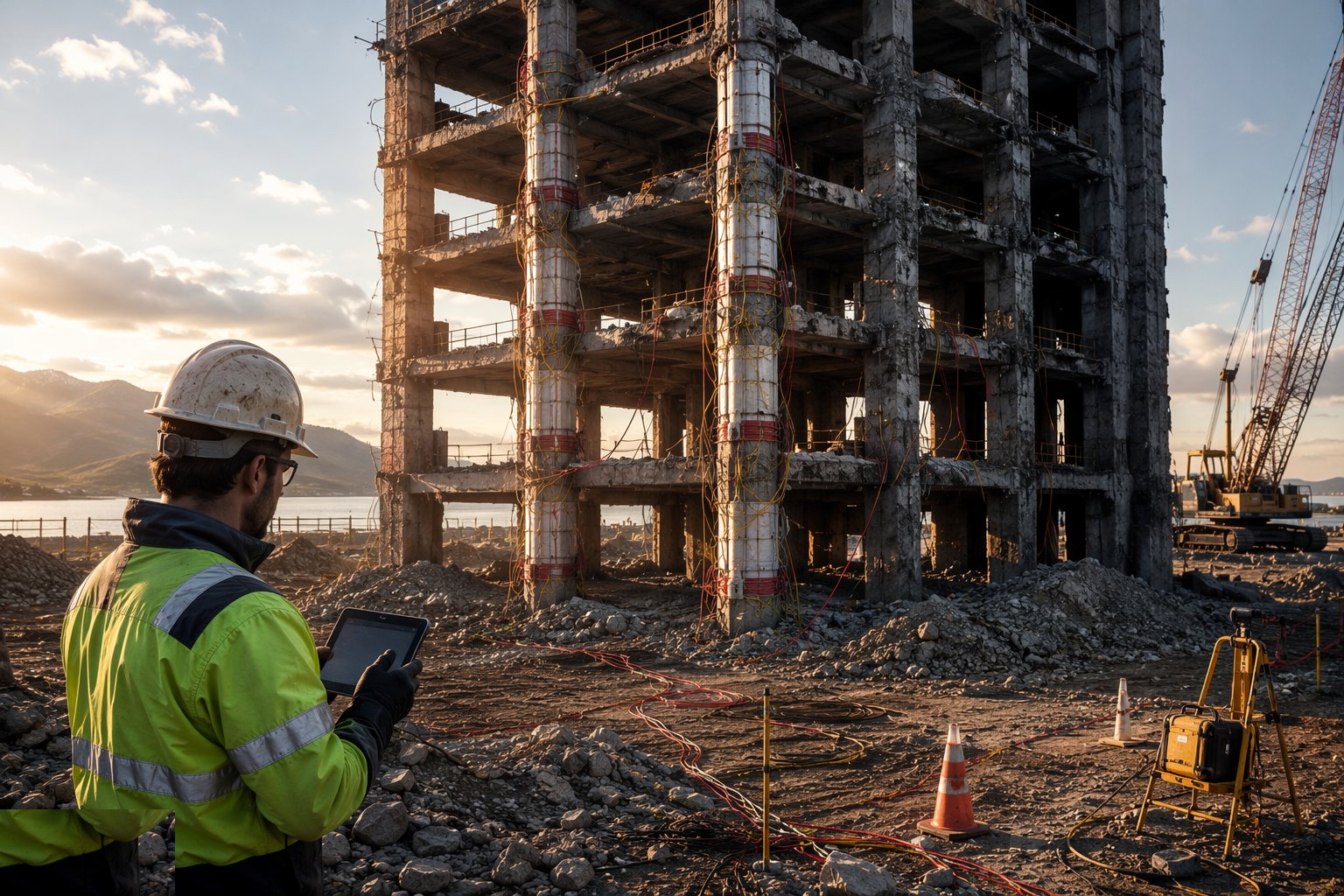
The shotfirer and engineer inspect the result: complete collapse into the zone, or a partial stand requiring the pre-planned contingency - typically high-reach machines approaching under a new assessment. Only when declared safe does the zone shrink and the processing begin: the collapse pile is mechanically sorted, crushed and removed like any demolition arising, over the following weeks. Monitoring records, the blast log and the post-blast survey close out the file.
What are the benefits of Explosive demolition?
- Total demolition in seconds - months of high-risk mechanical work eliminated
- Nobody works on or under the failing structure - the safest method for tall, unstable buildings
- Economic for large, heavily reinforced structures where machine time would be enormous
- Collapse mechanics can be directed away from sensitive neighbours and services
- A single, controllable event rather than months of continuous dust, noise and vibration
What are the limitations of Explosive demolition?
- Requires a fall zone and an exclusion area measured in hundreds of metres - rarely available in dense urban sites
- Months of design, consents and coordination before the event
- A partial collapse leaves a dangerous, unpredictable remnant to finish mechanically
- Vibration, air overpressure and dust are concentrated and unforgiving of mistakes
- Weather-dependent - wind can postpone a fully mobilised, road-closed operation
- Public and political sensitivity is extreme; one complaint history can sink the consent
What is Explosive demolition best suited for?
What plant does Explosive demolition need?
- Licensed explosives, detonators and remote firing systems (shotfirer's own)
- Drilling rigs for charge holes in columns and walls
- High-reach and standard excavators for pre-weakening and post-blast processing
- Debris beds and ground protection matting for the drop zone
- Vibration and air-overpressure monitoring stations at agreed positions
- Security, barriers, road-closure kit and communications for the exclusion zone
How is Explosive demolition quality-checked?
- Blast design independently checked; trial-blast results recorded against predictions
- Structural investigation records - cores, cover surveys - filed with the design
- Exclusion-zone sweep signed sector by sector before the countdown proceeds
- Vibration and overpressure monitoring live and logged at every agreed position
- Post-blast inspection and safe-declaration recorded before re-entry
- Full blast log, consents and post-blast survey archived in the H&S file